Estimated reading time: 1 minute
CustomGPT.ai Enterprise Agent Update Explained
Quick Answer
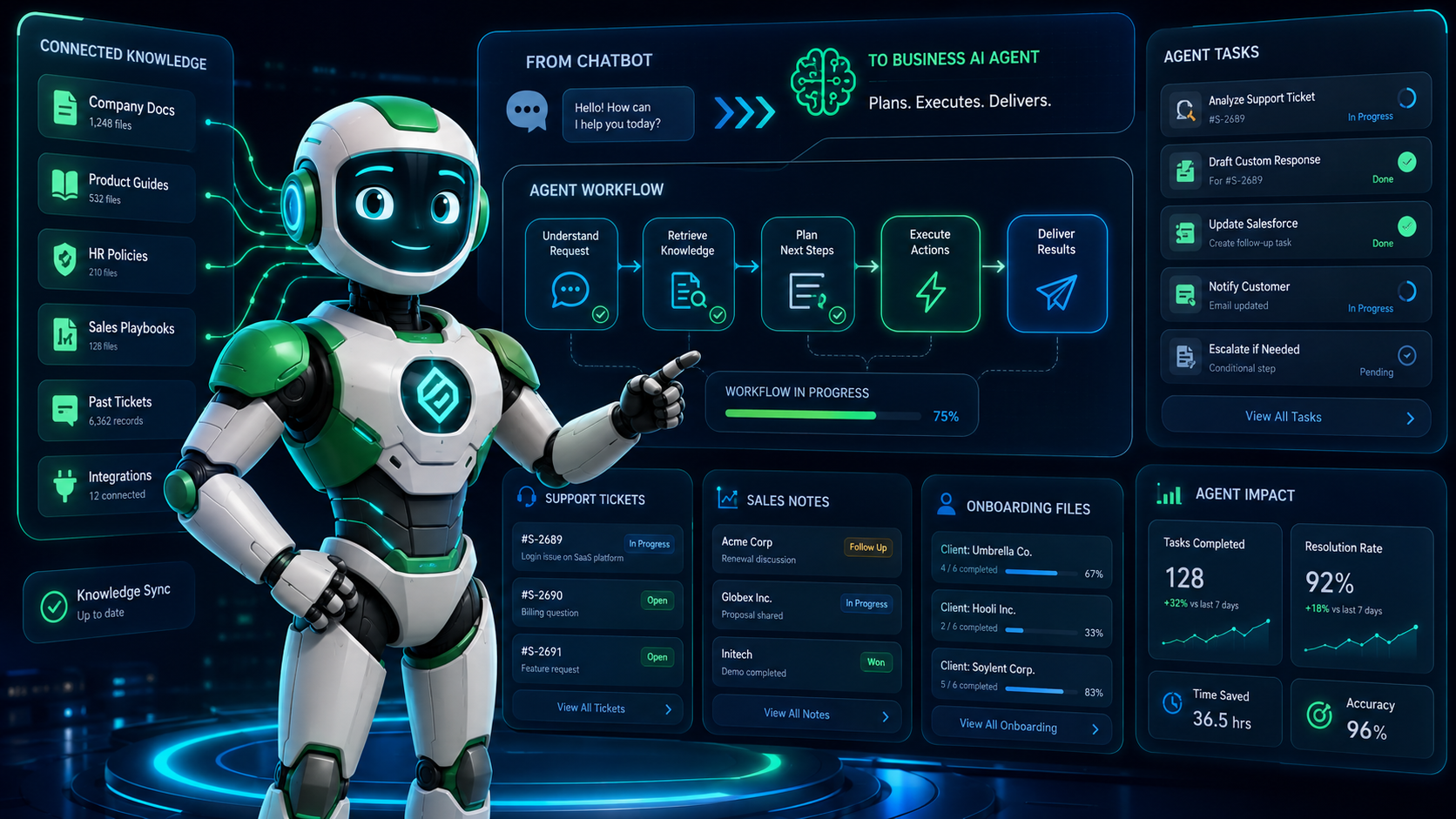
CustomGPT.ai’s Enterprise Agent update changes the platform’s story from “build a chatbot trained on your content” to “build an AI agent that can use your business knowledge, plan multi-step tasks, connect to tools, and help create finished deliverables.”
CustomGPT.ai says Enterprise Agents are live on every plan, and its Plan & Act mode lets an agent plan a multi-step task, run actions and tools, and stream results while it works. The current changelog lists per-query task ceilings of 5 on Standard, 10 on Premium, and 15 on Enterprise.
For businesses, that matters because most teams do not just want another chat window. They want AI that can use trusted company information, cite its sources, protect private data, and help get real work done.
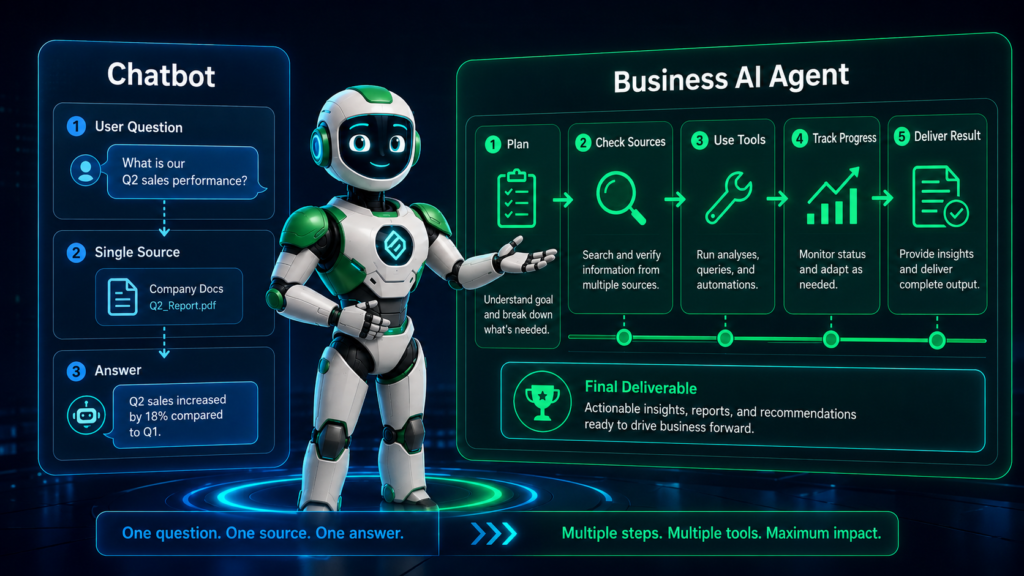
That is the difference between a chatbot and a business AI agent.
Table of contents
- Quick Answer
- Why This Update Matters
- What CustomGPT.ai Does
- What Changed With the Enterprise Agent Update
- Plan & Act Mode: The Core Shift
- Smart Tasks: From Chat Replies to Deliverables
- Custom Actions: More Than a Chatbot
- Security vs Features
- Best Use Cases
- CustomGPT.ai vs ChatGPT
- Pricing Notes
- Who CustomGPT.ai Is Best For
- Who May Not Need It
- TechnofluxAI Take
- What Should I Actually Do?
- FAQ
Key Takeaways
- The CustomGPT.ai Enterprise Agent update transforms AI from simple chatbots to powerful agents that execute multi-step business tasks.
- Features like Plan & Act mode allow agents to break down tasks, retrieve relevant data, and cite sources accurately.
- Businesses can leverage CustomGPT.ai for customer support, onboarding, sales enablement, and content repurposing with source-backed information.
- CustomGPT.ai offers a no-code solution suitable for organizations requiring secure access to their internal knowledge without training on user data.
- This update emphasizes AI as a workflow tool rather than just a Q&A interface, making it essential for businesses with complex information needs.
Why This Update Matters
For the last year or two, nearly every business AI platform has had some version of the same pitch:
Upload your documents.
Train an AI chatbot.
Ask questions.
Get answers.
That is useful, but it is no longer enough by itself.
The new CustomGPT.ai Enterprise Agent update shifts the value from simple answers to business workflow execution. Instead of only asking, “What does our documentation say?” a business can start asking, “Can this agent help us turn our knowledge into support replies, reports, content briefs, onboarding material, dashboards, or sales enablement assets?”
That is a much stronger business use case.
A chatbot answers.
An agent helps move the work forward.
CustomGPT.ai is worth a look if your business already has documentation, support content, training material, website content, internal notes, or customer-facing knowledge that should be easier to use.
Workflow fit: If your business has useful knowledge trapped in documents, websites, support material, or internal notes, CustomGPT.ai may be worth testing with one focused workflow first.
What CustomGPT.ai Does
CustomGPT.ai is a no-code platform for building AI agents from your own business content. Its documentation describes the platform as a way for organizations to get trusted answers from their own content, with cited answers and no engineering required.
That makes it different from simply opening a general AI tool and asking broad questions.
A business can connect sources like website content, documentation, files, knowledge bases, help content, and other business data. From there, the agent can answer based on the company’s own information instead of relying only on general model knowledge.
That matters for teams that care about:
- Customer support
- Sales enablement
- Employee onboarding
- Internal training
- Documentation support
- Report analysis
- Content repurposing
- Knowledge management
- Subject matter expertise
- Information monetization
The big idea is simple:
CustomGPT.ai helps businesses turn their own knowledge into a usable AI assistant.
What Changed With the Enterprise Agent Update
The new update adds a more agentic layer to CustomGPT.ai.
The main features to understand are:
- Plan & Act Mode
- Smart Tasks
- Custom Actions
- Tool-connected workflows
- Multi-step execution
CustomGPT.ai’s changelog says Plan & Act mode lets an agent plan a multi-step task, run actions and tools, and stream results while it works.
That means businesses should not think of this update as just a cosmetic feature release.
It changes what the agent is meant to do.
Instead of only asking:
“What does this document say?”
A user can move toward requests like:
“Create a client-ready summary from these documents.”
“Analyze these product questions and identify missing help center articles.”
“Turn this knowledge base into a sales training brief.”
“Build a report from this business information.”
That is a bigger workflow.
Plan & Act Mode: The Core Shift
Plan & Act Mode is the most important part of this update.
A normal chatbot responds to a prompt. An agent with Plan & Act capabilities can break a request into smaller steps, work through those steps, use available tools, and return progress as it works.
CustomGPT.ai’s API documentation describes a Plan & Act task endpoint that creates a task and submits the first prompt, with sessions that can run for minutes or longer while callers poll for progress events.
That matters because real business tasks usually are not one-step prompts.
A marketing task might require reviewing existing content, identifying gaps, creating a brief, and suggesting next assets.
A support task might require reading documentation, identifying the correct policy, drafting a customer reply, and citing the source.
A reporting task might require pulling information together, summarizing patterns, and creating a deliverable.
That is where Plan & Act becomes more useful than simple question-and-answer chat.
Smart Tasks: From Chat Replies to Deliverables
The Smart Tasks angle is where the update becomes easier for businesses to understand.
Businesses do not always want a paragraph of AI text. They want a usable output.
That could be:
- A report
- A content brief
- A support summary
- A customer-facing answer
- A dashboard-style view
- A sales training document
- A case study draft
- An onboarding guide
- A product insights summary
CustomGPT.ai’s changelog has referenced Smart Tasks improvements, including memory across code-execution steps and final summaries.
The practical point is this:
The more AI can turn business knowledge into finished deliverables, the more useful it becomes.
That is a better pitch than “ask your documents questions.”
Custom Actions: Why This Is More Than a Chatbot
Custom Actions are another key part of the shift.
The idea is that an agent should not only answer questions. It should be able to interact with connected tools, business systems, or custom workflows when configured correctly.
That matters because an AI tool becomes more valuable when it can connect to the systems a business already uses.
Without actions, an AI agent is mostly trapped in a chat box.
With actions, it can become part of a workflow.
That opens the door for use cases like:
- Updating support workflows
- Retrieving business information
- Creating task outputs
- Connecting to external apps
- Powering internal tools
- Supporting sales teams
- Building custom frontends through an API
This gives CustomGPT.ai two lanes:
No-code for business teams.
API and custom implementation for technical teams.
That combination is important.
A small business may only need the no-code setup. A larger team may want deeper integrations, API access, custom workflows, or internal deployment options.
Try it with one business workflow: Do not rebuild your whole support, sales, or knowledge system on day one. Start with one focused use case and test whether CustomGPT.ai gives your team faster, more reliable answers from your own content.
Why Businesses May Care More About Security Than Features
For creators, speed is often the main selling point.
For businesses, trust is usually the real decision point.
A company might ask:
- Will our uploaded data train public models?
- Can answers cite sources?
- Is the platform compliant?
- Is data encrypted?
- Can access be controlled?
- Can different agents stay separate?
- Can this be deployed internally or externally?
CustomGPT.ai’s website says it does not use customer data to train LLMs or AI systems, and its pricing page highlights SOC 2 Type II, GDPR compliance, and AES-256 encryption.
This should be a major part of the buying decision.
Business AI is not just about what the agent can generate. It is about whether the company can trust the agent with its information.
Best Use Cases for CustomGPT.ai Enterprise Agents
1. Customer Support
CustomGPT.ai can help customers or support teams find answers from product documentation, help centers, FAQs, internal notes, and policy pages.
The stronger use case is not just “answer a question.”
It is:
- Answer the question
- Cite the source
- Suggest the next step
- Help draft the support reply
- Identify documentation gaps
That is useful for ticket deflection, helpdesk support, and internal support teams that answer the same questions repeatedly.
2. Sales Enablement
Sales teams often need fast access to product details, pricing rules, objection handling, service information, and internal training material.
A business AI agent can help sales teams retrieve the right information faster and turn it into customer-ready language.
Useful sales workflows include:
- Product information retrieval
- Service explanations
- Proposal support
- Sales training
- Objection handling
- Customer-specific summaries
The goal is not to replace the sales team. The goal is to make the team faster and more consistent.
3. Onboarding and Training
Internal onboarding is one of the clearest business uses for a knowledge-based AI agent.
New employees often need to understand:
- Company policies
- Tools
- Workflows
- Documentation
- Training material
- Internal processes
A CustomGPT.ai agent can act like a searchable training layer across that material.
With Plan & Act features, it could also help create onboarding summaries, checklists, or role-specific learning paths.
4. Marketing and Content Repurposing
Marketing teams can use CustomGPT.ai to turn existing business knowledge into new assets.
Possible workflows include:
- Content repurposing
- Case study creation
- Report analysis
- Campaign briefs
- Social post drafts
- Blog outline creation
- Customer insight summaries
5. Knowledge Management
Many companies have too much information scattered across too many places.
Docs live in one place.
Policies live somewhere else.
Sales material gets buried.
Support answers are repeated manually.
Nobody knows which version is current.
A knowledge agent can help turn scattered information into a searchable, conversational interface.
That is valuable because the business is not just buying AI.
It is buying faster access to its own knowledge.
CustomGPT.ai vs ChatGPT: The Real Difference
The obvious question is:
“Why not just use ChatGPT?”
That is fair.
ChatGPT is powerful for general AI work: writing, brainstorming, analysis, coding help, planning, and creative tasks.
But CustomGPT.ai is aimed at a different business problem.
The better comparison is not:
“Which AI is smarter?”
The better comparison is:
“Which tool can safely use our company knowledge, cite sources, connect to our workflows, and support business-specific tasks?”
That is where CustomGPT.ai has a clearer business angle.
A general AI assistant is useful for individual productivity.
A business AI agent is useful when the company needs controlled access to trusted internal or customer-facing knowledge.
Pricing Notes
CustomGPT.ai’s public pricing page currently shows a 7-day free trial and plan options for Standard, Premium, and Enterprise, while also highlighting SOC 2 Type II, GDPR compliance, and AES-256 encryption.
CustomGPT.ai’s website FAQ currently describes Standard at $99/month, Premium at $499/month, and Enterprise with custom pricing.
You can check the current plans and start a trial here: Try CustomGPT.ai .
Who CustomGPT.ai Is Best For
CustomGPT.ai makes the most sense for businesses with useful knowledge that needs to be easier to access, search, cite, and reuse.
It is a strong fit for:
- Businesses with customer support needs
- Teams with internal documentation
- Companies with onboarding material
- Agencies managing client knowledge
- SaaS companies with help centers
- Sales teams that need fast answers
- Content teams repurposing business knowledge
- Teams that need source-backed responses
- Businesses that want no-code AI agents
- Organizations that need privacy and security controls
The best fit is not “anyone who wants AI.”
The best fit is a business with repeatable information workflows.
Who May Not Need It
CustomGPT.ai is probably not necessary for every user.
If someone only needs casual brainstorming, basic writing help, or one-off AI answers, a general tool like ChatGPT, Claude, Gemini, or Copilot may be enough.
CustomGPT.ai makes more sense when a business has:
- Important internal knowledge
- Customer-facing documentation
- Repeated support questions
- Sales enablement needs
- Onboarding material
- Compliance concerns
- Multiple users
- A need for source-backed answers
- Workflows that benefit from connected actions
That distinction matters.
We are not saying everyone needs this.
We are saying this is useful when the workflow fits.
TechnofluxAI Take
This update is important because it shows where business AI tools are heading.
The first wave was:
Ask AI a question.
The second wave was:
Give AI your business knowledge.
The next wave is:
Give AI a goal and let it help complete the workflow.
CustomGPT.ai’s Enterprise Agent update fits that direction. The value is not just that it can answer from company content. The bigger value is that it can start turning company knowledge into actions, deliverables, and repeatable business workflows.
That does not mean businesses should let AI run unsupervised.
Human review still matters, especially for customer support, financial information, legal content, medical content, compliance, and anything that affects real decisions.
But for teams buried in documentation, repeated questions, content repurposing, onboarding material, and internal knowledge work, this is the type of update worth watching.
The simple takeaway:
CustomGPT.ai is becoming less like a chatbot and more like a business AI agent layer.
That is the story.
What Should I Actually Do?
Start small.
Do not try to turn your whole business into an AI agent project in one weekend.
Pick one workflow first.
Good starter workflows include:
- A customer support FAQ agent
- A website knowledge assistant
- An internal onboarding assistant
- A sales enablement assistant
- A documentation search agent
- A content repurposing workflow
Then test three things:
- Does the agent answer from the right business content?
- Does it cite or point back to useful sources?
- Does it save enough time to justify keeping it?
That is the practical way to evaluate CustomGPT.ai.
Not hype.
Not a giant AI transformation project.
One workflow. One test. One measurable result.
Test one workflow: If you want to see whether a business AI agent fits your setup, start with one knowledge base, one support workflow, or one internal documentation use case. You can try CustomGPT.ai here .
FAQ
What is the CustomGPT.ai Enterprise Agent update?
The CustomGPT.ai Enterprise Agent update adds more agent-style workflow capabilities, including Plan & Act mode, Smart Tasks, and Custom Actions. The goal is to let agents work through multi-step business tasks instead of only answering questions.
What is Plan & Act mode?
Plan & Act mode lets a CustomGPT.ai agent break a task into steps, run tools or actions, and return progress while it works. CustomGPT.ai’s changelog says this mode is available on every plan with different per-query task limits.
How is CustomGPT.ai different from ChatGPT?
ChatGPT is a general AI assistant. CustomGPT.ai is designed for businesses that want AI agents connected to their own content, documentation, knowledge base, and workflows.
Who should consider CustomGPT.ai?
CustomGPT.ai is worth considering for businesses with customer support needs, sales enablement workflows, onboarding material, internal documentation, knowledge management problems, or a need for citation-backed answers from company data.
Is CustomGPT.ai no-code?
Yes. CustomGPT.ai describes itself as a no-code platform for creating custom AI agents from business content, while also offering API options for teams that want deeper technical implementation.
Does CustomGPT.ai train on my data?
CustomGPT.ai says it does not use customer data to train large language models or AI systems. Always review the latest security, privacy, and data handling terms before uploading sensitive business information.
Is CustomGPT.ai good for small businesses?
CustomGPT.ai can be useful for small businesses if they have repeatable questions, documentation, customer support needs, or internal knowledge that needs to be easier to access. If you only need casual brainstorming or general writing help, a general AI assistant may be enough.
? Creator AI Tools Update
AI creator tools are evolving quickly in 2026. Content creators now use AI systems for video editing, voice generation, thumbnails, workflow automation, scripting, image generation, social media planning, and AI-assisted publishing across multiple platforms.
Modern creators are combining AI tools with workflow systems to publish content faster, stay more consistent, improve engagement, and scale content production without large teams.
- AI video tools speed up content creation workflows
- Workflow automation helps creators stay consistent
- Short-form video content continues dominating social traffic
- AI image systems improve thumbnails and visual branding
- Cross-platform publishing workflows are becoming essential
Final Takeaway
CustomGPT.ai’s Enterprise Agent update matters because it points toward the next stage of business AI.
The old pitch was simple:
Upload content and ask questions.
The stronger pitch is now:
Connect
Connect your business knowledge, give the agent a task, and let it help move the workflow forward.
That does not mean every business needs CustomGPT.ai. It does mean businesses with support content, documentation, onboarding material, sales knowledge, or internal information workflows should pay attention.
AI tools are useful when they are part of a workflow. They are weak when used as one-click shortcuts.
CustomGPT.ai is most interesting when you treat it as a business workflow layer, not just another chatbot.
Ready to test it with one focused workflow? Try CustomGPT.ai .
Try CustomGPT.ai

About the Author
Jon Hicks
Founder of TechnofluxAI.
I’m the creator behind TechnofluxAI, focused on breaking down powerful AI tools, emerging trends, and practical strategies to help creators and entrepreneurs stay ahead in a rapidly evolving digital world.
Follow TechnofluxAI for the latest AI tools & strategies