Estimated reading time: 7 minutes
AI Infrastructure Explained
Why Do We Need So Many Data Centers?
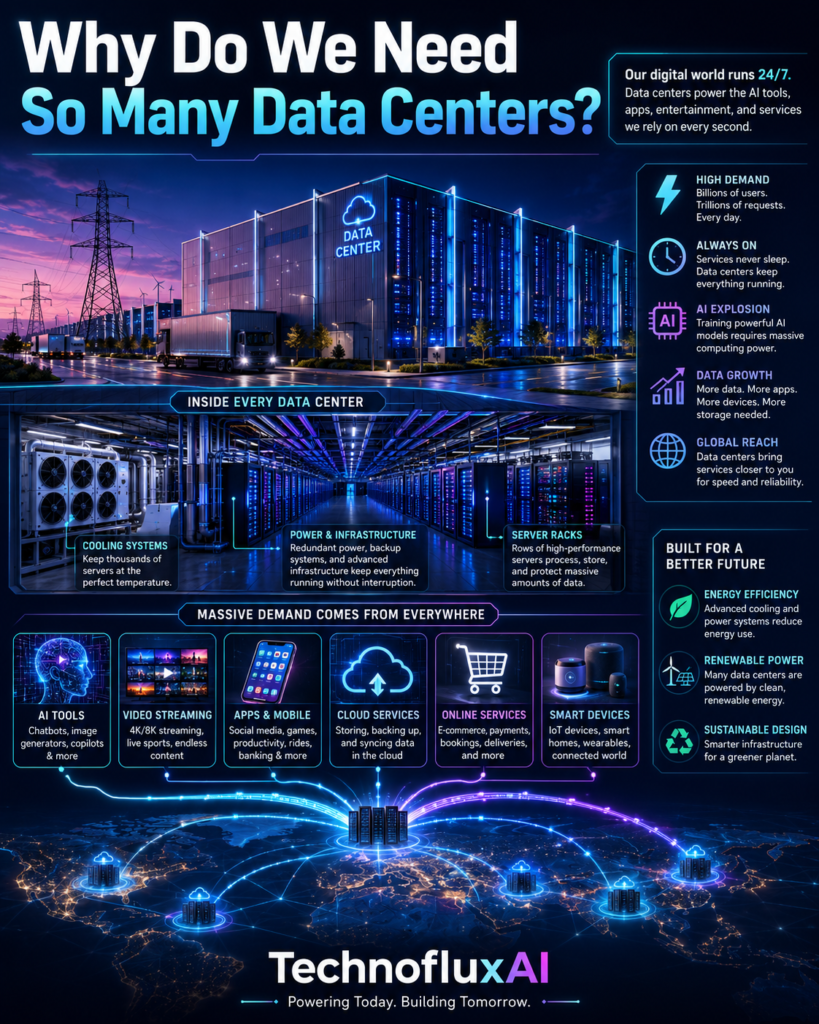
Why do we need data centers? Almost everything we do online now depends on them: AI tools, websites, cloud storage, banking apps, streaming, social media, business software, and the invisible systems that keep the internet running.
Quick Answer
We need so many data centers because modern life runs on data. Every search, video, website visit, AI prompt, payment, upload, backup, and cloud app has to be processed and stored somewhere. These facilities are the physical buildings that make the digital world work.
The Pain Point
People see huge new data center projects and ask a fair question: do we really need all of this? That concern makes sense because these facilities use land, electricity, water, cooling systems, hardware, and grid capacity.
What This Article Explains
This guide breaks down what data centers actually do, why AI is increasing demand, why companies keep building them, and which tradeoffs communities should watch closely.
TechnofluxAI takeaway: Data centers are not just “big tech buildings.” They are the factories of the digital economy. The real debate is not whether we need them; it is how to build them responsibly.
Main Breakdown
What Data Centers Actually Do
A data center is a secure building filled with servers, storage systems, networking equipment, backup power, and cooling systems. Inside those buildings, digital information gets stored, processed, protected, and delivered.
1. The Internet Needs a Physical Home
The internet feels invisible, but it is not floating in the air. Your website, email inbox, phone photos, YouTube videos, business apps, online banking data, and AI chat history all live on physical machines somewhere.
When someone visits a website, the page has to load from a server. Creator uploads need storage, business software runs in the cloud, and AI tools need machines powerful enough to answer requests quickly. Without data centers, the modern internet stops feeling instant.
Everyday Examples
Google searches, Netflix streaming, YouTube uploads, TikTok videos, online shopping, bank logins, cloud backups, and website hosting.
Business Examples
Customer databases, payment systems, AI tools, cybersecurity, remote work apps, inventory software, analytics dashboards, and file storage.
2. AI Uses More Computing Power
AI is one of the biggest reasons people are hearing about data centers more often. These models need powerful chips to train, run, answer prompts, generate images, summarize documents, write code, analyze video, and support business automation.
Every time someone uses an AI assistant, the request has to be processed. One prompt may feel small, yet millions of people using AI tools every day create massive demand for computing power.
Practical Example
A regular website might serve text, images, and videos. An AI platform has to process user prompts, search information, generate responses, manage safety systems, and deliver results quickly. That requires more servers, more chips, more cooling, and more electricity.
3. Cloud Computing Changed Everything
Years ago, many businesses ran their own servers in office closets or private server rooms. Today, more companies rent computing power from cloud providers because it is faster to scale, easier to manage, and usually more reliable.
That shift means more computing is concentrated inside professional data centers. Instead of one small business maintaining one local server, thousands of businesses use shared cloud infrastructure.
Old Model
Businesses bought their own servers, stored them locally, and handled backups, security, maintenance, and upgrades themselves.
New Model
Businesses use cloud platforms for websites, apps, customer data, collaboration, storage, AI, and analytics.
4. Speed and Reliability Require More Locations
Data centers are not only built for storage. Many are also built for speed, reliability, and backup capacity. If every user had to connect to one giant server on the other side of the world, apps would feel slow and unreliable.
Companies build facilities in different regions so websites, videos, apps, and AI tools can respond faster. More locations also create backup options. When one system has a problem, another system can help keep services online.
Simple Way to Think About It
A data center is like a digital warehouse, power plant, library, factory, and delivery hub combined. It stores information, processes work, protects systems, and delivers digital services to users as fast as possible.
Smart Infrastructure
The Real Question: How Do We Build Data Centers Responsibly?
The answer to “why do we need data centers?” is clear. We need them because the internet, AI, business software, cloud storage, and digital life depend on them. But communities are right to ask harder questions about energy, water, jobs, transparency, and long-term planning.
What Communities Should Watch
Electricity Demand
Large data centers can require major power capacity. Communities should ask how new projects affect the local grid and whether power upgrades are planned.
Water and Cooling
Some facilities use water for cooling, depending on design and location. Communities should ask what cooling method is being used and how water use is measured.
Local Benefits
Data centers can bring tax revenue, infrastructure upgrades, and technical jobs, but communities should look closely at the real long-term benefits.
Common Mistakes People Make About Data Centers
- Thinking the internet is weightless: Every digital action depends on physical infrastructure.
- Blaming only AI: AI is a major driver, but cloud apps, video, gaming, finance, storage, and cybersecurity also increase demand.
- Assuming all data centers are the same: Facilities vary by size, efficiency, cooling design, energy source, and workload.
- Ignoring tradeoffs: Data centers are useful, but power, water, land, noise, and grid capacity should be part of the conversation.
- Forgetting reliability: Extra capacity is not always waste. Sometimes it is what keeps websites, hospitals, banks, and emergency systems online.
FAQ: Why Do We Need Data Centers?
Why do we need data centers if everything is in the cloud?
The cloud is not magic. “The cloud” means your data and apps are running on servers inside data centers. Data centers are the physical foundation of cloud computing.
Are data centers only for AI?
No. AI is increasing demand, but data centers also support websites, apps, streaming, business software, banking, healthcare systems, cloud storage, and cybersecurity.
Do data centers use a lot of electricity?
Yes, large data centers can use significant electricity. That is why grid planning, energy sourcing, efficiency, and cooling design matter so much.
Are more data centers good or bad?
They are necessary, but they are not automatically good or bad. The impact depends on how they are built, powered, cooled, regulated, and connected to local communities.
What should small business owners understand?
If your website, store, email, payment system, AI tools, or customer data live online, your business already depends on data centers. Better infrastructure can mean faster tools, stronger uptime, and more advanced services.
Final Takeaway
We need so many data centers because the digital world is getting bigger, faster, smarter, and more demanding. AI is adding pressure, but the bigger picture is simple: modern life runs on cloud infrastructure.
CTA: The next time you hear about a new data center project, do not just ask, “Why do we need it?” Ask, “What will it power, how will it be built, and how will it serve the community responsibly?”