
NVIDIA Ising Explained
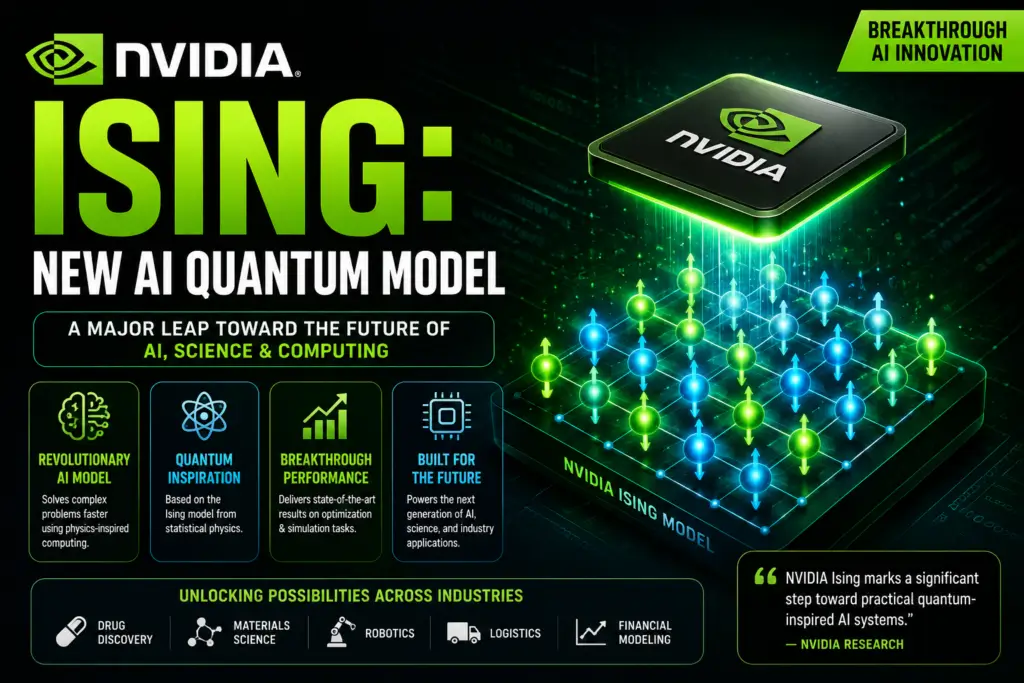
NVIDIA Ising is a family of open AI models and tools designed for quantum computing—not another chatbot. Its job is to help researchers calibrate quantum processors and deal with errors produced by fragile qubits.
Quick answer: NVIDIA is using specialized AI to help solve two difficult quantum-computing problems: keeping quantum processors properly calibrated and decoding errors fast enough for quantum error correction.
What Is NVIDIA Ising?
When most people hear the words “AI model,” they probably think of ChatGPT, Gemini, Claude, or an image generator.
NVIDIA Ising is built for a very different job.
Instead of generating an email or answering a question, Ising applies AI to the operation of quantum computers. NVIDIA introduced the Ising family around two main areas: Ising Calibration and Ising Decoding.
Those names sound technical, but the basic idea isn’t too difficult.
Ising Calibration
Uses AI to interpret quantum-processor measurements and help determine how the hardware should be adjusted.
Ising Decoding
Uses neural-network models as part of the process for detecting and handling errors during quantum error correction.
Why Does a Quantum Computer Need AI?
Quantum computers use qubits rather than the ordinary bits used by conventional computers.
The problem is that qubits are noisy. A quantum processor has to operate while researchers deal with hardware imperfections, changing conditions, measurement errors, and other sources of noise.
Two jobs become especially important.
First, the processor needs calibration. Researchers have to understand what the hardware is doing and continually tune it so operations behave as intended.
Second, errors need to be decoded. Quantum error-correction systems produce information about possible errors, and that information has to be processed quickly enough to decide what corrections are needed.
This is where NVIDIA is applying AI with Ising.
The simple version: calibration helps keep the quantum machine tuned, while decoding helps interpret error information produced while it is running.
That distinction is much more useful than simply comparing Ising with ChatGPT. Both involve AI, but they were designed for completely different jobs.
How Ising Calibration Works
Ising Calibration uses a vision-language model to analyze diagnostic information from quantum processors.
That is interesting because vision-language models are often associated with understanding images, screenshots, diagrams, and documents. Here, the same broad type of AI technology is being specialized for scientific hardware.
The model can interpret experimental outputs and recommend what should happen next in a calibration workflow. NVIDIA has also connected the technology with an agentic workflow so the system can repeatedly evaluate results and help automate processor calibration.
Ising Has Already Been Updated
The original announcement introduced Ising Calibration 1. NVIDIA’s current resources include Ising Calibration 1.5, a newer 31-billion-parameter model, along with updated deployment options, benchmark resources, and a Quantum Calibration Agent workflow.
That is an important update if you saw coverage of Ising when NVIDIA first announced it.
What Ising Decoding Actually Does
Decoding tackles another part of the quantum-computing problem.
Quantum error correction generates patterns of measurements that provide clues about errors occurring in a quantum system. A decoder has to interpret those patterns and help determine the appropriate correction.
NVIDIA’s Ising Decoding approach uses small 3D convolutional neural networks as pre-decoders. Rather than replacing every part of an existing decoder, the AI model can process local error information before a global decoder makes the final logical decision.
Important distinction: saying “AI fixes quantum errors” makes a good headline, but it oversimplifies what Ising is actually doing. The AI model operates as part of a larger quantum error-correction workflow.
Surface Codes and Color Codes
NVIDIA’s current Ising resources include models and training workflows for different quantum error-correction approaches, including surface codes and color codes.
The SurfaceCode Fast model is designed around the trade-off between low latency and decoding accuracy. NVIDIA has also released a ColorCode model, expanding Ising beyond the models available when the family was originally announced.
What NVIDIA’s Performance Numbers Really Mean
NVIDIA has reported strong results for its Ising decoding models compared with the open-source decoders used in its benchmarks.
For example, NVIDIA reports its SurfaceCode Fast decoder at up to 2.5× faster latency and 1.1× higher accuracy than PyMatching under a specified test configuration.
NVIDIA also reports much larger improvements for its ColorCode model compared with Chromobius under another specified benchmark configuration.
Don’t Read Those Numbers as Universal Guarantees
These results come from defined benchmark conditions involving particular code distances, noise probabilities, models, and comparison methods. They show why the research is interesting, but they do not mean every quantum computer suddenly becomes several times better by installing Ising.
Is NVIDIA Ising Really Open?
NVIDIA has released model weights, training resources, datasets, benchmarks, recipes, and code for parts of the Ising ecosystem.
The current Ising resources include Calibration and Decoding models, the QCalEval dataset, decoding training resources, and the Quantum Calibration Agent Blueprint.
This gives researchers more than access to a closed AI service. Teams can experiment with models, evaluate calibration systems, train decoders for particular noise characteristics, and explore how the technology fits into their own quantum-computing workflows.
At the same time, Ising fits naturally into NVIDIA’s wider quantum ecosystem, including CUDA-Q and GPU-accelerated infrastructure.
That’s the bigger strategy: NVIDIA doesn’t need to build the quantum processor itself to become an important part of the quantum-computing stack. It can provide the GPUs, software, AI models, and infrastructure surrounding the hardware.
Why NVIDIA Ising Matters Beyond Quantum Computing
For most people, the important part of Ising isn’t whether you’re about to start operating a quantum processor.
You’re probably not.
The more interesting lesson is what Ising says about where AI is going.
Consumer AI has trained us to think about artificial intelligence as something we talk to. We type a prompt, and the model gives us text, an image, code, research, or an answer.
Ising is a reminder that AI models can also become specialized components inside complicated technical systems.
An AI model doesn’t have to write anything. It can interpret measurements, recommend hardware adjustments, process error data, or become one step inside a much larger engineering workflow.
The Bigger AI Trend
The future of AI isn’t only bigger general-purpose chatbots. It also includes specialized models designed around a specific job, specific data, and a specific workflow.
What Ising Does Not Prove
There is also a reason to keep the excitement under control.
Ising does not mean the biggest problems in quantum computing have suddenly been solved. Quantum computing still faces major engineering challenges involving error rates, scalability, control, hardware, and fault tolerance.
NVIDIA’s published results demonstrate progress on particular calibration and decoding tasks. They are not proof that large-scale fault-tolerant quantum computing is now commercially solved.
That makes Ising more interesting, not less. It is a concrete example of AI being applied to some of the difficult engineering work standing between experimental technology and useful systems.
NVIDIA Ising vs ChatGPT: The Simple Difference
Frequently Asked Questions
What is NVIDIA Ising?
NVIDIA Ising is a family of open AI models, training resources, and workflows designed for quantum-computing tasks, particularly processor calibration and quantum error-correction decoding.
Is NVIDIA Ising a chatbot?
No. Ising is specialized AI for quantum computing. It is not intended to be a general conversational assistant or content-generation tool.
What is Ising Calibration?
Ising Calibration uses a vision-language model to interpret quantum-processor diagnostic results and recommend calibration actions. NVIDIA’s current model family includes Ising Calibration 1.5.
What is Ising Decoding?
Ising Decoding uses neural-network pre-decoders to process error information as part of quantum error-correction workflows.
Is NVIDIA Ising open source?
NVIDIA provides open model resources, weights, datasets, benchmarks, training frameworks, recipes, and code across the Ising ecosystem. Developers should still check the license attached to the specific model or repository they plan to use.
Can Regular People Use NVIDIA Ising?
The resources are publicly accessible, but Ising is primarily aimed at quantum-computing researchers, developers, hardware builders, and organizations working with quantum processors. It is not a consumer AI product.
The Part That Makes Ising Interesting
Ising probably won’t become a household AI name, and that isn’t really the point.
What makes it worth watching is the shift it represents.
AI is moving beyond tools that sit on our screens and answer prompts. Specialized models are becoming part of the machinery underneath scientific research, engineering, robotics, hardware control, and other technical workflows.
NVIDIA Ising is one example of that transition.
Whether its current models become long-term standards is still an open question. But the idea behind them is much bigger: instead of asking AI to explain a complicated machine, engineers are increasingly asking AI to help operate one.
TechnofluxAI takeaway: Don’t judge every AI model by how well it chats. Some of the most interesting AI systems may eventually be the ones users barely see because they’re working inside larger tools, machines, and scientific workflows.

About the Author
Jon Hicks
Founder of TechnofluxAI.
I’m the creator behind TechnofluxAI, focused on breaking down powerful AI tools, emerging trends, and practical strategies to help creators and entrepreneurs stay ahead in a rapidly evolving digital world.
Follow TechnofluxAI for the latest AI tools & strategies