

Estimated reading time: 8 minutes
TechnofluxAI Guide
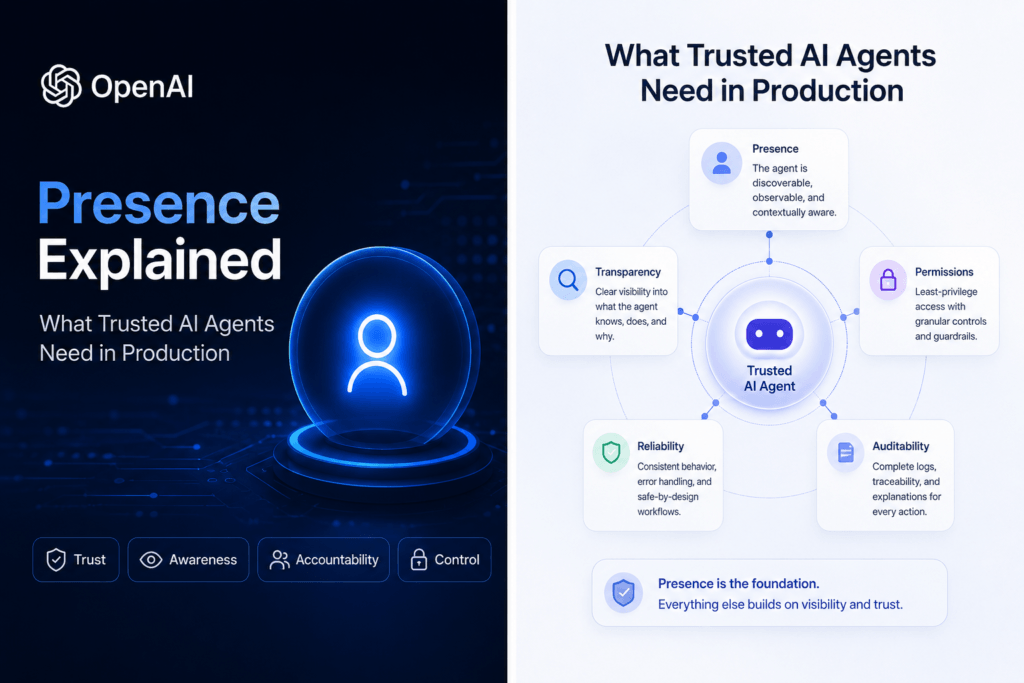
OpenAI Presence Explained: What Trusted AI Agents Need in Production
OpenAI Presence is designed for a problem most AI demos avoid: how to run AI agents safely inside real business workflows where permissions, approvals, data access, monitoring, and human escalation actually matter.
Quick Answer
OpenAI Presence is an enterprise platform for deploying governed AI agents that can answer questions, use connected business systems, take approved actions, monitor outcomes, and escalate to people when judgment or approval is needed.
Main Guide
What OpenAI Presence Actually Is
OpenAI Presence is best understood as a managed enterprise agent layer. Instead of giving a team only a model, an API, or a chatbot interface, Presence focuses on the full operating environment around the agent: what it can access, what it can do, how it is tested, how it is watched, and when a person needs to step in.
1. It Connects to Workflows
A production agent needs access to real business context. That may include support tickets, account records, product documentation, internal policies, CRM data, order history, or workflow tools.
2. It Uses Permissions
A trusted agent should not have unlimited power. It needs scoped permissions that define which tools it can use, which records it can see, and which actions require approval.
3. It Escalates to Humans
Some decisions should not be fully automated. Good production agents know when to pause, ask for approval, route to a specialist, or hand off the case to a human operator.
Why Production AI Agents Are Different From AI Demos
A demo proves that an agent can complete a task once. Production proves that the agent can complete the right task repeatedly, under real constraints, with safe behavior when something unexpected happens.
AI Demo
Works in a controlled example, often with clean prompts, limited data, simple tools, and no serious consequences if the output is wrong.
Production Agent
Works across messy real-world inputs, changing policies, sensitive data, customer exceptions, approval paths, compliance needs, and measurable business outcomes.
The Core Building Blocks of a Trusted AI Agent
Clear Job Definition
The agent should have a specific role. “Help customers” is too broad. “Resolve billing questions for subscription customers using approved refund rules and escalate exceptions above a set threshold” is much stronger.
Permission Boundaries
Permissions decide what the agent can read, write, change, submit, refund, delete, message, or approve. These boundaries protect the business from over-automation and help users understand what the agent is allowed to do.
Tool Access
An agent becomes more useful when it can use tools, but every tool adds risk. A read-only knowledge search tool is very different from a tool that can issue refunds, change account settings, or send messages to customers.
Evaluation Before Launch
Production agents need testing against realistic scenarios before they are released. That includes normal requests, edge cases, malicious prompts, incomplete information, conflicting policies, and situations where the agent should refuse or escalate.
Monitoring After Launch
Trust does not end at deployment. Teams need to watch how the agent behaves, where it fails, what users ask, which actions are approved, which outputs are corrected, and which workflows need stronger rules.
Practical Example: Customer Support Agent
Imagine a software company wants an AI agent to help with customer support. A weak version of this agent simply answers questions from a help center. A stronger production version can understand the customer’s issue, look up account status, check subscription rules, suggest a fix, draft a reply, and route risky cases to a human.
Safe Read Actions
Search the help center, retrieve product policy, summarize ticket history, identify account plan, and check current service status.
Controlled Write Actions
Draft a customer reply, tag the ticket, update case notes, create a follow-up task, or prepare a refund request for review.
Human Approval Cases
Large refunds, legal complaints, angry VIP customers, policy exceptions, suspicious account activity, or requests involving sensitive data.
A Simple Production Readiness Workflow
Step 1: Define the Agent’s Exact Job
Write the agent’s job in plain language. Include what it should do, what it should never do, and when it should ask for help.
Step 2: Map the Data It Needs
List the knowledge bases, databases, documents, tools, and business systems the agent needs to complete the workflow.
Step 3: Separate Read, Draft, and Action Permissions
Do not treat all tool access equally. Reading data, drafting a response, and taking an irreversible action should have different approval rules.
Step 4: Test Against Real Scenarios
Use real examples from support tickets, sales conversations, internal requests, or operations workflows. Add edge cases that force the agent to slow down or escalate.
Step 5: Monitor and Improve
Track where the agent succeeds, where users override it, where approvals are requested, where escalation happens, and where instructions need to become clearer.
TechnofluxAI
Practical AI for creators and website owners
Learn how to use AI, improve AI search visibility, build smarter workflows, and test what actually works.
Explore our other sites
TimewasterAI
— product reviews, buying guides, and useful finds.
Tina Trends
— fashion, beauty, pets, lifestyle, and fun discoveries.
Mistakenly Delicious
— simple recipes and practical cooking ideas.
Advanced Guidance
What Trusted AI Agents Need Before They Touch Real Work
The biggest mistake businesses make with AI agents is treating intelligence as the same thing as reliability. A model can be smart and still need structure. Production trust comes from the system around the model: scope, data quality, permissions, evaluations, monitoring, and human oversight.
Use Narrow Agents First
The safest agent is usually not the broadest agent. Start with one high-value workflow, one clear success metric, and one well-defined escalation path.
Design for Exceptions
Most production failures happen outside the happy path. Build rules for missing data, conflicting instructions, upset users, uncertain answers, and requests that exceed policy.
Separate Confidence From Authority
Even when an agent sounds confident, it should not automatically have authority to act. Confidence is a model behavior. Authority is a business rule.
Common Mistakes to Avoid
Mistake 1: Giving the Agent Too Much Access Too Early
An agent should earn more access through testing, review, and proven reliability. Start with limited permissions and expand carefully.
Mistake 2: Skipping Human Escalation Rules
If the agent does not know when to stop, the business has not designed the workflow properly. Escalation is not failure; it is part of trust.
Mistake 3: Measuring Only Speed
A fast wrong action is worse than a slow careful one. Measure accuracy, customer impact, approval quality, escalation quality, and policy compliance.
Mistake 4: Treating Launch as the Finish Line
Production agents need continuous improvement. Real usage reveals edge cases, unclear policies, missing data, and new workflow opportunities.
FAQ: OpenAI Presence and Production AI Agents
What is OpenAI Presence?
OpenAI Presence is an enterprise platform for deploying governed AI agents into high-value business workflows. It focuses on trusted operation, including permissions, policies, monitoring, testing, connected systems, and human involvement.
Is OpenAI Presence just another chatbot?
No. A chatbot mainly responds to messages. A production agent can understand tasks, use tools, retrieve business context, follow workflow rules, take approved actions, and escalate cases when needed.
Why do AI agents need governance?
Governance defines what the agent is allowed to do. Without governance, an agent may access the wrong data, take actions without approval, misunderstand policy, or create risk for customers and teams.
What makes an AI agent trustworthy?
A trustworthy agent has a clear job, limited permissions, reliable data access, tested behavior, visible logs, measurable outcomes, and a human escalation path for uncertain or sensitive situations.
Should small businesses care about OpenAI Presence?
Yes, even if they do not use enterprise-grade deployment immediately. The same principles apply at every size: define the workflow, limit access, test the agent, monitor results, and keep humans involved where judgment matters.
Final Takeaway
OpenAI Presence points to where AI agents are going next: away from simple chat experiences and toward governed systems that can operate inside real businesses. The future of AI agents will not be judged only by how smart they sound. It will be judged by whether they can complete useful work safely, consistently, and transparently.
For teams building with AI, the lesson is simple: do not rush from prototype to production without the trust layer. The agent needs a job, boundaries, tools, tests, monitoring, and a clear path back to human judgment. That is what separates a clever demo from a production-ready AI system.