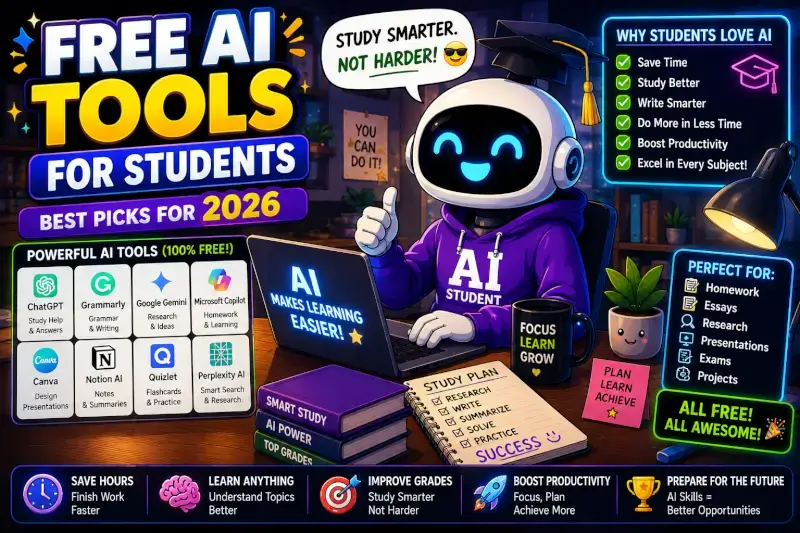
Artificial intelligence tools are everywhere in 2026. New apps launch every week. Big companies are racing to build smarter assistants. Smaller startups are releasing niche tools for writing, coding, research, image generation, and automation.
But if you had to choose just one AI tool to use today, the answer is still pretty clear: ChatGPT remains the #1 AI tool in 2026.
That does not mean it is perfect. Other tools are better in certain areas. Claude is often better for long-form writing and deeper reasoning. Gemini has stronger integration with Google products and multimedia features. Perplexity is excellent for fast research with citations.
Still, when you look at overall popularity, versatility, integrations, voice mode, coding support, image generation, research features, and daily usefulness, ChatGPT stays on top. It is the tool most people use, the one businesses build around, and the assistant that has become the default AI app for millions of users.

Quick Summary
- Best overall AI tool in 2026: ChatGPT
- Best for writing and long documents: Claude
- Best for Google users and multimedia: Gemini
- Best for research and citations: Perplexity
- Fastest growing new AI assistant: Meta AI
- Best AI tool for coding and business workflows: ChatGPT and Claude are currently tied for most professional use cases.
Why ChatGPT Is the #1 AI Tool in 2026
The biggest reason ChatGPT wins is simple: it does almost everything well.
You can use it for writing blog posts, summarizing PDFs, building marketing campaigns, creating images, brainstorming YouTube ideas, generating code, making spreadsheets, planning trips, learning skills, and even talking naturally with voice mode.
Unlike many AI tools that focus on one specific job, ChatGPT has become an all-purpose assistant. It is like having a writer, marketer, designer, coder, researcher, and productivity coach in one place.
OpenAI has also built a much larger ecosystem around ChatGPT than most competitors. The platform includes advanced research modes, memory, voice interaction, coding tools, image generation, browser-based features, and growing business integrations. Reports suggest OpenAI is even building an all-in-one productivity “superapp” that combines ChatGPT with browsing, coding, and deeper work tools.
Another reason ChatGPT stays ahead is pure usage. According to recent reports, ChatGPT has more than 900 million weekly active users and leads the AI market by a huge margin. Google Gemini is second in usage, but still far behind.
For everyday users, that matters. The more people use a tool, the more tutorials, plugins, communities, prompts, and integrations become available around it.
The Top 3 AI Tools in 2026
1. ChatGPT
ChatGPT is still the best overall AI tool because it balances power, simplicity, speed, and flexibility better than anyone else.
Best features:
- Writing and editing
- SEO content creation
- Coding help
- Research and summarization
- Voice mode
- Image generation
- Business workflows
- Idea generation
- Automation support
It is also one of the easiest AI tools for beginners to use. You do not need technical skills. You can simply type what you want and get useful answers quickly.
Many marketers, bloggers, freelancers, students, and business owners rely on ChatGPT every day because it replaces multiple tools at once.
According to several comparisons, ChatGPT consistently ranks at or near the top for deep research, voice capabilities, and everyday use.
2. Claude



Claude is the second-best AI tool in 2026.
Now Claude has become extremely popular because it is very strong at long-form writing, deep reasoning, analyzing large documents, and handling more nuanced instructions.
Writers, lawyers, consultants, researchers, and business professionals often prefer Claude because it can process huge amounts of text and maintain context better than many competitors.
Claude also performs extremely well in benchmark tests involving logic, system design, writing, and layered reasoning. In one recent head-to-head comparison, Claude outperformed ChatGPT across several real-world tasks.
Its biggest weakness is that it still feels more focused on serious work than casual everyday use. It is powerful, but not always as fun or flexible as ChatGPT.
Claude is especially good for:
- Rewriting content
- Summarizing reports
- Long documents
- Brainstorming business ideas
- Legal and policy analysis
- Coding support
- Research-heavy tasks
MIT Sloan and other business-focused sources often mention Claude as one of the most useful AI tools for handling complex communication and nuanced work.
3. Gemini


5
Gemini is currently the third-best AI tool in 2026.
Gemini is especially strong because it is deeply connected to the Google ecosystem. If you already use Gmail, Google Docs, Google Drive, YouTube, or Android, Gemini becomes incredibly convenient.
Google has also pushed hard into multimodal AI. Gemini can work with text, images, files, and even video in ways that feel more integrated than some competitors.
The launch of Gemini desktop apps and deeper Google Workspace integration has made it much more useful for professionals and students.
Gemini is best for:
- Google Docs and Gmail workflows
- Students
- Research
- Image and video generation
- Learning and education
- Google search integration
- Android users
Many reviewers now rank Gemini as the strongest option for multimedia tasks and Google-connected workflows.
Honorable Mentions
There are several other AI tools worth paying attention to in 2026.
Perplexity is probably the best AI search engine because it gives cited answers and stays focused during research. It is especially useful for fact-checking, finding sources, and digging into complex topics.
Grok has grown rapidly and is now one of the largest AI chatbots in the world. Some reviewers believe it performs very well on math, logic, and technical prompts.
Meta AI is growing fast because of social media integration and recent popularity boosts from Meta’s new Muse Spark technology.
Microsoft Copilot still matters for people who work inside Microsoft Office, Excel, and enterprise workflows, although its overall popularity has slowed compared to ChatGPT and Gemini.
Q&A: Best AI Tool in 2026
What is the best AI tool overall in 2026?
The best AI tool overall is ChatGPT because it combines writing, coding, research, image generation, voice, automation, and business use cases into one platform. It also has the largest user base and strongest ecosystem.
Is Claude better than ChatGPT?
In some cases, yes. Claude is often better for long documents, deep reasoning, and polished writing. However, ChatGPT is still better for overall versatility, integrations, and everyday use.
Is Gemini better than ChatGPT?
Not for most users. Gemini is stronger for Google Workspace, Android, and multimedia features. But ChatGPT is still better overall for business, marketing, coding, and general productivity.
What AI tool is best for research?
Perplexity is currently one of the best AI tools for research because it provides source citations and stays focused on factual answers.
What AI tool is best for content creators?
Content creators often use a mix of tools:
- ChatGPT for writing and planning
- Claude for scripts and long-form content
- Gemini for multimedia
- Perplexity for research
- Canva AI for design
- Midjourney for images
What AI tool is growing the fastest?
Meta AI and Grok are both growing very quickly in 2026, but ChatGPT still dominates total usage.
Suggested Internal Links
- Best AI Tools for Writing
- ChatGPT vs Claude: Which Is Better?
- Best AI Tools for Students
- Best AI Tools for Research
- Best AI Tools for Content Creators
Suggested External Links

Final Verdict
If you only want one AI tool in 2026, choose ChatGPT.
It is still the most complete, flexible, and useful AI platform available today. Claude comes in second because of its writing and reasoning strengths. Gemini is third because of its Google integrations and multimedia abilities.
The real power move, though, is using all three together. ChatGPT for ideas and productivity. Claude for deep writing and analysis. Gemini for Google workflows and multimedia.
That combination is honestly hard to beat ?

About the Author
Jon Hicks
Founder of TechnofluxAI.
I’m the creator behind TechnofluxAI, focused on breaking down powerful AI tools, emerging trends, and practical strategies to help creators and entrepreneurs stay ahead in a rapidly evolving digital world.
Follow TechnofluxAI for the latest AI tools & strategies