

Estimated reading time: 9 minutes
What Google Preferred Sources Actually Changes
Preferred Sources changes the visibility game from purely algorithmic discovery to reader-backed discovery. A publisher still needs strong content, crawlable pages, fresh coverage, and search relevance. But now, a loyal reader’s explicit preference can help that publisher stand out with a preferred label inside Google’s AI search surfaces.
Old SEO Mindset
Publish useful content, optimize it for search, earn links, and wait for Google to rank it.
AI Search Mindset
Publish useful content, build direct reader trust, and make it easy for your audience to identify your site as a preferred source.
Publisher Opportunity
Your brand becomes part of the search experience when readers recognize you before they search.
1. Make Reader Selection a Real Conversion Goal
Many publishers track newsletter signups, return visits, affiliate clicks, and paid subscriptions. Preferred Sources should become another audience action worth tracking. It is not enough to hope readers remember you. You need to ask at the right moment, explain the benefit clearly, and place the action where trust already exists.
Practical Placement Workflow
- Place the Preferred Sources prompt near the end of strong articles where the reader has received value.
- Add it to evergreen guides, breaking news explainers, comparison posts, and resource hubs.
- Include it in newsletter footers for loyal subscribers.
- Use a calm callout instead of a desperate pop-up.
- Repeat the message periodically, but do not interrupt the reading experience.
2. Use Google’s Official Implementation Paths
Google gives publishers three practical implementation paths: a standard JavaScript button, an advanced JavaScript implementation for custom interfaces, and a deeplink for sites that cannot add the interactive button. The standard button is the simplest path for most publishers because it only needs a script and a button container.
Basic Button Example
<script async src="https://news.google.com/swg/js/v1/publisher.js"></script>

<div google-add-preferred-source-btn data-theme="dark"></div>
The deeplink option is useful for newsletters, social posts, onboarding pages, and CMS environments where JavaScript is restricted.
Deeplink Example
<a href="https://www.google.com/preferences/source?q=example.com">
  Add us as a Preferred Source
</a>
3. Strengthen the Content Types Readers Would Actually Prefer
Nobody chooses a preferred source because of one average article. They choose sources that repeatedly save them time, explain things clearly, break news responsibly, or give them a point of view they trust. That means publishers should prioritize content that creates identity and repeat demand.
Original Reporting
Interviews, local coverage, first-party data, investigations, and primary-source explainers.
Expert Explainers
Beginner-friendly breakdowns with examples, context, and clear next steps.
Recurring Columns
Weekly briefings, market updates, trend reports, and opinion-led analysis.
Useful Tools
Templates, calculators, checklists, glossaries, and comparison pages readers return to.
4. Do Not Treat This Like a One-Time Announcement
A single “add us” message will not move much. Publishers should build a repeatable campaign around reader selection. The message should appear in high-trust places and explain the reader benefit in plain language.
Better CTA Language
“Read us often? Add TechnofluxAI as a Preferred Source in Google so our AI search and Top Stories links are easier to spot when we cover topics you care about.”
Warning Card
Do not promise readers that selecting your site guarantees rankings, traffic, or placement in every AI answer. Preferred Sources is a visibility and personalization feature, not a guaranteed ranking override.
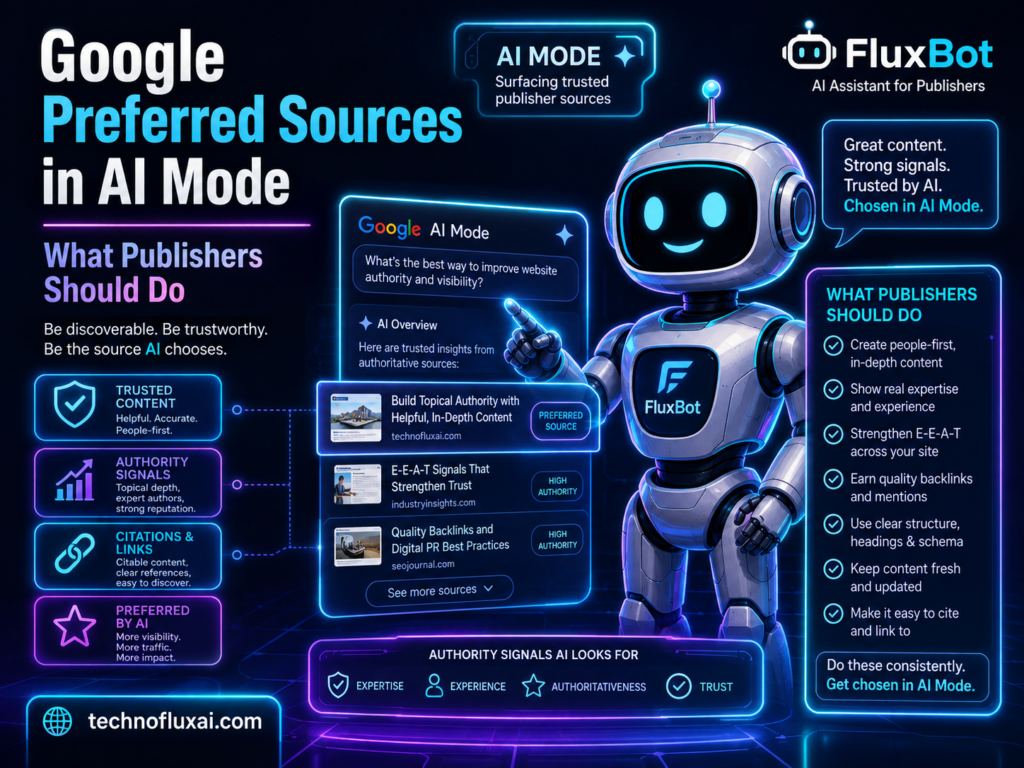
What Google Preferred Sources Actually Changes
Preferred Sources changes the visibility game from purely algorithmic discovery to reader-backed discovery. A publisher still needs strong content, crawlable pages, fresh coverage, and search relevance. But now, a loyal reader’s explicit preference can help that publisher stand out with a preferred label inside Google’s AI search surfaces.
Old SEO Mindset
Publish useful content, optimize it for search, earn links, and wait for Google to rank it.
AI Search Mindset
Publish useful content, build direct reader trust, and make it easy for your audience to identify your site as a preferred source.
Publisher Opportunity
Your brand becomes part of the search experience when readers recognize you before they search.
1. Make Reader Selection a Real Conversion Goal
Many publishers track newsletter signups, return visits, affiliate clicks, and paid subscriptions. Preferred Sources should become another audience action worth tracking. It is not enough to hope readers remember you. You need to ask at the right moment, explain the benefit clearly, and place the action where trust already exists.
Practical Placement Workflow
- Place the Preferred Sources prompt near the end of strong articles where the reader has received value.
- Add it to evergreen guides, breaking news explainers, comparison posts, and resource hubs.
- Include it in newsletter footers for loyal subscribers.
- Use a calm callout instead of a desperate pop-up.
- Repeat the message periodically, but do not interrupt the reading experience.
2. Use Google’s Official Implementation Paths
Google gives publishers three practical implementation paths: a standard JavaScript button, an advanced JavaScript implementation for custom interfaces, and a deeplink for sites that cannot add the interactive button. The standard button is the simplest path for most publishers because it only needs a script and a button container.
Basic Button Example
<script async src="https://news.google.com/swg/js/v1/publisher.js"></script> <div google-add-preferred-source-btn data-theme="dark"></div>The deeplink option is useful for newsletters, social posts, onboarding pages, and CMS environments where JavaScript is restricted.
Deeplink Example
<a href="https://www.google.com/preferences/source?q=example.com"> Add us as a Preferred Source </a>3. Strengthen the Content Types Readers Would Actually Prefer
Nobody chooses a preferred source because of one average article. They choose sources that repeatedly save them time, explain things clearly, break news responsibly, or give them a point of view they trust. That means publishers should prioritize content that creates identity and repeat demand.
Original Reporting
Interviews, local coverage, first-party data, investigations, and primary-source explainers.
Expert Explainers
Beginner-friendly breakdowns with examples, context, and clear next steps.
Recurring Columns
Weekly briefings, market updates, trend reports, and opinion-led analysis.
Useful Tools
Templates, calculators, checklists, glossaries, and comparison pages readers return to.
4. Do Not Treat This Like a One-Time Announcement
A single “add us” message will not move much. Publishers should build a repeatable campaign around reader selection. The message should appear in high-trust places and explain the reader benefit in plain language.
Better CTA Language
“Read us often? Add TechnofluxAI as a Preferred Source in Google so our AI search and Top Stories links are easier to spot when we cover topics you care about.”
Warning Card
Do not promise readers that selecting your site guarantees rankings, traffic, or placement in every AI answer. Preferred Sources is a visibility and personalization feature, not a guaranteed ranking override.
Advanced Publisher Strategy for Preferred Sources
The smartest publishers will not treat Preferred Sources as a button. They will treat it as a signal that brand trust, direct audience, and search visibility are merging. AI search rewards sources that users already recognize, and that makes your relationship with readers more valuable than ever.
Build a Preferred Source Funnel
The best place to ask someone to select your site is after they have experienced a clear win. That could be after reading a helpful guide, finishing a breaking-news explainer, downloading a resource, subscribing to a newsletter, or returning to the site multiple times.
Top of Funnel
Helpful articles that introduce the reader to your authority.
Middle of Funnel
Email signup, related guide, topic hub, or returning-reader prompt.
Trust Moment
A simple Preferred Sources CTA after the reader gets value.
Retention Loop
Newsletter, social, app, or direct visit habit that keeps the brand familiar.
Track the Right Signals
Publishers will not get a perfect dashboard that explains every reader’s Preferred Sources behavior. That does not mean the campaign is invisible. Track the surrounding signals that show whether your audience trust loop is improving.
Measurement Checklist
- Clicks on the Preferred Sources button or deeplink
- Return visitor rate on high-value content
- Newsletter click-through rate from Preferred Sources messaging
- Branded search growth
- Direct traffic growth
- AI Mode and AI Overview referral patterns where visible in analytics
- Engagement on articles that include the CTA compared with articles that do not
Common Mistakes to Avoid
Mistake 1: Asking Too Early
A first-time visitor who has not received value yet has little reason to select your site.
Mistake 2: Sounding Desperate
The CTA should feel like a helpful reader option, not a traffic panic message.
Mistake 3: Ignoring Content Quality
Preferred Sources cannot fix thin content, weak headlines, poor credibility, or inconsistent publishing.
Mistake 4: Hiding the Brand
If your articles feel interchangeable, readers will not remember you when Google asks them to choose sources.
FAQ
What is Google Preferred Sources in AI Mode?
It is a Google Search personalization feature that can highlight content from sources a user has selected as preferred inside AI Mode, AI Overviews, and Top Stories when relevant.
Can any publisher use it?
Google says domain-level and subdomain-level sites can be eligible, while subdirectories are not eligible. Sites also need fresh content to be available in the user-facing source selection experience.
Does being selected guarantee traffic?
No. A preferred badge can help selected sources stand out for that user, but it should not be treated as a guaranteed ranking or traffic promise.
Where should publishers place the CTA?
Place it where reader trust is already high: article endings, resource hubs, newsletters, account pages, and repeat-visitor experiences.
Is this only for news publishers?
No. Google says any website that publishes fresh content is eligible to be selected, but availability can depend on whether the source appears in the source preferences tool.
Final Takeaway
Google Preferred Sources in AI Mode is a reminder that the future of search is not only about ranking pages. It is about earning reader trust before the search result appears. Publishers who build direct relationships, publish recognizable work, and make source selection easy will be better positioned as AI search becomes more personalized.
Publisher Action Step
Add a Preferred Sources CTA to your highest-trust pages first, then test the message across newsletters, recurring columns, and evergreen guides.
Build Your AI Search Visibility Plan