

Estimated reading time: 13 minutes
Key Takeaways
- AI search is transforming into a content-control issue, requiring publishers to manage their content in Google AI search features.
- The UK Competition and Markets Authority mandates Google to give publishers more control over content in AI search, emphasizing the need for pages to offer ‘must-click’ value.
- Publishers should enhance their content by adding original examples, decision tools, and personal insights to make it harder for AI to replace.
- The future of search will favor well-structured, informative content that assists users in making better decisions.
- Small sites must audit their content and focus on improving pages that can be easily summarized to remain competitive.
The UK’s move matters because it shows where search is heading. Publishers want more control over how their content appears in AI-generated answers, and small sites need to prepare now.
AI search is no longer just an SEO trend.
It is becoming a content-control issue.
On June 3, 2026, the UK Competition and Markets Authority announced new requirements for Google Search under the UK digital markets regime. The big publisher takeaway is simple: Google must give publishers more control over whether their content is used in AI search features.
That matters because AI search can answer user questions directly inside Google.
For small sites, bloggers, affiliate publishers, and creators, the lesson is not “panic.”
The lesson is this:
Your pages need more must-click value.
A page that only gives a basic answer is easy to summarize. A page with proof, examples, screenshots, tools, frameworks, and real judgment is harder to replace.
This AI Overviews survival checklist will help you find the pages most at risk and improve them before clicks disappear.
Quick Answer
The UK is requiring Google to give publishers more control over whether their content appears in AI search features like AI Overviews and AI Mode, while still allowing those publishers to remain in regular Google Search. Reuters reported that sites opting out would not receive traffic from AI Overviews and AI Mode, but the controls would not affect traditional search results.
For small sites, this is a warning sign.
Pages that are easy to summarize may lose clicks even when they still get impressions.
The best response is to audit your most summarizable pages and add:
- Original screenshots
- Firsthand testing notes
- Real examples
- Comparison tables
- Decision tools
- Workflow maps
- Strong internal links
- Clear next steps
The goal is not just to rank.
The goal is to make the full page worth visiting.
What Happened
On June 3, 2026, the UK Competition and Markets Authority announced new requirements for Google Search.
The biggest change for publishers is simple: Google must give publishers a clearer way to opt out of having their content used in AI search features without removing them from traditional search listings.
This matters because many publishers have worried that AI search summaries can use their content to answer questions without sending users back to the original site.
The CMA’s move separates two things that used to feel tied together:
- Appearing in normal Google Search
- Being included in AI-generated search answers
AP reported that the requirements apply to AI features such as AI Overviews and AI Mode, and that Google must also provide clearer citations and links when publisher content is used in AI-generated search results.
TechCrunch also reported that Google is expected to test publisher controls with a subset of UK publishers before a wider rollout. The controls are expected to appear through Google Search Console.
This is not just a UK publisher story.
It is a preview of where search is going.
Why This Matters for Small Sites
AI Overviews can reduce the need to click.
That is especially true for simple informational queries.
Here is the basic pattern:
- A user searches a question.
- Google shows an AI answer.
- The user gets enough information from the summary.
- The original publisher may still get an impression.
- The click may never happen.
For creators and small publishers, the danger is not always losing rankings.
Sometimes the danger is ranking, appearing, and still getting fewer clicks.
That is a different SEO problem.
Old SEO asked:
“Can I rank?”
AI search optimization asks:
“Is my page still worth visiting after the summary?”
That second question is where small sites need to focus now.
The Real Problem Is Extractability
The real issue is extractability.
If your content can be pulled into a short answer and still feel complete, it is easy for AI search to replace the click.
That includes pages like:
- “What is AI SEO?”
- “How does ChatGPT work?”
- “Best AI writing tools”
- “What is affiliate marketing?”
- “AI Overviews explained”
- “Top 10 tools for creators”
Those topics are not bad.
But basic versions of those pages are vulnerable.
If the article only repeats common advice, AI can summarize it.
If the article includes lived experience, screenshots, testing, examples, mistakes, and decision-making tools, it becomes harder to replace with a short answer.
TechnofluxAI Take
The winners will not be the sites that publish the most generic content.
The winners will be the sites that publish evidence, frameworks, workflows, and useful decisions.
AI search rewards clarity.
But it cannot fully replace judgment.
Your job is to make your page useful after the quick answer.
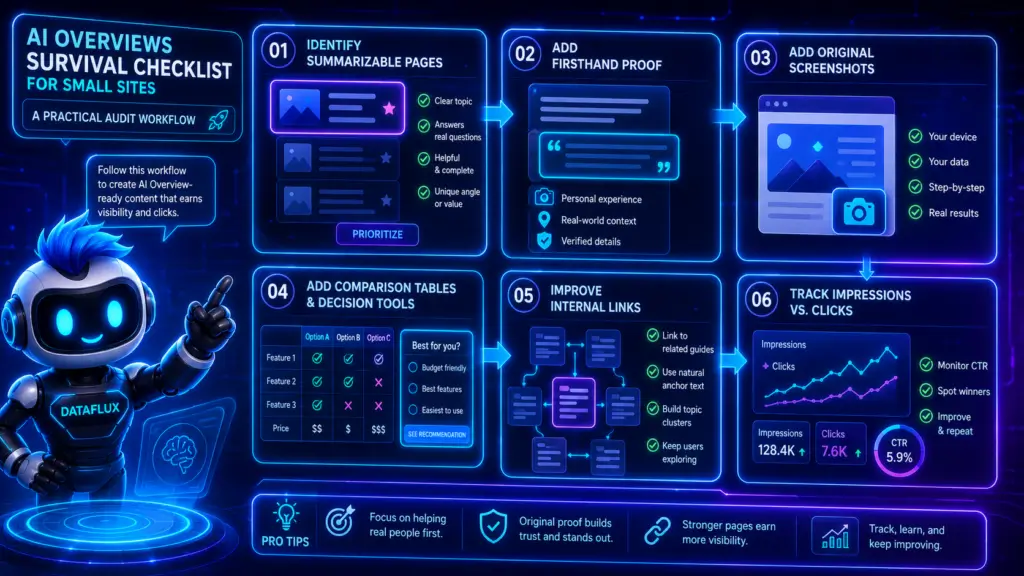
AI Overviews Survival Checklist for Small Sites
Use this checklist to audit your site.
Start with the pages that already get impressions.
Do not begin by creating 50 new articles.
Fix the pages that Google already understands.
1. Find Your Most Summarizable Pages
Start by looking for pages that answer simple questions.
These are often the easiest pages for AI Overviews to summarize.
Look for:
- Definition posts
- “What is” posts
- Basic how-to guides
- Best X for Y affiliate posts
- Tool comparison posts
- Template posts
- Simple FAQ pages
- Glossary-style content
- Short beginner explainers
Then open Google Search Console.
Look for pages with:
- High impressions
- Low CTR
- Falling CTR
- Stable or rising impressions
- Average position that has not dropped much
This is where the warning signs appear.
If impressions hold steady but clicks drop, your page may still be visible but less necessary to visit.
That is the AI search risk.
Action step
Create a spreadsheet with these columns:
- Page URL
- Main query
- Impressions
- Clicks
- CTR
- Average position
- Page type
- AI risk level
- Upgrade idea
Mark each page as low, medium, or high risk.
High-risk pages are usually pages that answer a question too completely in the first few paragraphs without giving the reader a reason to continue.
2. Add Firsthand Proof
AI can summarize general advice.
It has a harder time replacing your proof.
Add things that only you can provide.
For example:
- Original screenshots
- Your own testing notes
- Before-and-after examples
- Real tool outputs
- What worked
- What failed
- Personal observations
- Mini case studies
- Workflow experiments
This is especially important for AI tool reviews, affiliate posts, and creator tutorials.
Do not just say a tool is useful.
Show how you used it.
Do not just list features.
Show the result.
Do not just explain the workflow.
Show the steps, settings, prompts, screenshots, and final output.
Weak version
“ChatGPT can help bloggers write faster.”
Stronger version
“I used ChatGPT to turn one content brief into a blog outline, FAQ section, Pinterest pin idea, and YouTube Shorts script. The outline was useful, but the first draft sounded too generic until I added personal testing notes and internal links.”
That second version is harder to replace.
It contains experience.
3. Add Decision Tools
A basic answer can be summarized.
A decision tool gives readers a reason to click and stay.
Add sections like:
- Comparison tables
- Scoring rubrics
- Buyer checklists
- “Choose this if…” sections
- Mistake warnings
- Workflow maps
- Setup checklists
- Use-case filters
- Cost-benefit notes
This works well for affiliate content.
Instead of writing another generic “best tools” list, help the reader make a decision.
For example:
| Page Type | Weak Content | Stronger Content |
|---|---|---|
| AI tool list | “Here are 10 AI tools” | “Choose this tool if you are a beginner, creator, agency, or WordPress user” |
| How-to guide | “Follow these steps” | “Use this workflow, avoid these mistakes, and copy this checklist” |
| Comparison post | “Tool A vs Tool B” | “Use Tool A for speed, Tool B for control, and Tool C for teams” |
| Template post | “Download this template” | “Use this template, then customize these 5 sections” |
The more your page helps with judgment, the safer it becomes.
4. Make Affiliate Posts Use-Case Driven
Generic “best tools” posts are vulnerable.
They often repeat specs, pricing, and surface-level pros and cons.
AI search can summarize that easily.
A better structure is use-case driven.
Instead of:
“Best AI tools for blogging”
Use sections like:
- Best tool for beginners
- Best tool for creators
- Best tool for automation
- Best tool for small websites
- Best tool for low budget
- Best tool if you already use WordPress
- Best tool for repurposing content
- Best tool for building workflows
This helps readers self-select.
That is the point.
Affiliate content should not just say what exists.
It should help people choose.
Action step
Open one affiliate article and rewrite each tool section with this format:
Best for:
Who should use it?
Use it when:
What problem does it solve?
Avoid it if:
Who should skip it?
Workflow role:
Where does it fit in the process?
TechnofluxAI Take:
What is the practical decision?
This makes your affiliate content more useful, more trustworthy, and less replaceable.
5. Add a TechnofluxAI Take Section
Every major article should include a short original opinion or practical lesson.
This does not need to be dramatic.
It just needs to be useful.
Example:
TechnofluxAI Take: AI search rewards clarity, but it cannot replace judgment. If your page only explains the basics, it may get summarized. If your page helps someone make a better decision, it still has a reason to exist.
Add this section to:
- AI tool reviews
- SEO guides
- GEO articles
- Affiliate comparisons
- Creator workflow posts
- Blogging tutorials
- AI automation guides
This gives the article a human layer.
It also helps separate your content from generic AI-written pages.
6. Improve Internal Links
Internal links matter even more when search gets more answer-based.
Why?
Because every click matters more.
When someone lands on your site, give them a next step.
Example: For this topic, I will add internal links to:
- AI Blogging with anchor text: AI blogging workflow
- AI Tools for Creators with anchor text: AI tools for creators
- Make Money with AI with anchor text: make money with AI
- Ultimate AI Tools Directory with anchor text: best AI tools
- AI SEO / GEO content with anchor text: AI search visibility
- Free AI Resources with anchor text: free AI resources

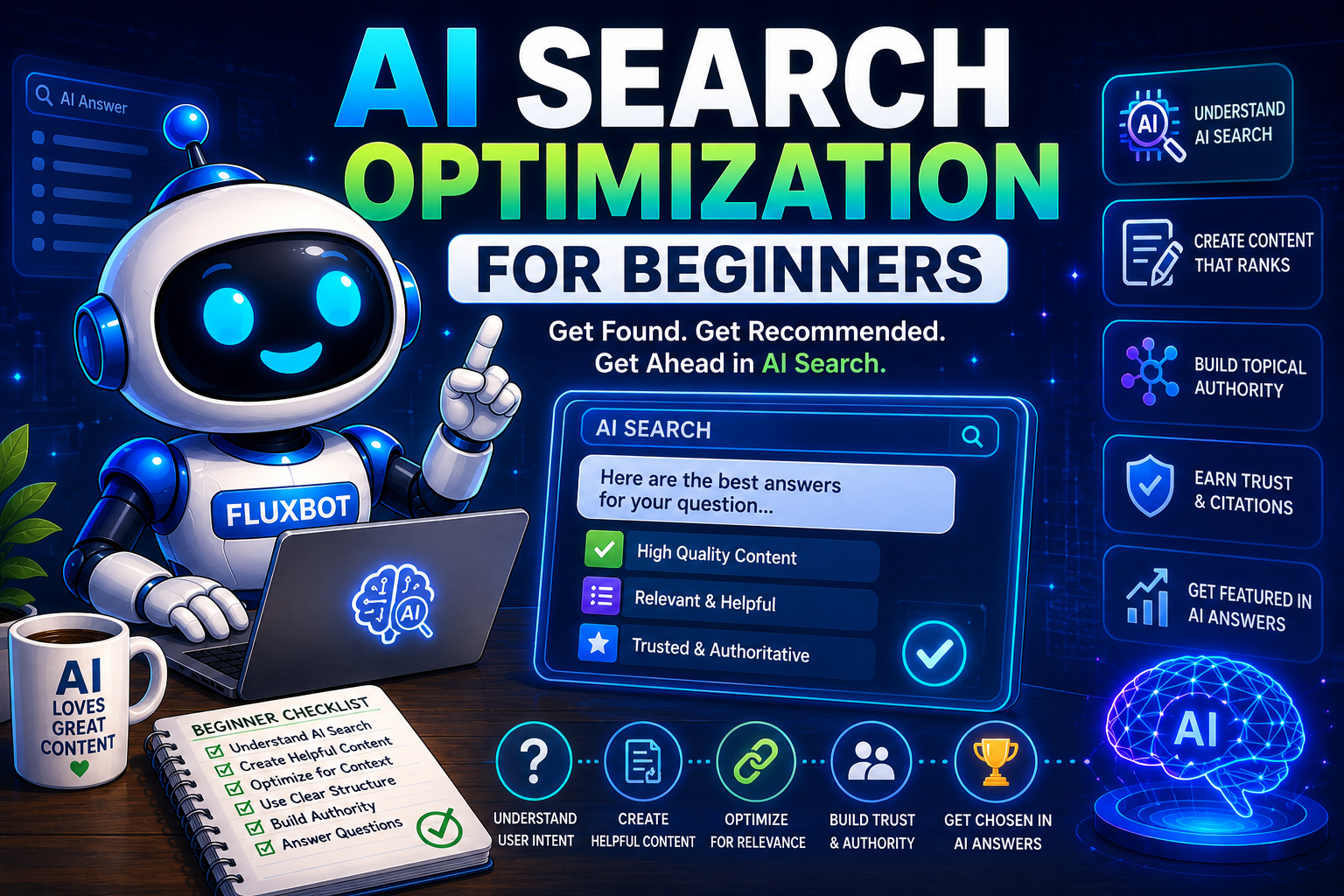
Do not add random links.
Add links that continue the reader’s journey.
A user reading about AI Overviews may want to know:
- How do I write AI-resistant content?
- Which AI tools help with SEO?
- How do I make money with AI content?
- How do I improve GEO?
- How do I track traffic drops?
Your internal links should answer those next questions.
7. Track Impressions vs Clicks
Do not only track rankings.
Rankings can hide the problem.
A page can keep its average position and still lose clicks.
Track:
- Impressions
- CTR
- Average position
- Query changes
- Pages with flat impressions but falling clicks
- Pages with more impressions but fewer clicks
- Pages that appear for simple question queries
- Pages where featured snippets or AI answers may satisfy the search
Look for this pattern:
- Impressions stay flat or increase
- Average position stays similar
- CTR drops
- Clicks decline
That means the page may still be visible.
But it may be less necessary to visit.
That is the real AI Overviews warning sign.
What Not to Do
Mistake 1: Do Not Just Make Every Article Longer
Length does not beat AI.
Specificity does.
A 3,000-word generic article is still generic.
A 1,500-word article with screenshots, examples, and decision tools can be much stronger.
Add value, not padding.
Mistake 2: Do Not Publish Generic AI Tool Lists
Generic lists are easy to summarize.
They are also easy to replace.
If your article looks like every other AI tool roundup, it has no moat.
Make tool content more useful by adding:
- Use cases
- Real workflows
- Constraints
- Screenshots
- Setup advice
- Mistakes
- Honest tradeoffs
The reader should leave knowing what to do next.
Mistake 3: Do Not Rely Only on Rankings
A page can rank and still lose clicks.
That is the uncomfortable part.
AI search changes the value of visibility.
You need to know whether your rankings are still producing traffic.
Check CTR trends often.
Especially for informational posts.
Mistake 4: Do Not Panic-Block Everything
Opt-out controls matter.
But many small sites still need Google visibility.
Blocking AI features may not automatically bring back traffic.
It may also remove your content from AI surfaces where some discovery could happen.
The smarter move is to improve must-click value first.
Then watch the data.
Then decide what to opt out of when controls become available in your market.
AI Overviews Survival Checklist: 17-Point Audit
Use this quick version when reviewing a page.
- Does the page answer a simple question?
- Could the answer fit inside an AI summary?
- Does the page include original screenshots?
- Does it include firsthand testing?
- Does it show examples?
- Does it include a comparison table?
- Does it include a decision tool?
- Does it explain who should and should not use the advice?
- Does it include mistakes to avoid?
- Does it include a TechnofluxAI Take?
- Does it link to a pillar page?
- Does it link to related cluster content?
- Does it link to a monetization page?
- Does it include a clear next step?
- Does Search Console show falling CTR?
- Are impressions steady while clicks fall?
- Is the page still worth visiting after the quick answer?
If the answer to number 17 is “no,” upgrade the page first.
Next Step: Audit One Page This Week
You do not need to fix your whole site today.
Start with one page.
Choose a page that gets impressions in Google Search Console but has a low or falling CTR. Then ask one simple question:
Would someone still need to click this page after reading an AI summary?
If the answer is no, improve the page.
Add:
- One original screenshot
- One real example
- One comparison table
- One “choose this if…” section
- One internal link to a related guide
- One clear next step
Small updates matter.
The goal is not to make every article longer.
The goal is to make each page more useful, more specific, and harder for AI search to replace.
FAQ
Can publishers opt out of AI Overviews and still rank in Google?
In the UK, the CMA requirement is designed to separate AI search participation from traditional Google Search visibility. That means publishers should have more control over AI search use without being removed from normal search listings. Reuters reported that Google said the controls would not affect traditional search results.
Does opting out guarantee more clicks?
No. Opting out may help some publishers, but it does not automatically solve the traffic problem. Small sites should also improve must-click value by adding proof, examples, screenshots, frameworks, and decision tools.
Which pages are most at risk from AI Overviews?
Pages that answer simple questions are usually the most vulnerable. That includes definitions, basic how-to posts, generic affiliate lists, comparisons, and short FAQ-style content.
How can small sites protect traffic from AI search?
Start by improving your most summarizable pages. Add firsthand testing, original screenshots, comparison tables, decision frameworks, internal links, and clear next steps.
Is AI search bad for small websites?
Not always. AI search can reduce clicks on simple answers, but it can also reward clear, trusted, well-structured content. Small sites need to move from generic information to useful proof and workflows.
Final Thoughts
AI Overviews are not just a big publisher problem.
They affect any site that depends on informational search traffic.
That includes bloggers, affiliate publishers, niche sites, creators, and small businesses.
The fix is not to panic.
The fix is to audit.
Find your most summarizable pages. Add proof, screenshots, decision tools. Improve internal links. Watch CTR. Make the full page worth the click.
The future of search will not reward generic content forever.
It will reward pages that help people make better decisions.
That is where small sites can still win.
About the Author
TechnofluxAI creates practical AI workflows, SEO systems, GEO frameworks, and creator growth resources for bloggers, creators, affiliate publishers, and small businesses. Our focus is simple: help readers use AI tools in real workflows that save time, improve visibility, and create better decisions.
Founder Insight: I’ve been working with computers, software, and creative technology since the early days of personal computing and personally test many of the AI tools featured on TechnofluxAI before recommending them.