
Quick Answer
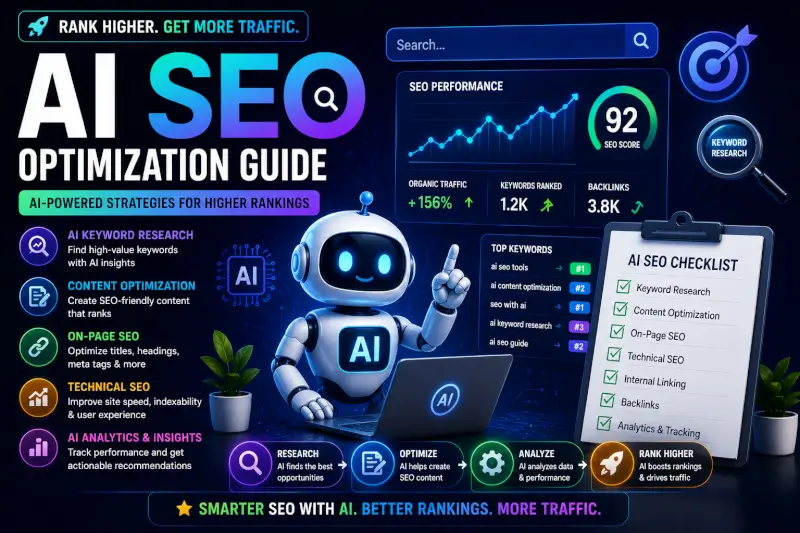
AI SEO optimization uses artificial intelligence to support keyword research, search-intent analysis, content planning, optimization, and content updates. The goal is not to publish more AI-generated pages. It is to use AI to create more useful, accurate, original, and well-structured content.
AI SEO Optimization in 2026
AI SEO has moved far beyond asking ChatGPT for a list of keywords and publishing whatever it generates.
AI can make research, planning, editing, and analysis much faster. But faster content production does not automatically mean better rankings, more traffic, or stronger authority.
A better approach is to use AI for tasks it handles well while keeping human judgment at the center of the process.
That means using AI to organize research, analyze search intent, identify content gaps, improve structure, compare competing pages, and refresh older content.
You still need to decide whether a topic belongs on your site, what original value you can add, and whether the finished article gives readers something genuinely useful.
If you are also working on visibility inside AI-generated answers, read How ChatGPT Chooses Sources for AI Answers. You can also explore the Ultimate AI Tools Directory.
What Is AI SEO Optimization?
AI SEO optimization is the use of artificial intelligence to support search engine optimization tasks such as research, planning, analysis, content improvement, and site organization.
AI can help with:
- Keyword and topic research
- Search-intent analysis
- Content-gap research
- Article outlines
- Competitor analysis
- Content refreshes
- Internal-link suggestions
- Readability improvements
- Structured-data drafts
The important distinction is that AI should support the SEO process rather than make every publishing decision for you.
Why AI SEO Matters in 2026
Search is becoming more fragmented. People can discover information through traditional search results, AI-generated search experiences, ChatGPT, Perplexity, and other AI assistants.
That makes clear, accurate, well-organized content increasingly important.
AI can help you:
- Understand search intent faster
- Identify missing questions
- Analyze related topics
- Improve existing articles
- Organize larger content clusters
- Reduce repetitive SEO work
AI can improve the workflow, but the content still needs a reason to exist. Original examples, testing, screenshots, experience, analysis, or a genuinely better explanation are what separate useful content from another generic AI summary.
What Google Says About AI-Generated Content
Using AI to help create content is not automatically a problem.
The bigger risk is producing large amounts of low-value or unoriginal content primarily to manipulate search rankings.
For a smaller publisher, that means quality and originality should matter more than publishing volume.
- Does this article answer a real question?
- Does it fit my existing content strategy?
- Did I verify important facts?
- Does it add something competitors are missing?
- Would I still publish it if there were no keyword-volume number attached?
One Thing I have Learned while building TechnofluxAi is that Ai tools usually sound easier to use than they are in the real world. I like to try things myself, see where I get stuck, and figure out what actually saves time instead of just repeating promisies.That’s the approach I use throughout this site: keep what works, point out what doesn’t, and explain things in a way that makes sense for someone who is still learning. I started out searching for an image creator. That was my first interaction with Ai. I was frustrated by the vast tool list without any real direction on which tool was best. Then I realized how powerful this tool was .and was going to be in the future. Making mistakes has helped me in the choice of articles I write.
How to Use AI for Keyword Research
AI can help with keyword research, but I would not use a chatbot as the only source of SEO data.
AI is useful for generating ideas, finding relationships between topics, grouping keywords by intent, and organizing research. Dedicated SEO tools are still more useful when you need search-volume estimates, ranking data, competitor metrics, or actual Search Console performance.
Step 1: Start With a Topic That Fits Your Site
Do not start with a random keyword just because a tool shows search volume.
Start with a topic that supports your existing site, audience, and content cluster.
Step 2: Gather Real Search Data
Use tools such as Google Search Console, Ubersuggest, Ahrefs, Semrush, or Google Trends to understand search queries, competition, related topics, and existing performance.
Step 3: Use AI to Organize the Research
Once you have real search data, AI can help group related phrases, identify search intent, find overlapping questions, and show which topics probably belong on the same page.
Step 4: Check Your Existing Content
Before creating another URL, check whether you already have an article that could be refreshed, expanded, or merged.
Step 5: Find the Missing Value
Look at what competing pages already explain and then identify what readers still need.
That missing value could be:
- Original testing
- Screenshots
- A practical workflow
- A better comparison
- Real limitations
- Original prompts
- A decision framework
- A clearer explanation
Search Intent Comes Before Keyword Placement
A keyword is not a complete content strategy.
You first need to understand what the person searching is trying to accomplish.
- Informational: The reader wants to understand something.
- Comparison: The reader is comparing options.
- Commercial: The reader may be deciding what to use or buy.
- Navigational: The reader wants a specific site or resource.
- Task-based: The reader wants instructions for doing something.
AI can help classify intent, but you should still inspect the actual search results before deciding how the article should be structured.
How to Create SEO Content With AI
I would not start by asking AI to write a complete article from one keyword.
A stronger workflow is:
- Choose a topic that fits the site.
- Check for overlapping existing content.
- Research current search results.
- Verify important facts with reliable sources.
- Identify what competitors already cover.
- Find what they are missing.
- Decide what original value you can add.
- Use AI to organize the research and outline.
- Add your own examples, screenshots, testing, or analysis.
- Fact-check the finished article before publishing.
“Here are my notes from the pages currently ranking for this topic. Group the points everyone already covers, then identify missing questions, examples, limitations, comparisons, or practical details. Do not write the article yet.”
On-Page SEO Without Keyword Stuffing
Your main topic should be clear, but that does not mean repeating the exact same keyword in every heading and paragraph.
Use a Clear SEO Title
The title should accurately describe what the page delivers and naturally include the main topic when appropriate.
Answer the Main Question Early
Readers should quickly understand what the article is about and whether it can solve their problem.
Use Logical H2 and H3 Headings
Use H2 headings for major sections and H3 headings for supporting subsections. This improves readability and creates a clear content hierarchy.
Use Internal Links Naturally
Link to related articles when they help the reader continue exploring the topic. Avoid adding internal links simply to hit a target number.
Support Important Claims
When discussing product features, prices, Google policies, benchmarks, or research, use reliable sources and link to the strongest original source available.
Use AI to Refresh Existing Content
One of the most useful AI SEO workflows is improving articles that already exist.
AI can help identify:
- Outdated information
- Missing sections
- Repeated paragraphs
- Weak explanations
- Old screenshots
- Broken links
- Missing internal links
- Claims that need better sourcing
Refreshing an existing article can often be more useful than creating another page targeting nearly the same search intent.
AI SEO and Generative Engine Optimization
SEO is increasingly connected with generative engine optimization, often shortened to GEO.
GEO generally refers to improving how clearly a website, brand, or source can be understood and potentially surfaced in AI-generated answers.
There is no guaranteed method for earning an AI citation, but several good content practices overlap with both SEO and AI visibility.
- Answer specific questions clearly
- Use accurate and current information
- Add original examples or evidence
- Make authorship and site identity clear
- Use descriptive headings
- Link to reliable supporting sources
- Build strong topical clusters
Common AI SEO Mistakes
Publishing Raw AI Drafts
AI can create readable content quickly, but readable does not automatically mean useful, original, or worth publishing.
Creating Too Many Similar Pages
Different keyword variations can represent the same search intent. Creating a separate page for each variation can lead to unnecessary overlap and cannibalization.
Treating SEO Metrics as Guarantees
Keyword difficulty, traffic estimates, and search-volume figures are useful research signals, but they are still estimates.
Ignoring Search Intent
You can optimize a page perfectly from a technical standpoint and still fail if it answers the wrong question.
Publishing More Instead of Publishing Better
AI makes it easy to increase publishing volume. That does not mean every possible topic deserves its own article.
For TechnofluxAI, I would rather publish fewer articles with original testing, screenshots, practical workflows, useful prompts, comparisons, or real analysis than fill the site with interchangeable AI summaries.
Image SEO for AI Content
Images should improve the article rather than exist only for SEO.
- Use descriptive filenames when practical
- Compress large images
- Use real screenshots when they add evidence
- Write accurate alt text for accessibility
- Avoid stuffing keywords into alt attributes
A real screenshot from an experiment, workflow, analytics report, or tool test usually provides more value than a generic decorative AI image.
AI SEO Optimization Checklist
- Does the topic fit the site?
- Did I check for overlapping content?
- Is the search intent clear?
- Did I review the current search results?
- Did I verify important claims?
- Does the article add original value?
- Is the answer easy to find?
- Are H2 and H3 headings used correctly?
- Are internal links genuinely useful?
- Did I remove repetition and filler?
- Are images and alt text useful rather than stuffed?
- Would I confidently publish this under my name?
AI SEO FAQ
Can AI-generated content rank on Google?
AI-assisted content can appear in search results. The more important issue is whether the page is accurate, useful, original, and created for readers rather than primarily to manipulate rankings.
Can ChatGPT do keyword research?
ChatGPT can generate keyword ideas, organize topics, classify search intent, and identify related questions. Dedicated SEO tools are still useful when you need search-volume estimates, competitor data, ranking information, or Search Console performance.
What is the best AI tool for SEO?
There is no single tool that handles every SEO task equally well. AI assistants can help with research and analysis, while SEO platforms and Search Console provide different types of search and performance data.
Does AI SEO replace traditional SEO?
No. Site accessibility, useful content, internal linking, clear structure, accurate information, and understanding user intent still matter. AI mainly helps improve and accelerate parts of the workflow.
What is GEO?
GEO stands for generative engine optimization. It generally refers to improving how clearly a website, brand, or source can be understood and surfaced within AI-generated answers.
The Bottom Line
AI can make SEO research, content planning, analysis, and optimization much faster.
But speed should not be the main goal.
Use AI to reduce repetitive work, find gaps, organize research, improve existing pages, and make better decisions.
Then put the time you save into the parts that build real value: testing, screenshots, experience, examples, analysis, and better explanations.
For official guidance, visit Google Search Central.
Founder Insight: I’ve been working with computers, software, and creative technology since the early days of personal computing and personally test many of the AI tools featured on TechnofluxAI before recommending them.

About the Author
Jon Hicks
Founder of TechnofluxAI.
I’m the creator behind TechnofluxAI, focused on breaking down powerful AI tools, emerging trends, and practical strategies to help creators and entrepreneurs stay ahead in a rapidly evolving digital world.
Follow TechnofluxAI for the latest AI tools & strategies