
Estimated reading time: 12 minutes
Key Takeaways
- ChatGPT selects sources based on relevance, clarity, authority, and how well they address user questions.
- Website owners must create content that is clear, trustworthy, and organized to be referenced by AI systems.
- AI-generated answers can increase visibility for brands even before users click through to their site.
- Effective content structure helps both readers and AI tools understand key information easily.
- Optimizing for AI search (GEO) complements traditional SEO by focusing on clarity and relevance in responses.
ChatGPT has changed how people search for answers online. Instead of typing a keyword into Google and clicking through several pages, many people now ask ChatGPT a direct question and expect a clear answer.
That creates a big question for website owners, bloggers, creators, and business owners:
How does ChatGPT choose which sources to use?
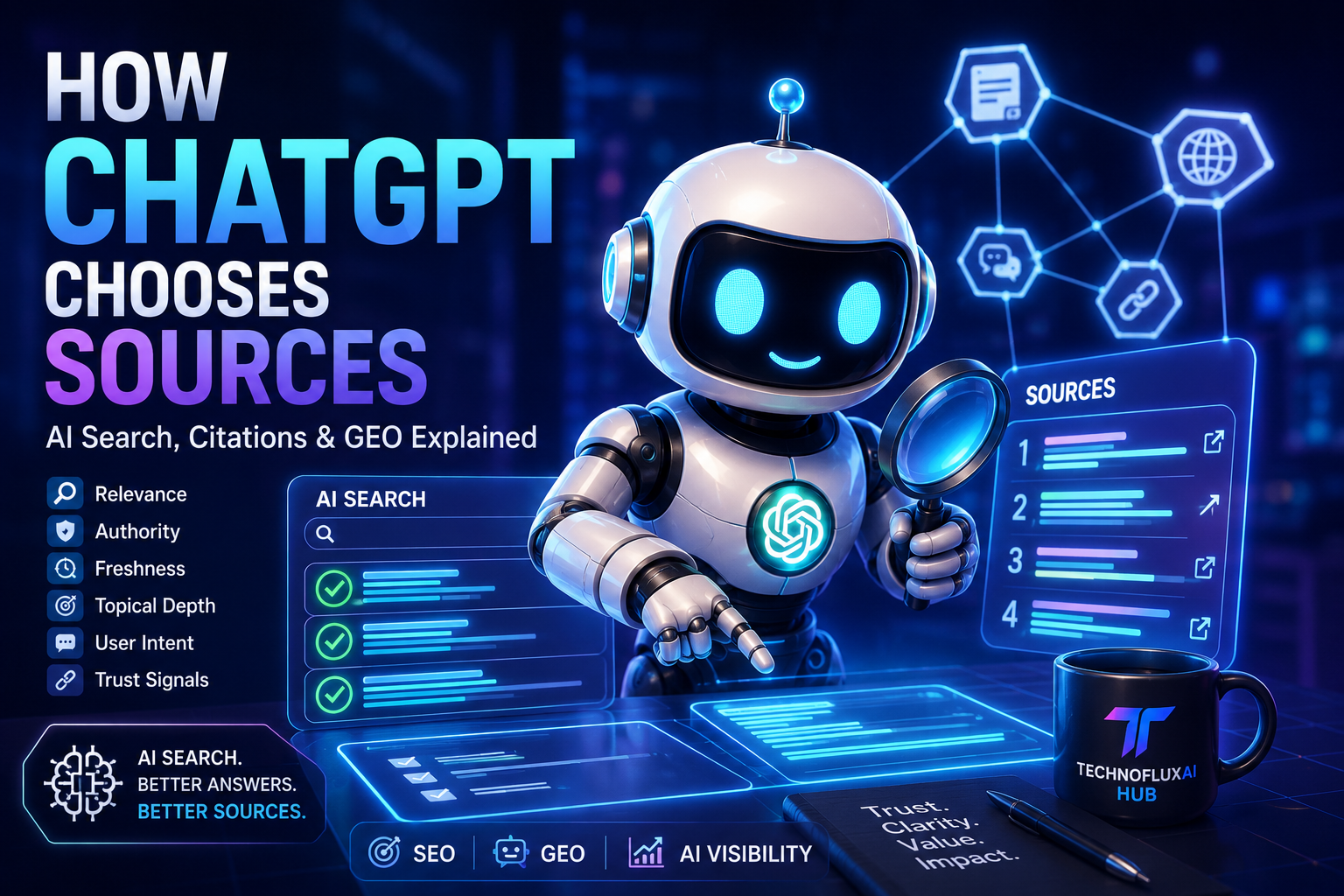
The answer is not as simple as “rank number one in Google.” ChatGPT looks for useful, clear, trustworthy, and relevant information. When search is available, it may use web results, cited sources, and other available context to build an answer.
This matters because the future of search is no longer only about ranking on a results page. It is also about being clear enough, helpful enough, and trusted enough for AI systems to understand and reference your content.
Quick Answer: How Does ChatGPT Choose Sources?
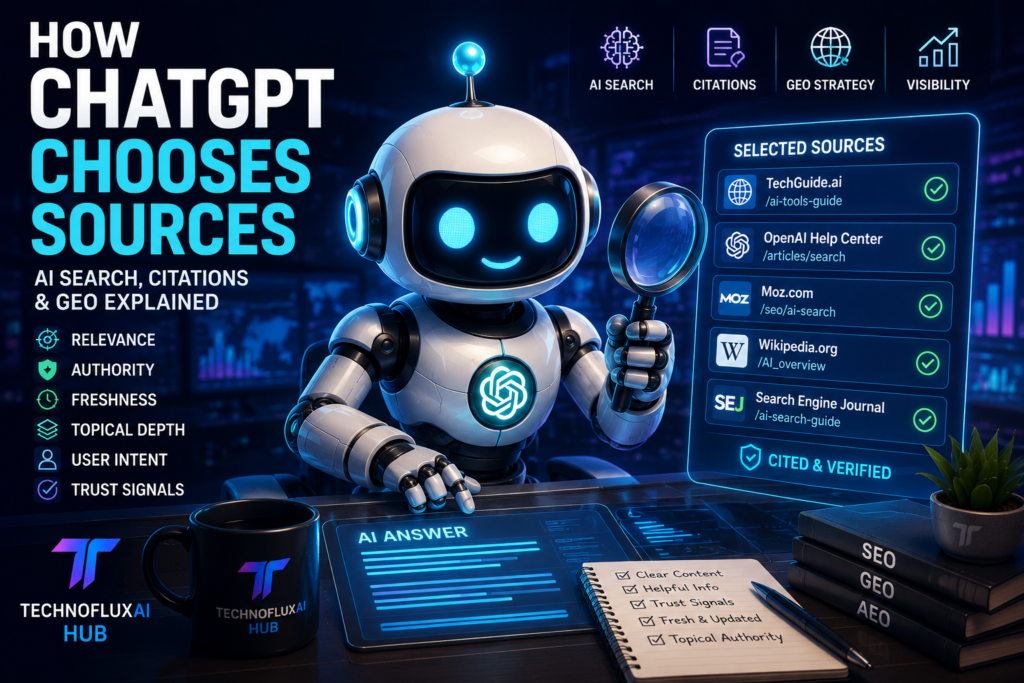
ChatGPT chooses sources based on relevance, usefulness, clarity, authority, freshness, and how well the content answers the user’s question.
In simple terms, ChatGPT is more likely to use content that clearly explains the topic, answers the question directly, includes helpful details, and comes from a page that appears trustworthy.
That does not mean every good page will be cited. It also does not mean ChatGPT always uses the same sources. The sources can change depending on the question, the wording, the user’s intent, the freshness needed, and whether ChatGPT uses live search or existing knowledge.
Founder’s Insight
Founder’s Insight: I see this as one of the biggest shifts in SEO. We are not just writing for Google anymore. We are writing for people, search engines, and AI answer systems at the same time. That means every page needs to be clear, helpful, organized, and trustworthy. If a page rambles, hides the answer, or feels thin, it is going to struggle in both traditional SEO and AI search.
Why ChatGPT Sources Matter
For years, website owners focused mostly on Google rankings. That still matters. However, AI search adds another layer.
People now ask tools like ChatGPT, Gemini, Claude, Perplexity, and Google AI Overviews for direct answers. As a result, they may never click through ten blue links. They may only see a summarized answer with a few cited sources.
That changes the game.
If your website becomes one of the sources used in an AI-generated answer, your brand can gain visibility even before someone visits your site. In some cases, a citation can act like a trust signal. It tells the reader that your content was useful enough to support the answer.
However, AI visibility is not automatic. You need content that is easy to understand, easy to summarize, and easy to trust.
ChatGPT Does Not Choose Sources Like a Human
A human reader might choose a source because they recognize the brand, like the writing style, or trust the author.
ChatGPT works differently.
It looks at the question and tries to understand what kind of answer is needed. Then it uses available information to create the best response it can. When web search is involved, sources may be selected because they match the topic, answer the question clearly, provide current information, or support specific parts of the response.
This is why structure matters.
A messy article may contain good information, but AI systems may struggle to extract the answer. A clear article with strong headings, direct definitions, examples, and FAQs is easier to understand.
The Main Factors That Can Influence Source Selection
There is no public checklist that guarantees your page will be chosen by ChatGPT. However, several factors clearly matter for AI search visibility.
Relevance
The page needs to match the question.
If someone asks, “What are the best AI tools for YouTube creators?” a general article about AI trends may not be the best fit. A focused page about YouTube creator tools is more relevant.
That is why each page should have a clear purpose.
Do not try to make one article answer everything. Instead, build focused pages that answer specific questions. Then connect those pages with internal links.
Clarity
ChatGPT works best with clear information.
If your article takes 600 words to explain the basic answer, the content may be harder to use. A strong page should answer the main question early, then expand with examples, details, and related sections.
This is one reason quick answer sections are powerful.
They help readers immediately understand the page. They also help AI systems identify the main point.
Authority
Authority does not only mean having a huge website.
It also means showing that your content is reliable. You can build authority by using real examples, adding founder insights, citing reputable sources when needed, updating old content, and creating a strong cluster of related articles.
For TechnofluxAI, that means building connected content around AI tools, AI workflows, AI SEO, GEO, automation, creators, and business growth.
One page helps. A full topic cluster helps more.
Freshness
Some topics need current information.
For example, an article about today’s AI tools, pricing, product features, or search changes may need to be updated often. If your content is outdated, ChatGPT may prefer a fresher source.
This does not mean every article needs daily updates. Evergreen guides can last a long time. However, pages about fast-moving AI tools should include recent updates, current examples, and clear publish or update dates.
Specificity
Specific content often beats generic content.
A page titled “Best AI Tools” is broad. A page titled “Best AI Tools for Faceless YouTube Channels” is more specific. It gives ChatGPT and readers a clearer reason to use it.
Specific pages also match long-tail searches better.
That matters because many AI searches are conversational. People ask full questions instead of typing short keywords.
Trust Signals
Trust signals help readers and AI systems understand why a page should be taken seriously.
These can include:
Author information
Founder’s insight
Clear dates
Helpful internal links
External references when needed
Original examples
Transparent affiliate disclosures
Real use cases
Consistent topical coverage
Trust is especially important in AI, finance, health, legal, and business topics. Even when the topic is not high-risk, trust still helps.
How This Connects to GEO
GEO stands for Generative Engine Optimization.
It means optimizing content so AI answer engines can understand, summarize, and possibly cite your page.
Traditional SEO focuses on ranking in search engines. GEO focuses on visibility inside AI-generated answers.
The two overlap. A good GEO page is usually also a good SEO page. It answers questions clearly, uses strong headings, explains the topic, includes examples, and helps the reader take action.
However, GEO adds a new priority:
Your content needs to be easy for AI to extract.
That means every article should include direct answers, definitions, lists, examples, summaries, and FAQs.
How to Write Content ChatGPT Can Understand
The best way to write for ChatGPT is not to sound robotic. The goal is to be clear.
Use normal language. Keep paragraphs short. Put the answer near the top. Add headings that match real questions. Then support your answer with examples.
A strong structure might look like this:
What is the topic?
Why does it matter?
How does it work?
What are the best examples?
What mistakes should readers avoid?
What should they do next?
What questions do beginners ask?
This structure works because it follows how people learn.
It also gives AI systems several clean sections to understand.
Practical Example: Weak Page vs Strong Page
A weak page might say:
“AI search is changing everything. Businesses need to adapt to modern technology and optimize for the future of digital discovery.”
That sounds fine, but it is vague.
A stronger page would say:
“AI search tools like ChatGPT choose sources that help answer the user’s question clearly. To improve your chances of being referenced, create focused pages with direct answers, strong headings, examples, updated information, and trust signals.”
That is much better.
It explains the topic directly. It also gives the reader a practical next step.
What Website Owners Should Do
If you want ChatGPT and other AI tools to better understand your website, start with your content structure.
First, make each article focused on one main topic.
Next, add a quick answer near the top. This gives readers and AI systems a simple summary of the page.
Then, use H2 and H3 headings that match real questions people ask.
After that, include practical examples. Examples make your article more useful and more original.
Finally, connect the article to related pages on your site. Internal links help readers explore more content. They also help search engines and AI systems understand your topical authority.
The Flux Method for AI Search Content
The Flux Method is simple:
Answer first.
Explain second.
Prove with examples.
Add founder insight.
Link to related resources.
Finish with FAQs.
This method keeps the article helpful for readers, friendly for Yoast, and easier for AI systems to understand.
It also makes publishing faster because you are not starting from scratch every time.
Internal Link Opportunities
Use this article to connect readers to other TechnofluxAI pages.
Recommended internal links:
? AI Search & GEO Update
AI search engines are rapidly changing how websites are discovered in 2026. Platforms like ChatGPT, Google AI Overviews, Claude, Perplexity, and Gemini now prioritize structured answers, topical authority, trusted sources, semantic relevance, and conversational content experiences.
Modern SEO is evolving into GEO (Generative Engine Optimization), where websites are optimized not only for rankings, but also for AI citations, summaries, recommendations, and conversational retrieval systems.
- AI search systems favor structured topical clusters
- Internal linking helps AI understand relationships between pages
- Fresh content updates improve visibility signals
- Helpful summaries and FAQs improve AI retrieval
- Conversational content performs better for AI search engines
AI Search Optimization Hub
GEO vs SEO
AI SEO for Beginners
Best AI SEO Prompts
Ultimate AI Tools Directory
Best AI Tools for Content Creators
AI Tools for Blogging
Make Money With AI
Common Mistakes to Avoid
Writing Only for Keywords
Keywords still matter. However, keyword stuffing does not help the reader.
Instead of repeating the same phrase too many times, answer the question naturally. Use related terms where they make sense.
For this article, related terms include ChatGPT sources, AI citations, GEO, AI search, source selection, and generative engine optimization.
Hiding the Main Answer
Do not make readers dig for the answer.
A strong article should give the basic answer early. Then it can explain the details below.
This improves readability. It also helps with featured snippets, AI summaries, and quick scanning.
Publishing Thin Tool Lists
Tool lists can work, but they need substance.
If every tool has the same short description, the page feels thin. Add use cases, pros and cons, pricing notes, examples, and who each tool is best for.
That makes the page more helpful and more original.
Ignoring Updates
AI content changes fast.
If your article mentions tools, features, pricing, or search behavior, review it regularly. Even a short update can help keep the page fresh.
Forgetting Trust
Readers want to know why they should believe you.
Add founder insight, explain your experience, include examples, and be transparent about affiliate links. These small details help your page feel more real.
Simple Workflow for Better AI Visibility
Here is a practical workflow for creating GEO-friendly content.
Start with one clear question.
For example:
How does ChatGPT choose sources?
Then write a direct answer in two or three sentences.
Next, create subheadings around related questions.
For example:
Why do ChatGPT sources matter?
What makes a source trustworthy?
How does GEO help?
How can website owners improve visibility?
After that, add examples, internal links, and a FAQ section.
Finally, review the article for readability. Break long paragraphs. Remove repeated sentences. Add transition words where they feel natural.
This workflow keeps the article clean and useful.
Final Thoughts
ChatGPT does not choose sources randomly. It tries to answer the user’s question using information that appears relevant, useful, clear, and trustworthy.
That means website owners need to think beyond old SEO habits.
Ranking in Google still matters. However, the next stage is building content that can also be understood by AI systems.
The best strategy is simple:
Create focused articles.
Answer questions clearly.
Use strong structure.
Add real examples.
Build topical authority.
Keep content updated.
Make your pages easy to trust.
That is how you prepare for SEO, AEO, and GEO at the same time.
Call to Action
Want to build content that works for both Google and AI search?
Start with the TechnofluxAI AI Search Optimization Hub. Then explore the AI SEO prompts, GEO guides, and AI tools directory to build stronger content workflows.
FAQ
How does ChatGPT choose sources?
ChatGPT chooses sources based on the question, available information, relevance, clarity, usefulness, and whether the source helps support the answer. When search is available, it may use web results and citations.
Can I guarantee that ChatGPT will cite my website?
No. There is no guaranteed way to make ChatGPT cite a specific website. However, you can improve your chances by creating clear, useful, trustworthy, and well-structured content.
Is GEO replacing SEO?
No. GEO is not replacing SEO. It is expanding it. Traditional SEO helps pages rank in search engines, while GEO helps content become easier for AI answer engines to understand and reference.
What kind of content is best for ChatGPT visibility?
Focused, helpful, and well-structured content is best. Pages with direct answers, useful examples, clear headings, FAQs, and trust signals are easier for AI systems to understand.
Do FAQs help with AI search?
Yes. FAQs can help because they answer specific questions clearly. They also make it easier for readers and AI systems to identify important information.
Should I update old content for GEO?
Yes. Updating old content can help. Add quick answers, better headings, examples, internal links, founder insight, and FAQ sections to make the page more useful.
What is the best first step for AI search optimization?
The best first step is to review your most important pages. Make sure each one answers the main question clearly near the top and includes helpful subheadings, examples, and internal links.
Founder Insight: I’ve been working with computers, software, and creative technology since the early days of personal computing and personally test many of the AI tools featured on TechnofluxAI before recommending them.