

Estimated reading time: 8 minutes
TechnofluxAI Publishing System
AI SEO Checklist Before You Hit Publish in WordPress
AI can help you write blog posts faster, but fast publishing can create messy SEO. Before you hit publish in WordPress, your article needs a final review for search intent, structure, metadata, readability, links, images, and trust.
Quick Answer
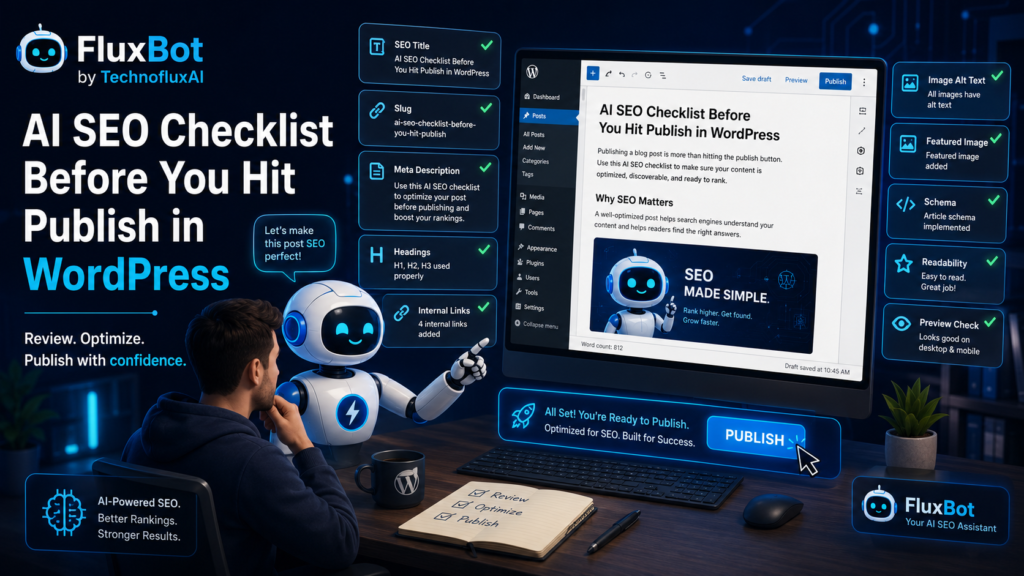
Before publishing an AI-assisted WordPress post, check the SEO title, URL slug, meta description, headings, search intent, internal links, image alt text, factual accuracy, readability, schema opportunities, and mobile layout.
Why This Matters
AI drafts often look finished before they are ready. A post can sound polished while still having weak headings, missing links, repeated phrasing, unsupported claims, poor image optimization, or a title that does not match search intent.
The WordPress Publishing Problem
WordPress makes publishing easy, which is helpful and dangerous at the same time. When the draft is already written, it is tempting to add a featured image, choose a category, and publish without checking the details that help readers and search engines understand the page.
That rushed final step can cost you clicks, rankings, readability, and trust. The fix is a repeatable pre-publish checklist that catches weak spots before the article goes live.
What This Checklist Will Help You Do
Use this workflow to review every AI-assisted WordPress post before publishing. It will help you clean up your SEO basics, improve the reader experience, reduce AI mistakes, and give each article a stronger chance to perform.
Suggested internal link: Connect this article to your AI blog writing workflow, WordPress content checklist, or AI fact-checking guide.
Main Checklist
The AI SEO Checklist for WordPress Publishing
A strong AI SEO checklist should move in the same order as your publishing process. Start with search intent, then review the content structure, then polish the WordPress settings before you publish.
Search Intent
Make sure the article answers the reason someone searched. A checklist post should be practical, scannable, and action-focused.
SEO Metadata
Review the SEO title, meta description, URL slug, focus keyphrase, and preview snippet before publishing.
Content Quality
Check accuracy, usefulness, examples, readability, formatting, internal links, and whether the article adds something better than generic AI output.
1. Confirm the Search Intent
Before editing tiny SEO details, check the big question first: does this post actually satisfy the reader’s intent? AI-generated drafts sometimes wander into broad explanations when the reader needs a direct checklist, tutorial, comparison, or answer.
Ask This
What problem does the reader want solved before they leave the page?
Fix This
Remove sections that sound useful but do not help the reader complete the task.
Improve This
Add examples, steps, warnings, and decisions that make the post easier to apply.
2. Review Your WordPress SEO Fields
SEO Title
Your SEO title should be clear, clickable, and aligned with the focus keyphrase. Avoid clever titles that hide the topic. A strong title tells the reader exactly what they will get.
URL Slug
Keep the slug short, lowercase, and descriptive. Remove filler words when possible. A clean slug like ai-seo-checklist-wordpress is easier to read than a long sentence-style URL.
Meta Description
Write a meta description that summarizes the benefit of the article. Include the focus idea naturally, but do not stuff the same phrase repeatedly.
Category and Tags
Choose one primary category that matches the article’s topic. Use tags to organize related ideas, but avoid creating dozens of near-duplicate tag pages.
3. Check the Article Structure
AI drafts often create decent sections, but they may not create the best reading path. Your headings should guide the reader from quick understanding to practical action.
Weak Structure
The article starts with a long generic intro, repeats the same SEO advice, and hides the actual checklist near the bottom.
Stronger Structure
The article gives a quick answer early, explains why the checklist matters, then walks through each publishing step in a logical order.
4. Run the AI Content Quality Pass
Fact-Check Claims
Verify statistics, tool features, plugin details, pricing references, platform rules, and any claim that could affect a reader’s decision.
Remove Generic AI Filler
Cut phrases that sound polished but say very little. Replace vague advice with specific examples, settings, checks, and next steps.
Check Repeated Sentence Starts
AI drafts often begin several sentences with the same rhythm, such as “This helps,” “You can,” or “It is important.” Rewrite repeated starts so the article feels more natural.
Add Human Experience
Include tested workflows, screenshots, examples, opinions, lessons learned, or decision rules. Human context makes AI-assisted content more useful.
5. Final WordPress Pre-Publish Checklist
- Focus keyphrase appears naturally in the title, intro, and at least one heading.
- SEO title is clear and not stuffed with repeated keywords.
- Meta description explains the benefit of the article.
- URL slug is short, readable, and relevant.
- H1 appears once and matches the page topic.
- H2 sections are clear, useful, and organized by reader need.
- Intro gives a quick answer without a long delay.
- Internal link suggestions are added where they make sense.
- External claims are checked before publishing.
- Images are compressed and named clearly.
- Alt text describes the image naturally.
- Featured image is selected.
- Category and tags are cleaned up.
- CTA matches the article’s purpose.
- Preview looks good on desktop and mobile.
Advanced Publishing Review
What to Check After the Basic SEO Settings
Once the title, slug, and meta description are finished, review the deeper signals that affect quality. A strong WordPress post should be accurate, useful, easy to scan, and ready for both human readers and AI-powered search.
Check Internal Links
Link to related posts that help the reader go deeper. Use descriptive anchor text instead of vague phrases like “click here.”
Review Image SEO
Make sure screenshots, featured images, and graphics have useful file names, natural alt text, and clean placement near the relevant section.
Preview the Reader Experience
Read the post like a visitor. If a section feels slow, repetitive, or unclear, fix it before publishing.
Common Mistakes to Avoid
Publishing Because the SEO Plugin Shows Green
A green score can be helpful, but it does not guarantee that the article is useful, accurate, original, or satisfying for the reader.
Stuffing the Focus Keyphrase
Repeating the same phrase too many times makes the article feel awkward. Use natural language, related terms, and clear explanations.
Skipping the Mobile Preview
A layout that looks clean on desktop may feel crowded on mobile. Check headings, spacing, images, buttons, and long paragraphs before publishing.
Forgetting the Final CTA
Every post should guide the reader somewhere useful. That could be another article, a checklist, a service page, a newsletter, or a downloadable resource.
FAQ: AI SEO Checklist for WordPress
What should I check first before publishing an AI blog post?
Check search intent first. If the article does not answer the reader’s real question, small SEO fixes will not save it.
Can I rely on an SEO plugin alone?
No. SEO plugins are useful for reminders, but they cannot fully judge accuracy, originality, reader satisfaction, or whether the article offers real value.
How long should my meta description be?
Keep it concise and benefit-focused. The goal is to explain what the reader will learn, not to force every related keyword into one sentence.
Should AI-written WordPress posts include internal links?
Yes. Internal links help readers find related content and help organize your site around clear topics.
How do I make AI content sound less generic?
Add specific examples, personal workflow notes, screenshots, tested steps, opinions, comparisons, and practical warnings. Remove vague advice that could appear on any website.
Final Takeaway
AI can help you create content faster, but your pre-publish checklist protects quality. Before you hit publish in WordPress, review the intent, structure, metadata, links, images, facts, readability, and final CTA.
The goal is not to publish more AI content. The goal is to publish better content with a repeatable system.
Next Step
Before your next WordPress post goes live, copy this checklist into your publishing workflow. Review the article once for SEO, once for reader usefulness, and once for final formatting.
TechnofluxAI
Practical AI for creators and website owners
Learn how to use AI, improve AI search visibility, build smarter workflows, and test what actually works.
Explore our other sites
TimewasterAI
— product reviews, buying guides, and useful finds.
Tina Trends
— fashion, beauty, pets, lifestyle, and fun discoveries.
Mistakenly Delicious
— simple recipes and practical cooking ideas.

About the Author
Jon Hicks
Founder of TechnofluxAI.
I’m the creator behind TechnofluxAI, focused on breaking down powerful AI tools, emerging trends, and practical strategies to help creators and entrepreneurs stay ahead in a rapidly evolving digital world.
Follow TechnofluxAI for the latest AI tools & strategies