

Estimated reading time: 19 minutes
AI Search Optimization Mistakes Small Sites Make
Small websites are not losing AI search visibility because they are too small. Most are losing because their content is unclear, thin, poorly structured, or difficult for AI systems to understand and trust.
Quick Answer
The biggest AI search optimization mistake small sites make is publishing content that answers broad topics without giving direct, specific, trustworthy answers. AI search tools prefer pages that are clear, complete, well-organized, and easy to cite or summarize.
The Pain Point
Many small site owners are still writing for old search results only. They focus on keywords, word count, and plugins, but ignore whether an AI assistant can clearly understand what the page says, who it helps, and why it should be trusted.
What You Will Learn
This guide breaks down the common AI search mistakes small websites make, why they hurt visibility, and how to fix them with stronger page structure, clearer answers, better examples, and smarter trust signals.
Why This Matters Now
AI search does not work exactly like classic search. A traditional search result may send someone to a list of blue links. AI search often summarizes answers before the click happens. That means your content must be easy for machines to understand and useful enough for humans to trust.
AI search systems look for content that can be understood, summarized, compared, and trusted. Small sites often have useful experience, but they hide it inside vague intros, weak headings, generic paragraphs, and pages that do not answer the reader quickly enough.
Write a long article, repeat the keyword, add a plugin score, and hope Google understands the page. Give a clear answer, prove it with useful detail, organize the page cleanly, and make the content easy to extract.
One of the biggest AI search optimization mistakes small sites make is burying the answer. Many posts begin with a slow introduction, a broad definition, or a dramatic setup before giving the reader anything useful.
Keywords still matter, but AI search is heavily question-driven. A page that only targets a phrase like “best email tool” may be less useful than a page that clearly answers questions such as “Which email tool is best for a solo creator?” or “What should a small business use before paying for advanced automation?”
“Best AI Tools for Business” with a generic list and no real use-case guidance. “Best AI Tools for Solo Business Owners Who Need Content, Email, and Customer Support Help.”
AI search can expose shallow content quickly. A page may look polished, but if it does not include examples, tradeoffs, steps, limitations, or real decision guidance, it becomes easy to ignore.
A 1,500-word article can still be thin if it repeats basic advice without adding specific examples, screenshots, workflows, comparisons, or practical next steps.
AI systems need to understand what your page is about. That means your content should clearly name the topic, related tools, audiences, problems, industries, and outcomes. Small sites often use vague wording like “this platform,” “these solutions,” or “modern strategies” without giving enough context.
Small sites can compete in AI search, but they need to show why their content should be trusted. That does not always mean having a huge brand. It can mean showing author experience, clear examples, updated information, transparent recommendations, and practical proof.
Explain what you tested, used, compared, built, reviewed, or learned firsthand. Use examples, pricing context, scenarios, screenshots, use cases, or decision rules. Update pages when tools, platforms, features, policies, or best practices change.
A page can have good information and still perform poorly if the structure is hard to scan. AI search benefits from clear headings, short answer blocks, lists, comparison tables, FAQs, and sections that make the page easy to parse.
Once your page has a clear answer and strong structure, the next step is to make the content more useful than the average result. Small sites do not need to publish like giant media companies. They need to publish with focus, clarity, and proof.
Add short, direct answer sections near the top of important pages so readers and AI tools can quickly understand the main point. Instead of only saying what is best, explain when it is best, who it is best for, and when someone should choose something else. Connect related articles together so your site looks like a focused resource instead of a random collection of posts. AI search optimization is the process of making your content easier for AI-powered search tools, answer engines, and generative assistants to understand, summarize, trust, and recommend. Yes. Small sites can earn visibility when they answer specific questions clearly, show useful expertise, and organize information better than larger but less focused pages. It overlaps with SEO, but it puts more pressure on clarity, structure, context, trust signals, and direct answers. Traditional SEO often focuses on ranking pages, while AI search optimization also focuses on being understandable enough to be summarized. AI can help with drafts, outlines, and research organization, but small sites should add human review, examples, opinions, firsthand details, and brand voice before publishing. Add a direct answer near the top, improve headings, remove filler, add examples, answer related questions, and make the page easier to scan on mobile.
Small sites do not need to become huge brands to compete in AI search. They need to become clearer, more useful, more specific, and easier to trust.
The winning move is not publishing more generic content. It is improving the pages that already have potential by giving better answers, stronger structure, and real-world guidance.
Start with one important article on your site. Rewrite the opening answer, improve the headings, add examples, and build a short FAQ. One upgraded page can teach you more than publishing five weak new ones.
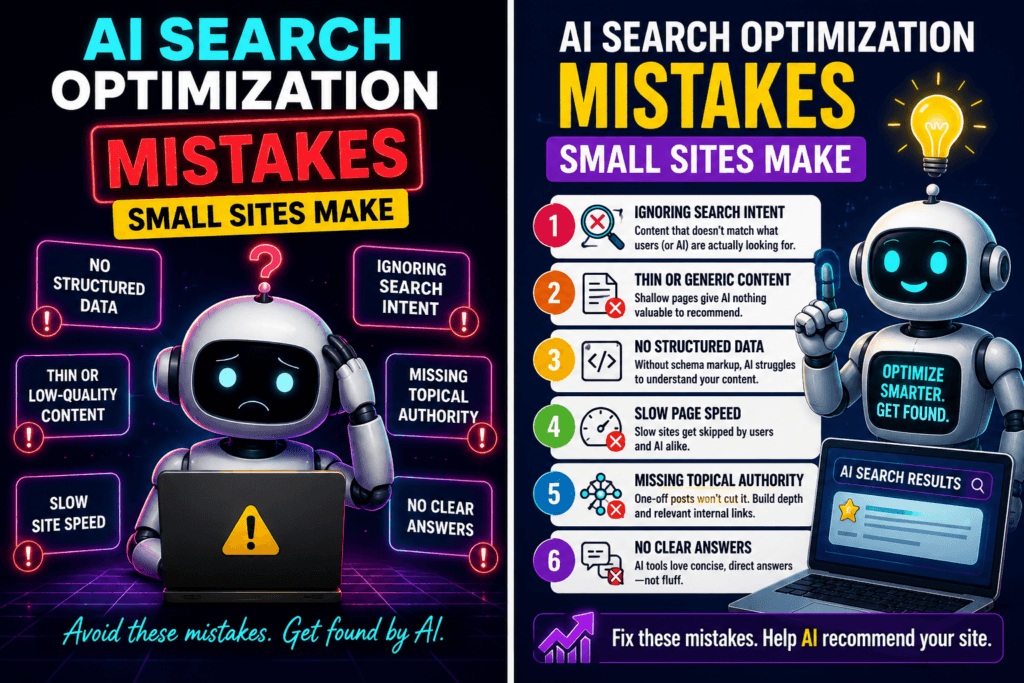
The Core Problem: Small Sites Often Publish Content That AI Cannot Easily Use
Old SEO Habit
AI Search Reality
Mistake 1: Starting With a Long Intro Instead of a Direct Answer
Better Structure
Mistake 2: Writing for Keywords Instead of Questions
Weak Page Angle
Stronger Page Angle
Mistake 3: Publishing Thin Answers That Sound Complete but Are Not
Warning Card
Mistake 4: Ignoring Entity Clarity
Entity Clarity Checklist
Mistake 5: Forgetting Trust Signals
Add Experience
Add Specifics
Add Freshness
Mistake 6: Using Messy Formatting
Simple AI Search Content Workflow
Advanced Fixes for Better AI Search Visibility
Use Answer Blocks
Add Decision Rules
Build Topic Clusters
Common Mistakes to Avoid
FAQ
What is AI search optimization?
Can small sites show up in AI search?
Is AI search optimization different from SEO?
Should small sites use AI to write content?
What is the fastest fix for an old post?
Final Takeaway
Ready to Improve Your AI Search Visibility?
Want more TechnofluxAI in Google?
Add TechnofluxAI as a Preferred Source to help Google show you more of our AI guides, tests, workflows, and research.