

Estimated reading time: 15 minutes
Key Takeaways
- AI search has transformed SEO; content must now be designed for AI visibility, clarity, and citation.
- The AI Search SEO Checklist for 2026 offers practical steps for creators to enhance content structure and signals.
- Focus on crafting clear answers, using descriptive headings, and linking to reliable sources to improve AI recognition.
- Ensure your site is crawlable, keeps content fresh, and utilizes schema where appropriate for better AI performance.
- Original insights and practical examples enhance content value, making it more likely to be cited by AI tools.
AI search has changed how people discover answers online.
A few years ago, the main goal was simple: rank on page one of Google. That still matters. But now, your content may also appear inside Google AI Overviews, ChatGPT search results, Perplexity answers, Copilot responses, and other answer engines.
That means your content needs to do more than rank. It needs to be easy for AI systems to find, understand, summarize, trust, and cite.
This AI Search SEO Checklist for 2026 is built for creators, bloggers, small business owners, and WordPress site owners who want practical steps. No hype. No magic tricks. Just better content, cleaner structure, stronger signals, and fewer technical roadblocks.
What Changed About SEO?
Traditional SEO is still important.
You still need helpful content, good titles, crawlable pages, fast loading, internal links, clear site structure, and trustworthy information.
The difference is that AI search tools often answer the question directly. Instead of only showing ten blue links, they may summarize multiple sources and cite a few pages. Google says AI Overviews and AI Mode can use query fan-out, which means Google may issue multiple related searches across subtopics and sources to build a response.
So the new goal is not only “rank higher.”
The goal is:
Be the source AI tools can confidently use.
Why AI Search Visibility Matters
AI answers can reduce clicks for some simple informational searches, especially when users get the answer directly on the results page. Research on Google AI Overviews and Wikipedia found that AI Overview exposure reduced daily traffic to exposed English Wikipedia articles by about 15%, with stronger effects for some categories.
That does not mean blogging is dead.
It means weak, generic content has less room to hide.
Useful content still matters. Original insight matters. Clear structure matters. Firsthand experience matters. Pages that answer real questions better than everyone else still have a reason to exist.
What Is AI Search SEO?
AI search SEO is the process of optimizing your content so AI-powered search systems can discover it, understand it, trust it, and possibly cite it in generated answers.
You may also hear related terms:
SEO
Search engine optimization. This focuses on helping search engines crawl, index, rank, and display your pages.
AEO
Answer engine optimization. This focuses on making your content easy to use in direct answers.
GEO
Generative engine optimization. This focuses on helping generative AI tools understand, cite, and recommend your content.
The names are different, but the practical work overlaps.
You are still trying to make good pages.
The difference is that AI search rewards clarity, structure, credibility, and extractable answers.
The 2026 AI Search SEO Checklist
1. Start With a Specific Search Question
Before writing, define the exact question your page should answer.
Bad target:
AI SEO
Better target:
How do I optimize blog posts for AI search in 2026?
Specific questions help you create focused content. They also match how people use AI tools. Users often ask complete questions instead of typing short keywords.
For each article, write down:
- The main question
- The beginner version of the question
- The buyer or decision-making version of the question
- The follow-up questions a reader will probably ask next
For this article, the main question is:
How do I optimize content so AI search tools can find, understand, cite, and recommend it?
That is the page’s job.
2. Put the Answer Near the Top
AI tools and human readers both need a clear answer quickly.
Add a short “Quick Answer” section near the beginning of your post. Keep it simple. Use 3–5 sentences. Answer the main question directly before adding deeper detail.
This helps readers who are skimming.
It also gives AI systems a clean summary of what the page is about.
Example:
To optimize for AI search, create helpful content that answers a specific question, uses clear headings, includes original examples, cites reliable sources, stays updated, and is easy for crawlers to access.
That is simple. is useful. it is not stuffed with keywords.
3. Use Clear H2 and H3 Headings
Headings are not decoration.
They help readers scan your page. They also help search engines and AI systems understand the structure of your content.
Use headings that describe the actual section.
Weak heading:
Important Stuff
Better heading:
How to Make Your Content Easier for AI Search to Cite
Good headings often include natural questions:
- What is AI search SEO?
- How does Google AI Overview choose sources?
- How do I optimize WordPress for ChatGPT search?
- What schema should I use for AI search?
Do not force keywords into every heading. That gets messy fast.
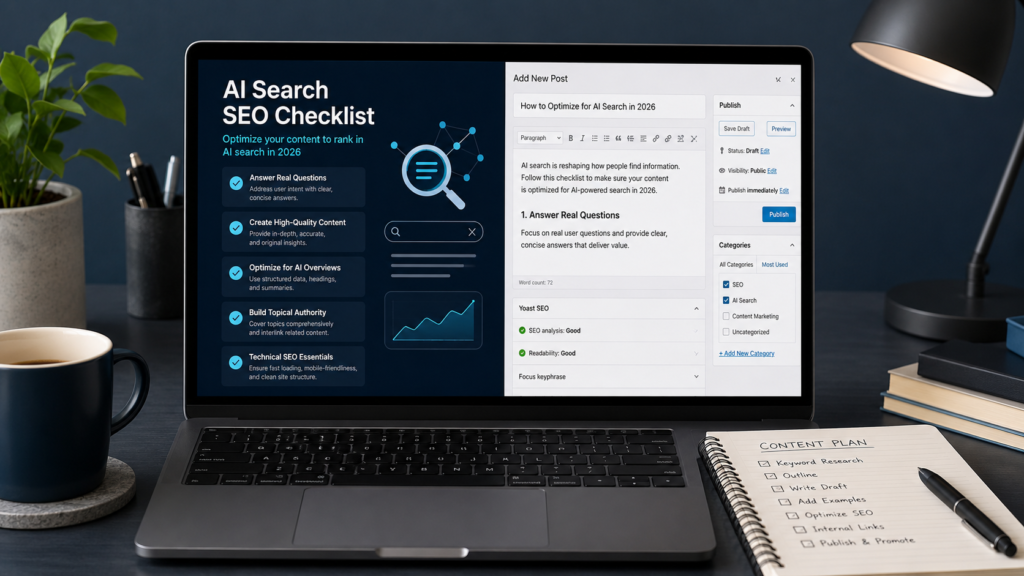
4. Add Original Experience and Examples
AI search has a generic-content problem.
If your article says the same thing as every other article, there is no strong reason to cite yours.
Add something useful that comes from real experience:
- A screenshot from your workflow
- A before-and-after content example
- A WordPress plugin setup
- A content template
- A checklist
- A mini case study
- Your own process
- A mistake you fixed
- A comparison table
- A real example from your niche
For example, instead of only saying “use schema,” show which schema a recipe blog, local business, SaaS site, or affiliate blog might use.
Original detail makes the article more useful.
It also makes it harder to replace with a generic summary.
5. Make Facts Easy to Verify
AI systems are more likely to trust content when claims are clear and supported.
For important factual claims, link to reliable sources. Use primary sources when possible.
Good external sources include:
- Google Search Central
- OpenAI documentation
- Schema.org
- W3C documentation
- Reputable research papers
- Government or university sources
- Official platform documentation
Google’s own documentation says there are no special technical requirements to appear in AI Overviews or AI Mode beyond being indexed and eligible for Google Search snippets. It also recommends foundational SEO work like allowing crawling, making content easy to find through internal links, providing good page experience, and ensuring important content is available in text form.
That kind of source is stronger than a random social media post.
6. Keep Content Fresh
Freshness matters more in AI search than many creators realize.
AI tools need current, reliable answers. If your page says “best tools for 2024” and it is now 2026, it looks stale even if the advice is still good.
Update your important content regularly.
Check:
- Dates
- Screenshots
- Tool names
- Pricing
- Plugin recommendations
- Platform rules
- Broken links
- Outdated statistics
- Old screenshots from WordPress, Google Search Console, or SEO tools
Add a “Last updated” date if your site design supports it.
Do not fake freshness. Actually update the page.
7. Use Schema Where It Helps
Schema markup helps search engines understand the type of content on your page.
It is not a magic AI ranking button. Google specifically says there is no special schema.org structured data required for AI features, and structured data should match the visible content on the page.
Still, schema is useful.
Use schema when it accurately describes the page.
Good options include:
- Article schema
- BlogPosting schema
- FAQPage schema
- HowTo schema, when the page is truly instructional
- Product schema, when reviewing or selling products
- LocalBusiness schema, for local businesses
- Organization schema
- BreadcrumbList schema
- Review schema, only when valid and visible
- Recipe schema, for recipe sites
For WordPress, many SEO plugins can add basic schema automatically. Just make sure the output matches what readers can see.
8. Strengthen Internal Links
AI search tools and traditional search engines both need to understand your site structure.
Internal links help show which pages matter and how topics connect.
For every new article, add links to:
- A related beginner guide
- A deeper tutorial
- A category page
- A tool review
- A relevant checklist
- A money page, when natural
Example for TechnofluxAI:
An article about AI search SEO could link to:
- WordPress SEO checklist
- Best AI tools for bloggers
- GEO vs SEO guide
- How to use schema in WordPress
- AI content workflow for small business owners
Use descriptive anchor text.
Bad anchor text:
click here
Better anchor text:
WordPress SEO checklist for beginners
9. Make Your Site Crawlable
If AI search tools cannot access your public content, they cannot use it well.
Start with the basics:
- Check robots.txt
- Check noindex tags
- Check canonical tags
- Make sure important content is not hidden behind login walls
- Avoid blocking essential crawlers by accident
- Check CDN, firewall, and bot protection settings
- Make sure pages return normal 200 status codes
For ChatGPT search specifically, OpenAI says OAI-SearchBot is used to surface websites in ChatGPT search features, and sites opted out of OAI-SearchBot will not be shown in ChatGPT search answers, though they may still appear as navigational links.
OpenAI also notes that robots.txt, web protection systems, bot mitigation, CAPTCHAs, JavaScript challenges, authentication, and rate limiting can block crawler access.
For WordPress users, this is worth checking.
Sometimes the problem is not your content.
Sometimes the bot simply cannot reach the page.
10. Improve Page Experience
AI search is not only about words.
Your page still needs to work well for humans.
Check:
- Mobile layout
- Page speed
- Intrusive popups
- Readability
- Font size
- Navigation
- Image compression
- Broken elements
- Ads that cover content
- Table of contents usability
A slow, cluttered, hard-to-read page is less helpful.
That matters for users. It can also affect how your content performs across search.
11. Add Useful Images With Alt Text
Images help explain ideas.
For AI search SEO, use images that add value:
- Screenshots
- Diagrams
- Workflow examples
- Checklists
- Comparison graphics
- Before-and-after examples
Add descriptive alt text.
Bad alt text:
image
Better alt text:
Screenshot showing a WordPress SEO plugin schema settings panel
Do not stuff keywords into alt text. Describe the image.
12. Write for Humans First
AI search optimization is not about writing robotic content for robots.
It is about making useful content easier to understand.
Good AI-search-friendly writing is:
- Clear
- Specific
- Accurate
- Well organized
- Updated
- Easy to skim
- Helpful beyond the obvious
Bad AI-search writing is:
- Repetitive
- Vague
- Overstuffed with keywords
- Full of filler
- Missing real examples
- Unsupported by sources
- Written only to chase citations
The rule is simple:
If a beginner can understand it, an AI system has a better chance of understanding it too.
AI Search and GEO Angle
What GEO Means
GEO stands for generative engine optimization.
It is the practice of improving your content so generative AI tools can use it in answers.
In plain English, GEO asks:
Would an AI answer engine understand this page well enough to cite it?
A 2025 study on AI answer engine citation behavior found that page quality, metadata and freshness, semantic HTML, and structured data were associated with citation patterns across tested answer engines. The study was limited to English-language B2B SaaS pages, so it should not be treated as a universal rule, but it supports the practical idea that clean, well-structured, fresh pages are more citation-friendly.
How to Make Your Content Easier to Cite
Make each article answer one clear topic.
Then add:
- A short definition
- A quick answer
- Step-by-step instructions
- A checklist
- FAQs
- Examples
- Current sources
- Clear author or brand information
- Updated dates
- Descriptive headings
AI tools cite pages that help them support an answer.
Be useful enough to support the answer.
Google AI Overview Angle
Google says the best practices for SEO remain relevant for AI features like AI Overviews and AI Mode. It also says there are no additional technical requirements to appear in those features beyond being indexed and eligible for Google Search snippets.
That means creators should not panic and chase weird tricks.
Focus on:
- Helpful content
- Crawlability
- Indexability
- Internal links
- Good page experience
- Important content in visible text
- High-quality supporting images or videos
- Structured data that matches visible page content
Practical Google AI Overview Checklist
Before publishing, ask:
- Is the page indexed?
- Is the answer clear near the top?
- Does the article answer related follow-up questions?
- Are headings clear?
- Is the page written for people, not just search engines?
- Does the page include original examples or experience?
- Are important claims sourced?
- Is schema accurate?
- Is the article internally linked from related pages?
- Is the content current?
Google AI Overviews are not guaranteed. Even strong pages may not be cited. But these steps make the page stronger for both classic SEO and AI search.
ChatGPT Search Angle
ChatGPT search visibility depends partly on whether OpenAI can access and use your content for search.
OpenAI identifies OAI-SearchBot as its crawler for surfacing websites in ChatGPT search features. It also separates OAI-SearchBot from GPTBot, which is used for crawling content that may be used in training generative AI foundation models. Site owners can allow one and disallow the other through robots.txt.
That distinction matters.
A site owner may want to appear in ChatGPT search while still making a separate decision about training access.
Practical ChatGPT Search Checklist
Check:
- Is OAI-SearchBot allowed in robots.txt?
- Is your CDN or firewall blocking it?
- Are pages hidden behind JavaScript challenges?
- Are important pages public?
- Are canonical tags correct?
- Do pages have clear titles and meta descriptions?
- Is content visible in HTML, not only hidden inside scripts?
- Are important pages internally linked?
- Does each page answer a real question clearly?
For WordPress users, also check security plugins, firewall plugins, and Cloudflare settings. Bot protection can accidentally block legitimate crawlers.
Perplexity and Answer Engine Angle
Perplexity and similar answer engines are citation-forward.
That means your content needs to be more than “SEO optimized.” It needs to be citation-worthy.
Citation-worthy pages tend to:
- Answer the question directly
- Include clear sections
- Use current facts
- Show expertise or experience
- Link to reliable sources
- Avoid vague claims
- Avoid thin rewritten content
- Include original value
Perplexity’s public app positioning emphasizes answers backed by sources and citations, which is why content creators should think beyond rankings and focus on becoming a reliable source for answer engines.
Practical Answer Engine Checklist
Ask:
- Would this article help an AI answer a specific question?
- Is the best answer easy to extract?
- Are facts supported?
- Is the content current?
- Does the page offer anything original?
- Are headings descriptive?
- Does the article include FAQs?
- Would a human trust this page?
If the answer is no, improve the page before worrying about tools.
FAQs
What is AI search SEO?
AI search SEO is the process of optimizing content so AI-powered search tools can find, understand, summarize, and potentially cite it. It combines traditional SEO with clearer answers, better structure, stronger sourcing, and content that is easy for answer engines to use.
What is GEO?
GEO stands for generative engine optimization. It focuses on improving visibility in generative AI tools such as ChatGPT, Perplexity, Google AI Overviews, AI Mode, and similar answer engines.
Is GEO replacing SEO?
No. GEO is not replacing SEO. It builds on SEO. You still need crawlable pages, helpful content, strong internal links, good page experience, and accurate metadata. GEO adds more focus on answer clarity, source quality, citations, and AI readability.
How do I optimize for Google AI Overviews?
Follow Google’s core SEO best practices. Make sure your page is indexable, eligible for snippets, helpful, well structured, internally linked, and easy to read. Google says there are no special technical requirements or special schema needed for AI Overviews or AI Mode.
How do I optimize for ChatGPT search?
Make sure your important public pages are crawlable and not blocked by robots.txt, firewalls, bot protection, CAPTCHAs, or authentication. OpenAI says OAI-SearchBot is used for ChatGPT search features, while GPTBot is separate and relates to training.
Should I allow OAI-SearchBot?
If you want your site to be eligible for ChatGPT search results, you should review whether OAI-SearchBot can access your public content. OpenAI says sites opted out of OAI-SearchBot will not be shown in ChatGPT search answers, though they can still appear as navigational links.
Does schema help with AI search?
Schema can help search engines understand your content, but it is not a guaranteed AI citation tool. Use schema when it accurately describes visible page content. Good options include Article, BlogPosting, FAQPage, HowTo, Organization, BreadcrumbList, Product, and LocalBusiness schema.
Do I need an llms.txt file?
Not for Google AI Overviews or AI Mode. Google says site owners do not need new machine-readable files, AI text files, or special markup to appear in those features.
How often should I update content for AI search?
Update important content at least every few months, especially if it includes tools, pricing, platform rules, screenshots, statistics, or fast-changing advice. For evergreen guides, refresh them whenever something meaningful changes.
Can AI search reduce website traffic?
It can, especially for simple informational queries where users get an answer without clicking. One study found Google AI Overview exposure reduced daily traffic to exposed English Wikipedia articles by about 15%.
What makes content citation-worthy?
Citation-worthy content is clear, specific, current, well structured, supported by reliable sources, and useful beyond generic advice. Original examples, real experience, checklists, and direct answers can make a page more valuable.
Final Takeaway
AI search SEO in 2026 is not about chasing shortcuts. It is about making your content easier to find, easier to understand, easier to trust, and easier to cite.
For TechnofluxAI readers, the practical path is simple: write clear answers, structure pages well, keep information updated, use schema honestly, check crawler access, and add real value that generic content cannot copy.
? Creator AI Tools Update
AI creator tools are evolving quickly in 2026. Content creators now use AI systems for video editing, voice generation, thumbnails, workflow automation, scripting, image generation, social media planning, and AI-assisted publishing across multiple platforms.
Modern creators are combining AI tools with workflow systems to publish content faster, stay more consistent, improve engagement, and scale content production without large teams.
- AI video tools speed up content creation workflows
- Workflow automation helps creators stay consistent
- Short-form video content continues dominating social traffic
- AI image systems improve thumbnails and visual branding
- Cross-platform publishing workflows are becoming essential