Estimated reading time: 6 minutes
Key Takeaways
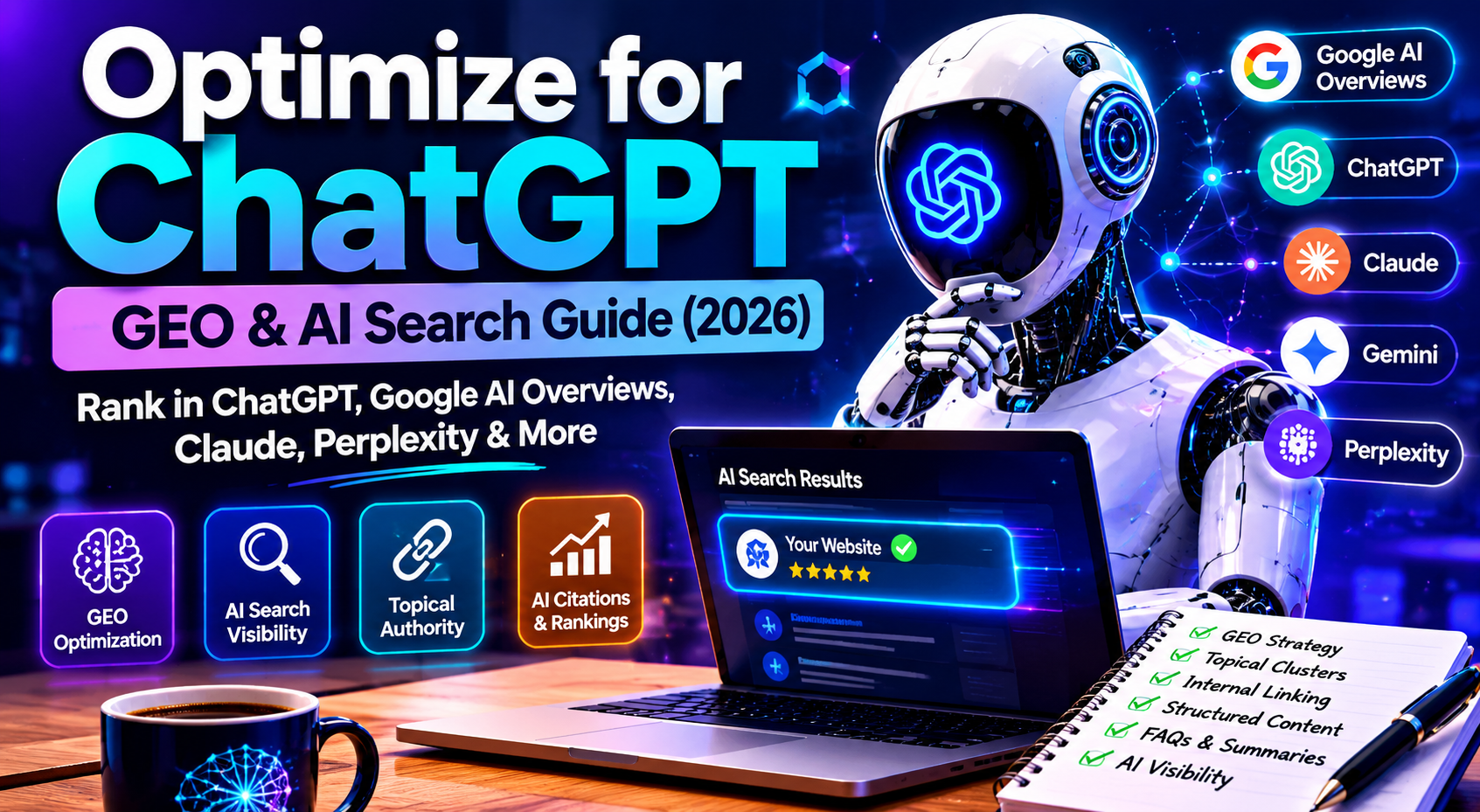
- To optimize for ChatGPT, create clear and structured content that directly answers questions.
- Use strong headings, internal links, and topical clusters to improve AI comprehension.
- Regularly update content and include FAQs to enhance usability and relevance.
- GEO, or Generative Engine Optimization, complements traditional SEO by focusing on AI search visibility.
- Organizing content well helps ChatGPT find patterns and authority signals, increasing chances for recommendations.
? AI Search & GEO Update
AI search engines are rapidly changing how websites are discovered in 2026. Platforms like ChatGPT, Google AI Overviews, Claude, Perplexity, and Gemini now prioritize structured answers, topical authority, trusted sources, semantic relevance, and conversational content experiences.
Modern SEO is evolving into GEO (Generative Engine Optimization), where websites are optimized not only for rankings, but also for AI citations, summaries, recommendations, and conversational retrieval systems.
- AI search systems favor structured topical clusters
- Internal linking helps AI understand relationships between pages
- Fresh content updates improve visibility signals
- Helpful summaries and FAQs improve AI retrieval
- Conversational content performs better for AI search engines
Quick Answer
To optimize for ChatGPT, create clear, helpful, well-structured content that answers real questions directly. ChatGPT and other AI search systems are more likely to understand pages that use strong headings, short explanations, FAQs, internal links, topical clusters, trusted sources, and fresh updates.
Traditional SEO still matters, but AI search optimization also focuses on being useful, easy to summarize, and connected to a larger topic ecosystem.
What Does It Mean to Optimize for ChatGPT?
Optimizing for ChatGPT means creating content that AI systems can understand, summarize, and recommend. Instead of only trying to rank for one keyword, your page should clearly explain a topic, answer related questions, and connect to other helpful pages on your website.
This is part of GEO, or Generative Engine Optimization. GEO focuses on helping AI tools like ChatGPT, Google AI Overviews, Gemini, Claude, and Perplexity understand why your content is useful.
How ChatGPT Understands Content
ChatGPT does not read a page the same way a person does. It looks for patterns, relationships, context, clarity, and authority signals. Pages that are organized well are easier for AI systems to interpret.
- Clear headings help explain the page structure
- Short answers help AI summarize the content
- Internal links show topic relationships
- FAQs answer conversational search questions
- Fresh updates show the page is maintained
- Helpful examples improve usefulness
Best Ways to Optimize Content for ChatGPT
1. Start With a Clear Answer
Place a simple answer near the top of the page. This helps readers quickly understand the topic and gives AI systems a clean summary to work with.
2. Use Question-Based Headings
Headings like “What Is GEO?” or “How Does ChatGPT Choose Sources?” match the way people ask questions in AI search tools.
3. Build Topical Clusters
One article is not enough. Build related pages around the same topic and link them together. For example, a GEO cluster might include pages about ChatGPT optimization, AI search visibility, AI citations, and generative engine optimization.
4. Add Internal Links
Internal links help AI systems understand how your pages relate to each other. They also help visitors move through your site naturally.
5. Write in Simple Language
Clear writing is better for both humans and AI tools. Avoid overcomplicated wording when a simple explanation works better.
6. Add FAQs
FAQs are useful because AI search is conversational. People ask AI tools direct questions, and FAQ sections give your page more chances to match those questions.
7. Keep Pages Updated
AI search is changing quickly. Updating older pages with new examples, better links, and fresh explanations helps keep your content useful.
GEO vs SEO: What Is the Difference?
SEO focuses on helping pages rank in traditional search engines. GEO focuses on helping pages appear in AI-generated answers, summaries, recommendations, and citations.
The two strategies work best together. Strong SEO helps search engines find your content, while strong GEO helps AI systems understand and recommend it.
Content Types That Work Well for AI Search
- Beginner guides
- Tool comparisons
- Step-by-step tutorials
- Definition pages
- FAQ pages
- Workflow guides
- Product reviews
- Best tools lists
- Case study style examples
Common Mistakes to Avoid
- Writing thin content with no real explanation
- Creating many similar pages that compete with each other
- Using keywords unnaturally
- Forgetting internal links
- Publishing content without FAQs
- Ignoring page updates
- Writing only for search engines instead of users
How TechnofluxAI Uses GEO
At TechnofluxAI, GEO is built around clear topic clusters, reusable update blocks, internal linking, AI workflow guides, and practical tool comparisons. Instead of publishing random AI articles, the goal is to build connected content systems around AI tools, productivity, automation, creator workflows, and AI search optimization.
This helps readers find useful information while also helping AI search systems understand what TechnofluxAI is about.
Related GEO Guides
What Is GEO?
Learn how generative engine optimization works.
How ChatGPT Chooses Sources
Understand how AI systems evaluate content.
Best GEO Tools
Explore tools for AI search optimization.
AI Search Optimization
A beginner guide to visibility in AI search.
Useful External Resources
Google Search Central
Official guidance for search visibility.
FAQs
Can you optimize content for ChatGPT?
Yes. You can optimize content for ChatGPT by using clear headings, helpful summaries, topical clusters, FAQs, internal links, structured content, and fresh updates.
Is GEO replacing SEO?
No. GEO is not replacing SEO. It is expanding SEO for AI search systems, AI answers, AI citations, and conversational search experiences.
Does internal linking help AI search?
Yes. Internal linking helps AI systems understand relationships between pages, topics, tools, and concepts on your website.
What type of content does ChatGPT prefer?
ChatGPT is more likely to understand content that is clear, useful, well organized, direct, and supported by related topic pages.
How often should I update GEO content?
Important GEO content should be reviewed every few months or whenever major AI search changes happen.
Final Thoughts
Optimizing for ChatGPT is about more than adding keywords. It means creating helpful, structured, trustworthy content that answers real questions and connects clearly to a larger topic.
As AI search grows, websites that build strong topical clusters, update content regularly, and explain subjects clearly will have a better chance of being discovered, summarized, and recommended by AI systems.
Founder Insight: I’ve been working with computers, software, and creative technology since the early days of personal computing and personally test many of the AI tools featured on TechnofluxAI before recommending them.