

Estimated reading time: 8 minutes
How to Turn Your Brand Voice Into Custom GPT Instructions
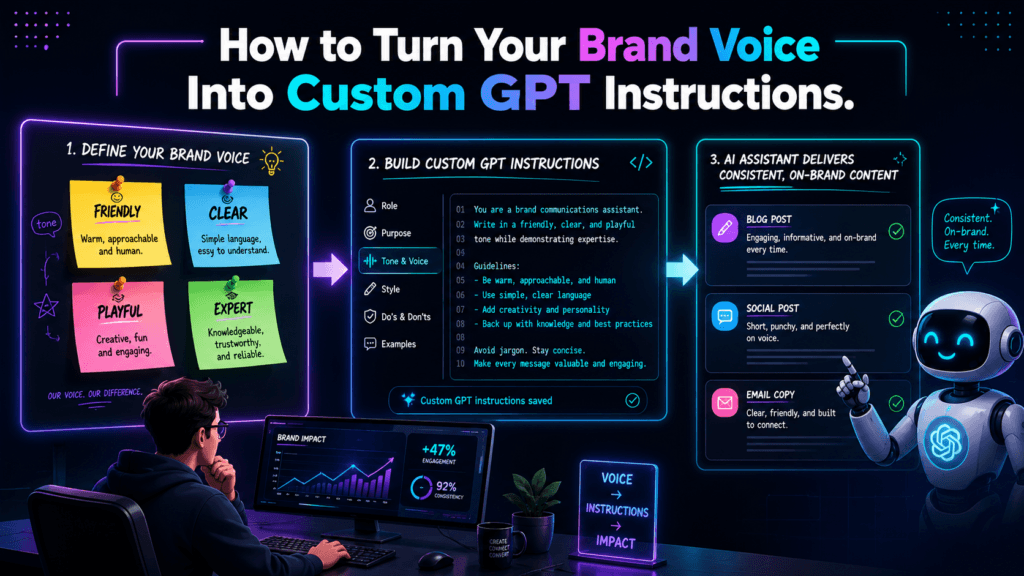
A Custom GPT is only as useful as the instructions behind it. If your brand voice is vague, your GPT will sound vague. If your brand voice is clear, specific, and structured, your GPT can become a reliable content assistant that writes closer to your actual style.
Quick Answer
To turn your brand voice into Custom GPT instructions, define your audience, tone, writing rules, formatting style, examples, banned phrases, content goals, and decision-making process. Then organize those details into clear instruction sections your GPT can follow every time.
The Pain Point
Most brands tell AI to “write in our voice,” but they never explain what that voice actually means. The result is content that sounds generic, polished, safe, and disconnected from the way the brand really communicates.
What This Guide Helps You Build
You will learn how to convert your brand personality into practical GPT instructions that control tone, structure, examples, vocabulary, CTAs, formatting, and content quality.
Why Brand Voice Instructions Matter
A Custom GPT should not just know what your business does. It should understand how your brand explains ideas, how direct or friendly it should sound, what your audience already knows, and what kind of content feels off-brand.
Brand voice is not just a list of adjectives. Saying your brand is “friendly, clear, and professional” is a start, but it is not enough for a Custom GPT. Your instructions need to explain what the GPT should actually do when it writes, edits, summarizes, recommends, or answers questions.
“Write in our brand voice. Be helpful, modern, and engaging.”
“Write in a beginner-friendly, direct, creator-focused tone. Use short paragraphs, practical examples, confident recommendations, and avoid corporate filler.”
Your brand voice changes depending on the reader. A GPT writing for first-time business owners should sound different from one writing for enterprise buyers, developers, parents, coaches, or local service businesses.
“Write for [specific audience] who want [main outcome] but struggle with [main problem]. Assume they understand [basic knowledge level], but avoid [terms, jargon, or assumptions].”
“Write for solo creators and small business owners who want to use AI tools without becoming technical experts. Assume they are smart but busy. Explain steps clearly, avoid heavy jargon, and give practical examples they can use today.”
Tone words are useful, but they need translation. “Confident” should become a writing rule. “Friendly” should become a sentence style. “Premium” should affect vocabulary, pacing, and structure.
Helpful Give direct answers, examples, and next steps instead of vague encouragement. The output feels useful, not fluffy.
A strong Custom GPT does not just match tone. It also follows your preferred format. If your brand always uses quick answers, short sections, checklists, examples, or CTA blocks, put that directly into the instructions.
The easiest way to make a GPT sound more like your brand is to show it what belongs and what does not. Keep this section practical. Avoid turning it into a giant list of banned words that makes the GPT stiff.
Examples are where your Custom GPT instructions become much stronger. Add a few short samples of writing that sound like your brand. Then add a few samples that do not sound like your brand and explain why.
“When writing social posts, use a direct hook, one clear lesson, and one practical takeaway. Avoid sounding like a motivational quote. The tone should feel like a smart creator explaining what actually works.”
Once you have your audience, tone, structure, rules, and examples, combine them into one clean instruction block. Use headings so the GPT can follow the setup consistently.
Role: You are a branded content assistant for [brand name]. Audience: Write for [specific audience] who need [main outcome]. Voice: Sound [tone traits], but never [off-brand traits]. Structure: Use [preferred format, sections, bullets, CTAs, examples]. Rules: Always [brand rules]. Avoid [banned phrases, weak habits, formatting mistakes]. Quality Bar: Make every answer clear, practical, specific, and ready to use.
Once your page has a clear answer and strong structure, the next step is to make the content more useful than the average result. Small sites do not need to publish like giant media companies. They need to publish with focus, clarity, and proof.
Add short, direct answer sections near the top of important pages so readers and AI tools can quickly understand the main point. Instead of only saying what is best, explain when it is best, who it is best for, and when someone should choose something else. Connect related articles together so your site looks like a focused resource instead of a random collection of posts. AI search optimization is the process of making your content easier for AI-powered search tools, answer engines, and generative assistants to understand, summarize, trust, and recommend. Yes. Small sites can earn visibility when they answer specific questions clearly, show useful expertise, and organize information better than larger but less focused pages. It overlaps with SEO, but it puts more pressure on clarity, structure, context, trust signals, and direct answers. Traditional SEO often focuses on ranking pages, while AI search optimization also focuses on being understandable enough to be summarized. AI can help with drafts, outlines, and research organization, but small sites should add human review, examples, opinions, firsthand details, and brand voice before publishing. Add a direct answer near the top, improve headings, remove filler, add examples, answer related questions, and make the page easier to scan on mobile.
Small sites do not need to become huge brands to compete in AI search. They need to become clearer, more useful, more specific, and easier to trust.
The winning move is not publishing more generic content. It is improving the pages that already have potential by giving better answers, stronger structure, and real-world guidance.
Start with one important article on your site. Rewrite the opening answer, improve the headings, add examples, and build a short FAQ. One upgraded page can teach you more than publishing five weak new ones.
Start by Translating Your Brand Voice Into Behavior
Weak Instruction
Stronger Instruction
Step 1: Define Who the GPT Is Writing For
Audience Instruction Template
Example
Step 2: Convert Tone Words Into Writing Rules
Tone Word
GPT Rule
Content Result
Tone Translation Checklist
Step 3: Give the GPT a Content Structure
Simple Brand Content Workflow
Step 4: Add “Do” and “Avoid” Rules
Do
Avoid
Step 5: Add Real Examples of Your Voice
Example Instruction
Step 6: Create a Final Custom GPT Instruction Block
Copyable Custom GPT Instruction Framework
Advanced Fixes for Better AI Search Visibility
Use Answer Blocks
Add Decision Rules
Build Topic Clusters
Common Mistakes to Avoid
FAQ
What is AI search optimization?
Can small sites show up in AI search?
Is AI search optimization different from SEO?
Should small sites use AI to write content?
What is the fastest fix for an old post?
Final Takeaway
Ready to Improve Your AI Search Visibility?
Want more TechnofluxAI in Google?
Add TechnofluxAI as a Preferred Source to help Google show you more of our AI guides, tests, workflows, and research.