

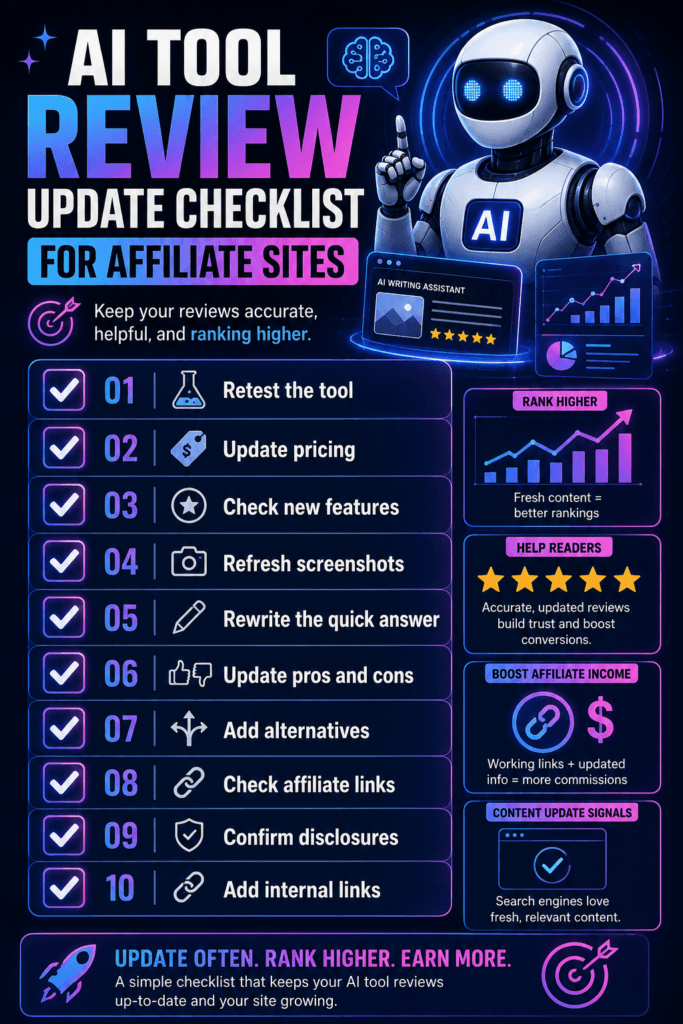
AI Tool Review Update Checklist for Affiliate Sites
AI tool reviews age fast. Pricing shifts, features move, free plans disappear, screenshots become outdated, competitors improve, and affiliate recommendations can quietly become wrong.
Quick Answer
An AI tool review update should check pricing, plan limits, feature changes, screenshots, affiliate disclosures, alternatives, real-use examples, pros and cons, dates, schema, internal links, and whether the recommendation still matches the reader’s actual use case.
The Pain Point
Many affiliate sites publish a review once, add links, and move on. That page might still rank, but the advice becomes outdated. As trust drops, conversions weaken and readers are more likely to bounce to a fresher competitor.
What This Checklist Helps You Do
Use this checklist to refresh AI tool reviews with stronger accuracy, clearer recommendations, better buyer guidance, cleaner affiliate compliance, and more useful SEO structure.
Why Review Updates Matter More for AI Tools
AI software changes faster than many traditional products. A review from six months ago may now have the wrong pricing, missing features, outdated limits, old screenshots, or a recommendation that no longer makes sense.
The Core Rule: Do Not Just Change the Date
Updating an AI tool review does not mean changing the published date and calling it fresh. A real update improves accuracy, usefulness, trust, and conversion quality. Your main goal is to make the page better for readers who are deciding whether a tool is worth using now.
Weak Update
Change the year, swap one paragraph, leave the old screenshots, and keep the same recommendation.
Strong Update
Retest the tool, verify pricing, update screenshots, revise pros and cons, compare alternatives, and explain who should still use it.
1. Verify Pricing, Free Plan Limits, and Trial Details
Pricing is one of the first things to go stale in AI tool reviews. Check the official pricing page, plan names, monthly versus annual pricing, free plan limits, credit systems, usage caps, team seats, watermark rules, API costs, and trial terms.
Pricing Update Checklist
- Plan names are current.
- Monthly and yearly prices are accurate.
- Free plan limits are correct.
- Trial length and requirements are updated.
- Credit, token, export, or generation limits are explained clearly.
- Affiliate buttons do not promise outdated discounts.
2. Retest the Main Use Case
A review is stronger when it explains what the tool actually does in a real workflow. For an AI writing tool, test a blog intro, outline, rewrite, and email. Image tools should be checked with product images, social graphics, and brand consistency tasks. Automation tools need a fresh look at setup flow, integrations, and output quality.
Simple Retesting Workflow
- Choose one practical task your reader would actually do.
- Run the task using the current version of the tool.
- Save notes on speed, quality, limits, and friction.
- Capture fresh screenshots where helpful.
- Update the review with what changed since the last test.
3. Update Screenshots, Interface Notes, and Feature Names
AI tools change dashboards often. Old screenshots can make your site look abandoned, even when the written review is still useful. Replace images that show outdated menus, old branding, removed features, wrong pricing, or workflows that no longer exist.
Screenshot Review Questions
- Does the dashboard still look like this?
- Are feature names still correct?
- Could the screenshot reveal sensitive account information?
- Will this image support the buying decision?
- Does the alt text describe the image clearly?
4. Rebuild the Recommendation Section
Your recommendation should not be locked forever. If a tool has become more expensive, less reliable, better for teams, worse for beginners, or stronger for a specific use case, say that clearly.
Good For
Name the reader type that should use the tool, such as solo creators, agencies, ecommerce teams, local businesses, or advanced AI users.
Not Good For
Explain who should skip it. This builds more trust than pretending every affiliate tool is perfect for everyone.
Best Alternative
Mention the strongest alternative when the tool is not the best fit. That path keeps the review helpful and improves internal linking.
5. Refresh Pros, Cons, and Product Evolution
A useful review explains how the product has changed. Did it add better templates, remove a free feature, improve output quality, add team controls, become more expensive, or fall behind competitors? Those changes help readers make a smarter decision.
Product Evolution Prompts
- What has improved since the last review?
- Where has the tool become worse or more limited?
- Which features were added or removed?
- Has the tool changed its target audience?
- Is the tool still worth the price?
6. Check Affiliate Disclosure Placement
Affiliate review updates should always include a disclosure check. Make sure your disclosure is easy to see before or near affiliate links, written in plain language, and not hidden in a footer, tiny font, tooltip, or terms page.
Disclosure Reminder
A simple disclosure such as “We may earn a commission if you buy through links on this page, at no extra cost to you” is clearer than vague language like “partner links may be present.”
7. Improve Internal Links and Comparison Paths
A refreshed review should guide readers to the next best page. Add internal links to comparison posts, alternatives, pricing guides, use-case articles, tutorials, and “best tools” roundups where relevant.
8. Update SEO, Schema, and AI Search Signals
Review updates should also improve the technical and structural parts of the page. Check the title, meta description, headings, table of contents, review summary, FAQ section, product schema, author details, and last-updated note.
AI Search Visibility Checklist
- Add a short review summary near the top.
- Use clear headings that match real buyer questions.
- Include updated pros and cons.
- Explain who the tool is best for.
- Add practical examples from actual use.
- Answer common follow-up questions in the FAQ.
- Show when the review was last updated.
Advanced AI Tool Review Update System
The best affiliate sites do not update reviews randomly. Instead, they use a repeatable system. Each review should have an update rhythm based on traffic, conversions, product volatility, ranking value, and how quickly the tool changes.
Monthly
Update high-traffic reviews, major affiliate earners, fast-changing AI tools, and pages where pricing or features shift often.
Quarterly
Refresh stable reviews, comparison posts, “best tools” lists, and pages that still bring traffic but need stronger recommendations.
Immediately
Update when a tool changes pricing, removes a free plan, launches a major feature, has reliability issues, or changes its affiliate program.
Common Mistakes to Avoid
- Updating the date without retesting the tool.
- Keeping outdated screenshots because replacing them takes time.
- Recommending the highest-commission tool instead of the best fit.
- Ignoring free plan limits, credit systems, and usage caps.
- Writing only positives and hiding real drawbacks.
- Forgetting to check affiliate disclosure placement.
- Leaving broken affiliate links or expired discount claims.
- Not explaining who should avoid the tool.
FAQ
How often should affiliate sites update AI tool reviews?
High-traffic and high-converting AI tool reviews should be checked at least monthly. Lower-priority reviews can often be refreshed quarterly, unless the tool changes pricing, features, or affiliate terms sooner.
What is the most important part of an AI tool review update?
Recommendation accuracy matters most. Pricing, features, competitors, and user experience can all change whether the tool still deserves the same rating or placement.
Should I say when the review was last updated?
Yes. A visible last-updated note helps readers understand that the review has been checked recently, especially in fast-moving AI software categories.
Should I remove old AI tool reviews?
Remove or redirect a review if the tool is dead, unsafe, irrelevant, or impossible to recommend. When the tool still has search value, consider updating the page into an alternatives guide instead.
Do affiliate disclosures hurt conversions?
Clear disclosures should not be treated as a conversion problem. They build trust, set expectations, and help readers understand your relationship with the products you recommend.
Final Takeaway
AI tool reviews are not one-time assets. Treat them as living affiliate pages.
Winning sites keep reviews accurate, specific, transparent, and useful. Update the recommendation, not just the date. Retest the product, check the pricing, refresh the examples, and make the page easier for readers to trust.
Build a Smarter Affiliate Review System
Pick your top five AI tool reviews and run this checklist today. Start with pricing, screenshots, affiliate disclosures, recommendation accuracy, and competitor alternatives. Small updates can protect rankings, improve trust, and make your reviews more useful.
Explore More Affiliate SEO Guides
About the Author
Jon Hicks
Founder of TechnofluxAI.
I’m the creator behind TechnofluxAI, focused on breaking down powerful AI tools, emerging trends, and practical strategies to help creators and entrepreneurs stay ahead in a rapidly evolving digital world.
Follow TechnofluxAI for the latest AI tools & strategies
Want more TechnofluxAI in Google?
Add TechnofluxAI as a Preferred Source to help Google show you more of our AI guides, tests, workflows, and research.