

Estimated reading time: 11 minutes
Reusable AI Prompt Templates for Blog Post Updates
Updating old blog posts is one of the fastest ways to improve your content without starting from zero. The problem is that most bloggers do it randomly. These reusable AI prompt templates help you refresh posts with a repeatable system.
Quick Answer
The best AI prompt templates for blog post updates help you audit outdated content, improve introductions, refresh examples, add missing sections, strengthen SEO, create FAQs, improve readability, and repurpose the updated post into social content.
The Real Problem
Most blog updates fail because people only change the title, add a few new words, and hit publish. A real update should improve accuracy, usefulness, search intent, structure, examples, internal links, and reader trust.
What This Guide Will Help You Do
This guide gives you reusable AI prompts you can copy, customize, and use whenever you refresh an old blog post. You will learn how to review content, find weak sections, update old information, improve SEO, add helpful depth, and turn one refreshed article into multiple content assets.
Next step: Choose one older blog post with traffic potential, then use the audit prompt below before making any edits.
Why Reusable Prompts Make Blog Updates Easier
Blog updates become easier when you stop treating each post like a brand-new project. A reusable prompt gives AI a consistent job: inspect the article, find weak spots, suggest improvements, and help you rewrite specific sections without changing your entire voice.
The goal is not to let AI blindly rewrite everything. The goal is to use AI as a content update assistant. You stay in charge of accuracy, judgment, brand voice, and publishing decisions.
Random Blog Update
You skim the post, change a few paragraphs, maybe add one heading, and hope the update helps.
Prompt-Based Blog Update
You run a structured audit, identify missing value, update sections by priority, improve search intent, and document what changed.
1. Blog Post Audit Prompt
Start every update with an audit. This prevents you from editing randomly and helps you see what the post actually needs.
Prompt Template
Act as an SEO content editor. Review the blog post below and identify what should be updated. Focus on outdated information, weak explanations, missing subtopics, search intent gaps, unclear sections, thin examples, poor internal linking opportunities, and FAQ opportunities. Return your response in this format: Summary of current weaknesses, highest-priority updates, sections to rewrite, new sections to add, internal link ideas, FAQ ideas, and quick wins.
When to Use It
Use this before editing any older post, especially posts that used to rank, posts with declining traffic, posts with outdated tools, or posts that feel too short compared with newer competitors.
2. Search Intent Refresh Prompt
Search intent changes over time. A post that worked two years ago may now feel incomplete because readers expect examples, comparisons, tools, workflows, or direct answers.
Prompt Template
Analyze this blog post for search intent alignment. The target keyword is: [insert keyword]. The target reader is: [insert reader]. Identify whether the post fully satisfies the likely intent behind this keyword. Tell me what the reader probably wants to know, what the current post answers well, what it misses, what should be removed, and what should be added to make the article more useful.
Good For
Posts that rank on page two, posts with high impressions but low clicks, and posts that feel too broad.
Watch Out For
Do not expand a post just to make it longer. Add sections only when they help the reader solve the problem faster.
3. Introduction Rewrite Prompt
Old introductions often waste space. They start too slowly, over-explain the topic, or sound generic. A strong updated intro should quickly confirm the reader is in the right place.
Prompt Template
Rewrite the introduction for this blog post. Make it clearer, more direct, and more useful for a beginner reader. Include the reader’s pain point, a quick explanation of what the article covers, and a reason to keep reading. Avoid hype, filler, corporate language, and generic phrases. Keep the tone practical and human.
Update Tip
Do not let AI make the intro sound too polished. The best blog intros usually feel clear, useful, and specific, not dramatic.
4. Outdated Information Update Prompt
If your article mentions tools, pricing, platforms, screenshots, policies, statistics, plugins, rankings, or recent trends, those sections need extra review.
Prompt Template
Review this blog post and flag any information that may be outdated, time-sensitive, unsupported, or risky to keep as-is. Pay close attention to tools, prices, dates, statistics, platform features, screenshots, product recommendations, laws, policies, and trend claims. Create a table with the section, the issue, why it may be outdated, and what I should verify before publishing.
Important Warning
AI can flag possible outdated sections, but it cannot replace verification. Always check current facts before publishing updates that mention prices, tool features, legal rules, medical topics, financial claims, or recent events.
5. Add Missing Sections Prompt
A blog post update is not only about fixing what is already there. Sometimes the biggest improvement comes from adding a missing section that readers now expect.
Prompt Template
Suggest new sections that would make this blog post more complete and helpful. Focus on beginner questions, practical examples, step-by-step guidance, comparison points, mistakes to avoid, checklists, templates, and FAQ opportunities. For each suggested section, explain why it helps the reader and where it should be placed in the article.
6. Practical Example Generator Prompt
Examples make updated content feel more useful. If an old post explains a concept but does not show how it works, use AI to create examples you can edit and personalize.
Prompt Template
Create practical examples for this section of my blog post. The target reader is [insert reader]. The topic is [insert topic]. Give me three examples: one beginner example, one small business example, and one content creator example. Keep the examples realistic, specific, and easy to understand.
Weak Update
Adding one generic paragraph that repeats what the article already said.
Strong Update
Adding examples that show how different readers can apply the idea in real situations.
7. Internal Link Prompt
Internal links help readers move through your site and help search engines understand how your topics connect. Blog updates are a perfect time to improve internal linking.
Prompt Template
Review this blog post and suggest internal link opportunities. I will provide a list of existing related pages below. Recommend where each link should be placed, what anchor text to use, and why the link helps the reader. Avoid forcing links where they do not naturally fit.
Pages Worth Linking To
- Related beginner guides
- Service pages
- Comparison articles
- Case studies
- Tool tutorials
- Downloadable resources
- Author bio or expertise pages
- Content hubs or category pages
8. FAQ Expansion Prompt
Adding a useful FAQ section can make a refreshed post more complete, especially when the topic has beginner questions or common objections.
Prompt Template
Create an FAQ section for this updated blog post. Write questions a beginner reader would actually ask. Avoid obvious filler questions. Each answer should be concise, helpful, and specific. Include one question about mistakes to avoid and one question about what to do next.
9. Readability Improvement Prompt
A post can have good information and still be hard to read. Use this prompt when your article has long paragraphs, stiff wording, confusing transitions, or too much jargon.
Prompt Template
Improve the readability of this section without changing the meaning. Make the writing clearer, more direct, and easier for a beginner to follow. Break up long sentences, remove filler, simplify jargon, and keep the tone practical. Do not add claims or new facts unless clearly marked as suggestions.
10. Meta Description and Title Refresh Prompt
Updating the content without reviewing the title and meta description is a missed opportunity. Your refreshed post should have a clear search result preview.
Prompt Template
Based on this updated blog post, create five SEO title options and five meta description options. The focus keyword is [insert keyword]. Keep the titles clear and clickable without exaggeration. Keep the meta descriptions concise, specific, and useful. Avoid fake urgency, hype, and keyword stuffing.
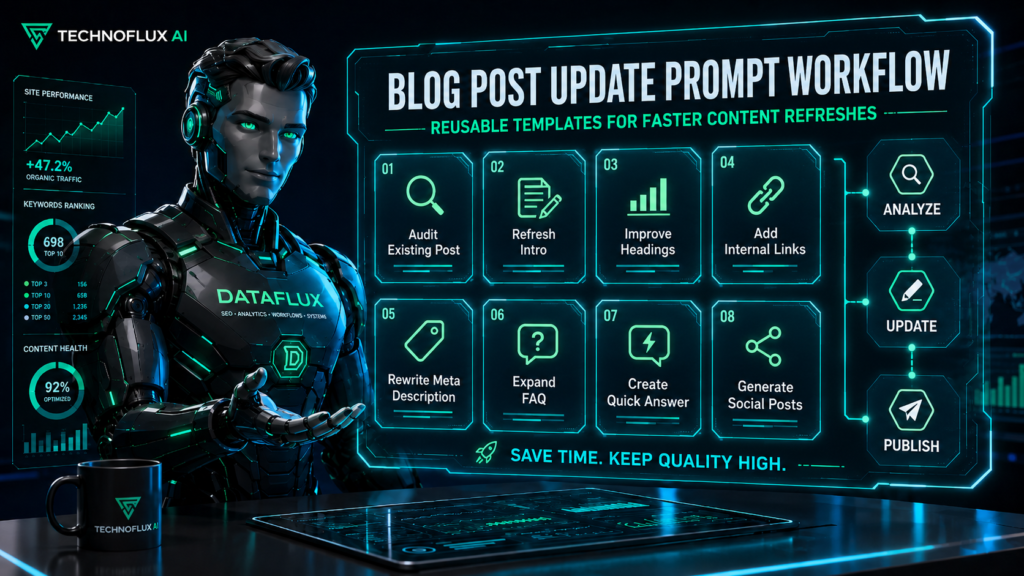
Simple Blog Update Workflow Using AI Prompts
Step 1
Run the audit prompt and identify the biggest problems.
Step 2
Check search intent and decide what the article needs to answer better.
Step 3
Rewrite weak sections, add examples, and improve readability.
Step 4
Add internal links, FAQs, title options, and a final update note.
Advanced Tips for Better Blog Update Prompts
Reusable prompts work best when they include context. The more clearly you explain the post, audience, goal, and constraints, the better the AI output will be.
Include the Reader
Tell AI whether the post is for beginners, business owners, creators, advanced users, parents, freelancers, or another specific audience.
Give the Goal
Say whether the update should improve SEO, add depth, fix outdated information, make the post more beginner-friendly, or prepare it for republishing.
Set Boundaries
Tell AI what not to do. For example, do not invent statistics, do not add fake examples, do not change the brand voice, and do not make unsupported claims.
Common Mistakes to Avoid
- Asking AI to update everything at once: Break the work into audit, rewrite, examples, FAQ, links, and metadata.
- Skipping fact-checking: AI can help flag issues, but you still need to verify current information.
- Using vague prompts: “Make this better” usually creates generic results.
- Letting AI remove your voice: Keep your original style where it works.
- Adding filler sections: New sections should solve real reader questions, not just increase word count.
- Ignoring internal links: Updated posts should connect to newer, relevant pages on your site.
- Forgetting the final review: Always read the post like a human before publishing.
Final Blog Update Prompt Bundle
Use this full prompt when you want one complete update plan before editing the article.
All-in-One Prompt Template
Act as an SEO content editor and blog update strategist. Review the blog post below for a full content refresh. The target keyword is [insert keyword]. The target reader is [insert reader]. The goal of this update is [insert goal]. Identify outdated information, search intent gaps, weak sections, missing examples, internal link opportunities, FAQ opportunities, readability issues, and title or meta description improvements. Do not invent statistics, credentials, links, or facts. Return a prioritized update plan with quick wins, major edits, new sections, rewrite suggestions, verification notes, and a final publishing checklist.
FAQ: Reusable AI Prompt Templates for Blog Post Updates
Can AI update an entire blog post for me?
AI can help update a blog post, but you should still review the final version. Use AI for audits, rewrites, examples, FAQs, summaries, and structure. Keep human control over facts, voice, judgment, and publishing.
What is the best first prompt to use?
Start with a blog post audit prompt. It helps you understand what the article needs before you spend time rewriting sections that may not matter.
Should I use the same prompt for every blog update?
Use the same prompt structure, but customize the keyword, reader, goal, and article context. Reusable prompts work best when they are flexible, not copied blindly.
Can AI help with SEO when updating old posts?
Yes. AI can help identify search intent gaps, missing subtopics, internal link opportunities, FAQ ideas, title options, and readability issues. You still need to verify facts and make final SEO decisions.
How often should I update blog posts?
Review important posts every few months, especially if they target competitive keywords, mention tools, include dated examples, or bring in traffic, leads, or affiliate revenue.
Final Takeaway
Reusable AI prompts make blog updates faster, but the real advantage is consistency. Instead of guessing what to improve, you can run the same update system across your older posts: audit, refresh, expand, verify, optimize, and republish with confidence.
CTA
Want a faster way to refresh your old content? Pick one post, copy the all-in-one prompt above, and build a repeatable update workflow you can use every month.
Request an AI Content Refresh Review