

Estimated reading time: 9 minutes
Affiliate Blogging Template
AI Tool Comparison Template for Affiliate Bloggers
AI tool roundups can convert well, but only when they help readers make a real decision. Strong comparison posts do more than list features. They explain who each tool is best for, where it falls short, and which option fits the reader’s actual use case.
Quick Answer
The best AI tool comparison template includes a clear affiliate disclosure, quick recommendation table, “best for” labels, pricing snapshot, feature comparison, hands-on testing notes, pros and cons, use-case recommendations, alternatives, FAQs, and a final buying decision guide.
The Pain Point
Many affiliate comparison posts feel fake because they praise every tool equally. Readers do not need another generic list. What they need is a clear reason to choose one tool over another.
What This Template Helps You Build
This guide gives affiliate bloggers a reusable structure for AI software roundups, “best AI tools” posts, direct tool comparisons, and buyer guides.
You can use it for AI writing tools, SEO tools, image generators, automation platforms, chatbot builders, AI video tools, productivity apps, email marketing software, and no-code AI platforms.
Soft internal link suggestion: Add a link here to your related guide on “How to Write AI Tool Reviews That Convert” or “Affiliate SEO for AI Software Blogs.”
Why Affiliate Bloggers Need a Better AI Tool Comparison Format
AI tool affiliate content is crowded. A basic roundup that says “Tool A is great, Tool B is powerful, Tool C is beginner-friendly” is not enough. Readers want proof, context, tradeoffs, and a recommendation they can trust.
Helpful comparison content should serve the reader before it serves the commission. For affiliate bloggers, that means your post should explain real decision factors instead of simply pushing the highest-paying product.
Weak Affiliate Comparison
Lists 10 tools, repeats the sales-page features, adds affiliate buttons, and gives no clear winner for specific users.
Strong Affiliate Comparison
Compares tools by use case, budget, learning curve, output quality, integrations, limits, support, and who should avoid each option.
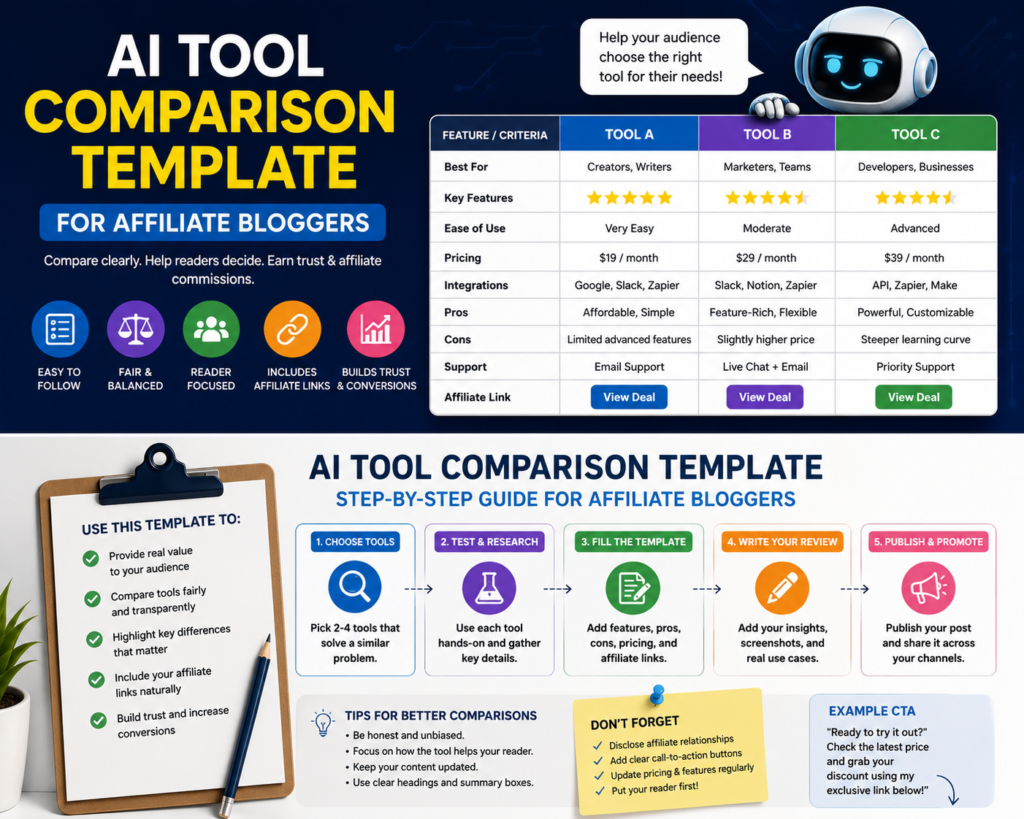
The AI Tool Comparison Template
Use this structure as your default layout for affiliate comparison posts. Smaller comparisons can use a shorter version. Competitive “best tools” articles may need the full framework.
Recommended Post Structure
- Affiliate disclosure: Explain that the post may contain affiliate links.
- Quick verdict: Name the best overall tool and who it is best for.
- Comparison table: Show pricing, best use case, free plan, standout feature, and main drawback.
- Testing method: Explain how you evaluated the tools.
- Individual reviews: Cover each tool with pros, cons, pricing notes, and ideal user.
- Use-case recommendations: Recommend tools for beginners, agencies, creators, bloggers, teams, or budget users.
- Alternatives: Mention tools that did not make the top list and why.
- FAQ: Answer buying questions and comparison questions.
- Final recommendation: Help the reader choose based on their situation.
Section 1: Affiliate Disclosure
Do not hide your disclosure at the bottom of the page. Place it near the top before the buying recommendations. Keep the wording simple and human.
Disclosure Template
“This article may contain affiliate links. If you buy through one of these links, we may earn a commission at no extra cost to you. We only recommend tools based on usefulness, fit, and research.”
Section 2: Quick Verdict Box
Many readers want the answer fast. Give them a quick verdict before the detailed reviews. This also helps search engines and AI answer engines understand the core recommendation.
Quick Verdict Template
Best overall: [Tool Name] — best for [specific user/use case].
Best budget option: [Tool Name] — best for [specific user/use case].
Best for teams: [Tool Name] — best for [specific user/use case].
Best for beginners: [Tool Name] — best for [specific user/use case].
Section 3: AI Tool Comparison Table
Your comparison table should not be overloaded. Readers need the decision-making details first. Deeper feature breakdowns can go below the table.
| Tool | Best For | Free Plan | Standout Feature | Main Drawback | Affiliate CTA |
|---|---|---|---|---|---|
| [Tool A] | Best overall for [user] | Yes / No / Trial | [Feature] | [Drawback] | Try [Tool A] |
| [Tool B] | Best budget option | Yes / No / Trial | [Feature] | [Drawback] | Try [Tool B] |
| [Tool C] | Best for teams | Yes / No / Trial | [Feature] | [Drawback] | Try [Tool C] |
Section 4: Testing Method
Trustworthy comparison posts explain how the tools were evaluated. Even a simple testing method gives readers more confidence than a list of copied feature claims.
Testing Method Template
- Review each tool’s core features, pricing page, free plan or trial, and target use case.
- Test every tool with the same task: [insert task].
- Compare output quality, ease of use, setup time, integrations, export options, and limitations.
- Consider which users benefit most from each tool instead of ranking only by feature count.
Section 5: Individual Tool Review Template
Each tool review should follow the same structure so readers can compare options fairly. Do not write one tool review like a sales page and another like a quick note.
Copy-and-Paste Tool Review Block
Tool name: [Tool Name]
Best for: [Specific audience or use case]
What it does: [Plain-English explanation]
Why it stands out: [Main advantage]
Where it falls short: [Real limitation]
Pricing note: [Free plan, trial, starter price, or “check current pricing”]
Best alternative: [Alternative tool]
CTA: Try [Tool Name]
Section 6: Use-Case Recommendation Cards
The best affiliate comparisons do not force one winner for everyone. They match tools to reader situations.
Best for Beginners
Choose [Tool Name] if you want the simplest setup, clean interface, and fast results without a steep learning curve.
Best for Agencies
Choose [Tool Name] if you need team seats, client workspaces, repeatable templates, approval workflows, or bulk output.
Best Budget Pick
Choose [Tool Name] if you want enough features to start without paying for advanced functions you will not use yet.
Affiliate Blogger Comparison Checklist
Before You Publish, Check This
- Is the affiliate disclosure visible near the top?
- Does the post give a quick verdict?
- Does every tool have a clear “best for” label?
- Did you explain how you compared the tools?
- Did you include drawbacks for every tool?
- Are pricing notes current or clearly marked as subject to change?
- Are recommendations based on reader use cases?
- Did you avoid copying only sales-page claims?
- Does the FAQ answer buying objections?
- Are affiliate buttons natural and not excessive?
TechnofluxAI
Practical AI for creators and website owners
Learn how to use AI, improve AI search visibility, build smarter workflows, and test what actually works.
Explore our other sites
TimewasterAI
— product reviews, buying guides, and useful finds.
Tina Trends
— fashion, beauty, pets, lifestyle, and fun discoveries.
Mistakenly Delicious
— simple recipes and practical cooking ideas.
Advanced Tips for AI Tool Affiliate Comparisons
Once your template is in place, the next step is to make the comparison more useful than the tool websites themselves. Your advantage as an affiliate blogger is not access to features. It is interpretation.
Add a Decision Filter
Help readers self-select. Use lines like: “Choose this if you need speed. Avoid this if you need advanced customization.”
Show Real Prompts or Tasks
For AI tools, compare them using the same real task. Example: one blog outline, one email sequence, one image prompt, or one automation workflow.
Update the Post Regularly
AI tools change fast. Add a “last updated” note and schedule refreshes for pricing, features, free plans, screenshots, and limitations.
Common Mistakes to Avoid
Avoid These Affiliate Comparison Mistakes
- Ranking by commission instead of reader fit. Readers can usually feel when the recommendation is forced.
- Calling every tool “best.” If everything is best, nothing is useful.
- Skipping drawbacks. Honest limitations make recommendations more trustworthy.
- Using outdated pricing. AI SaaS pricing changes often, so include a “check current pricing” note.
- Writing only feature summaries. Explain what the features actually mean for the user.
- Not testing the same task across tools. A fair comparison needs a consistent evaluation method.
- Hiding affiliate disclosures. Make the relationship easy to understand before readers click.
FAQ: AI Tool Comparison Templates for Affiliate Bloggers
What should an AI tool comparison post include?
It should include an affiliate disclosure, quick verdict, comparison table, testing method, individual tool reviews, pros and cons, use-case recommendations, alternatives, FAQs, and a final recommendation.
How many AI tools should I compare in one post?
For a direct comparison, two to four tools is usually enough. For a roundup post, five to ten tools can work, but only if each tool gets a meaningful review and clear use-case label.
Where should I put affiliate links?
Place affiliate links after helpful context, such as in the quick verdict, comparison table, individual review sections, and final recommendation. Avoid stuffing links into every paragraph.
Should I include tools I do not recommend?
Yes, when it helps the reader. Mentioning tools that did not make the final list can make your comparison more useful, especially if you explain why they were excluded.
How do I make an AI tool review sound trustworthy?
Use specific testing notes, screenshots, real use cases, clear drawbacks, pricing context, and honest recommendations. Avoid repeating only the tool’s marketing copy.
Can I use AI to write affiliate comparison posts?
Yes, but do not publish generic AI output without review. Use AI to draft structure, summarize notes, create tables, and generate FAQs, then add your own testing, judgment, screenshots, examples, and final recommendations.
Final Takeaway
A strong AI tool comparison post does not just say which product is “best.” It helps readers understand which tool is best for their budget, skill level, workflow, and goal. The more specific your comparison is, the more useful it becomes for readers, search engines, and AI answer engines.
CTA
Want more affiliate blogging systems for AI tools, SaaS reviews, and comparison content? Explore more TechnofluxAI guides built for creators who want practical templates, not generic advice.
Want more TechnofluxAI in Google?
Add TechnofluxAI as a Preferred Source to help Google show you more of our AI guides, tests, workflows, and research.