Estimated reading time: 10 minutes
Key Takeaways
- AI content can rank on Google if it is helpful, original, and valuable to readers.
- Google focuses on content quality rather than the method of creation; AI tools can assist bloggers without penalties.
- Common mistakes include publishing raw AI outputs without editing and failing to optimize for SEO basics.
- To rank better, bloggers should enhance AI content with personal insights, original images, and clear formatting.
- Successful use of AI in blogging involves treating it as a tool for productivity, while maintaining human creativity and oversight.
Artificial intelligence tools are changing how content is created online. Bloggers, marketers, and creators are increasingly using AI writing assistants to generate ideas, outlines, and even full articles. But one important question continues to come up:
Can AI content rank on Google?
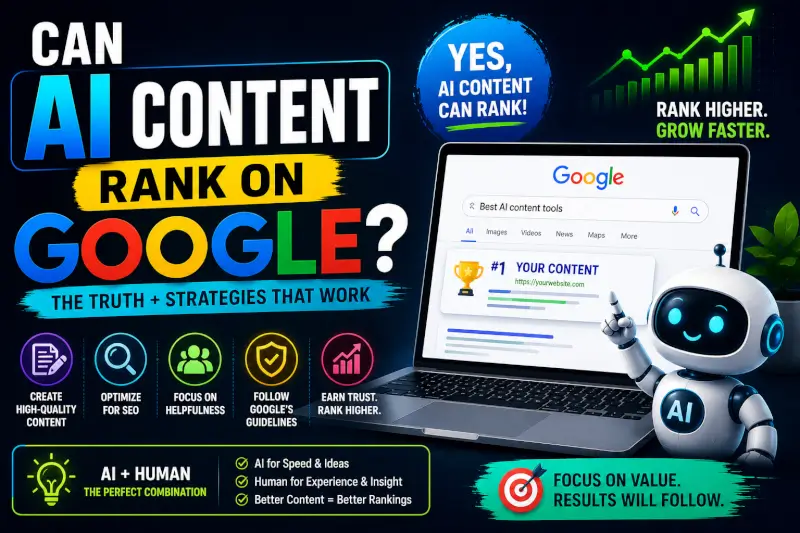
The short answer is yes — AI content can rank on Google, but only when it provides real value to readers. Search engines are focused on the quality and usefulness of content rather than how it was created.
In this article, we’ll explore how AI-generated content works with search engines and how creators can use AI responsibly while still producing content that ranks.

Can AI Content Rank on Google? What Bloggers Need to Know
AI content is everywhere right now. Bloggers are using tools like ChatGPT, Jasper, Claude, and other writing assistants to speed up content creation, generate ideas, write outlines, and even produce full articles in minutes.
But there is still one big question many bloggers ask before publishing anything written with AI:
Can AI content rank on Google?
The short answer is yes. AI content can absolutely rank on Google if it is helpful, original, accurate, and valuable to readers.
Google does not automatically penalize content just because it was created with AI. What Google cares about is the quality of the content itself. If a post solves a problem, answers a question, and provides useful information, it has a chance to rank no matter how it was written.
That said, not all AI content performs well. Thin, repetitive, low-quality content often struggles to rank and can even hurt a site over time. Bloggers who rely too heavily on raw AI output without editing, improving, or fact-checking their content may see poor results.
Does Google Allow AI Content?
Google has made it clear that it does not ban AI-generated content. Instead, Google focuses on whether the content is helpful and created for people.
In other words, Google does not care if a human wrote every sentence or if AI helped along the way. What matters is whether the final article is useful, trustworthy, and relevant.
This is good news for bloggers because AI tools can save a huge amount of time. They can help with:
- Generating blog ideas
- Creating outlines
- Writing introductions
- Suggesting headlines
- Building FAQ sections
- Rewriting awkward sentences
- Speeding up research
- Creating meta descriptions
Used correctly, AI can help bloggers publish more content without sacrificing quality.
Why Some AI Content Fails to Rank
Even though AI content can rank, a lot of it still fails.
One of the biggest reasons is that many bloggers simply copy and paste whatever the AI tool gives them without making improvements. That usually leads to generic articles that sound robotic and offer little value.
For example, if hundreds of websites publish almost identical AI-generated articles about the same topic, Google has no reason to rank all of them highly.
Low-quality AI content often has these problems:
- Repetitive wording
- Generic advice
- No personal experience
- No examples
- Weak introductions
- Thin information
- Poor formatting
- No internal links
- No original insights
Google wants content that stands out. If your article looks exactly like every other article on the internet, it will be much harder to rank.
What Makes AI Content Rank Better?
The bloggers who get the best results with AI are usually the ones who treat it like a helper, not a replacement.
Instead of publishing raw AI text, they improve it with their own ideas, examples, formatting, opinions, screenshots, and personal experiences.
Some of the best ways to improve AI content include:
Add Personal Experience
If you have used the tool, product, or strategy you are writing about, talk about your experience.
For example, instead of saying:
“AI writing tools can save time.”
You could say:
“I used ChatGPT to create outlines for five blog posts in one afternoon, which cut my content planning time in half.”
That feels more real, more useful, and more trustworthy.
Use Better Formatting
Large blocks of text can make content harder to read. Break your article into short paragraphs, bullet points, headings, and numbered lists.
This improves the user experience and can increase time on page.
A well-formatted article is also more likely to earn featured snippets in Google.
Add Original Images
Screenshots, charts, graphics, and custom images can make your content more unique.
If you are reviewing an AI tool, include screenshots of the dashboard, features, pricing page, or results you got from using it.
Original visuals can help your content stand out from competing articles.
Add Internal Links
Internal links are important for SEO because they help Google understand how your content is connected.
For example, if you publish an article about AI content ranking, you could also link to related posts such as:
- Best AI SEO Tools for Bloggers
- Best ChatGPT Prompts for Bloggers
- How to Use AI Tools for Beginners
- Best AI Writing Tools in 2026
Internal links also keep readers on your site longer.
Answer Real Questions
One of the easiest ways to improve AI content is to answer questions real people are already asking.
Examples include:
- Does Google penalize AI content?
- Can ChatGPT articles rank?
- Is AI content bad for SEO?
- How much AI content is too much?
- Should bloggers edit AI-written posts?
Adding FAQ sections can help your article appear in featured snippets and People Also Ask boxes.

Can ChatGPT Content Rank on Google?
Yes, content written with ChatGPT can rank on Google.
In fact, many bloggers are already using ChatGPT to create articles, outlines, product descriptions, FAQs, and social media content.
However, ChatGPT works best when combined with human editing.
If you ask ChatGPT to write a full article and publish it exactly as it comes out, the content may sound too broad or repetitive.
A better approach is to use ChatGPT for:
- Brainstorming ideas
- Creating outlines
- Writing rough drafts
- Generating title ideas
- Creating FAQ sections
- Improving readability
- Rewriting sections
Then you can add your own voice, examples, and expertise before publishing.
This combination is often much stronger than relying entirely on AI or entirely on manual writing.
Common AI Content Mistakes to Avoid
Many bloggers make the mistake of publishing too much AI content too quickly without checking quality.
This can hurt rankings over time.
Some common mistakes include:
Publishing Without Editing
Always review your AI-generated content before posting it.
Check for spelling mistakes, awkward wording, inaccurate information, and repetitive phrases.
Ignoring SEO Basics
Even great content can struggle if it is not optimized.
Make sure your post includes:
- A target keyword
- A strong title
- Proper headings
- Internal links
- A meta description
- Alt text for images
- A clean URL slug
Creating Thin Content
A 400-word article with generic advice is unlikely to compete against a detailed 2,000-word guide.
Whenever possible, go deeper than your competitors.
Add examples, tips, screenshots, FAQs, and useful resources.
Using AI for Topics You Do Not Understand
AI can sometimes provide incorrect information, especially on technical, financial, or legal topics.
Always fact-check important claims before publishing.
The Best Way to Use AI for Blogging
The smartest bloggers use AI to work faster, not to avoid effort completely.
AI is best used as a productivity tool.
For example, you can use it to:
- Find keyword ideas
- Create outlines
- Write first drafts
- Build FAQ sections
- Rewrite weak paragraphs
- Create social media captions
- Generate email subject lines
- Brainstorm Pinterest titles
This can save hours every week and help you publish more content consistently.
At the same time, you still need human input.
Your voice, opinions, experiences, examples, and formatting are what make the content feel real.
Google’s View on AI-Generated Content
According to Google, the most important factor in ranking content is whether it is helpful and valuable for users.
Google’s guidelines emphasize:
- helpful information
- trustworthy sources
- clear expertise
- useful answers to search queries
This means content created with AI tools like ChatGPT or Claude can still rank if it meets those standards.
Google is not focused on whether AI was used. Instead, it evaluates whether the final content helps people find the information they need.
When AI Content Can Rank
AI-generated content can rank well when it is used as a tool to assist human creators rather than replace them entirely.
Many bloggers use AI to help with:
- brainstorming article ideas
- generating outlines
- drafting initial content
- summarizing research
After the AI produces a draft, the writer edits and improves the content. This combination of AI assistance and human editing often produces the best results.
When the final article is accurate, helpful, and well-structured, it can rank just like any other piece of content.
When AI Content Struggles to Rank
AI content may struggle to rank when it is produced in large quantities without proper editing or research.
Common problems include:
- generic information
- repeated ideas
- lack of expertise
- inaccurate facts
Search engines are becoming better at identifying low-quality content. Articles that are rushed or poorly written usually perform poorly regardless of whether they were written by humans or AI.
The key is to focus on quality over quantity.
Start Here AI Tools for Creators
How Bloggers Use AI to Improve Content
Many successful bloggers use AI as part of their content workflow.
AI tools help with tasks such as:
- keyword research
- generating blog outlines
- rewriting sentences
- summarizing long articles
- suggesting headlines
These tools can save time and make the writing process more efficient.
For example, a blogger might use AI to create a rough outline, then write the article themselves and add personal insights and examples.
Google’s Helpful Content Approach
Google’s ranking systems prioritize what is called helpful content. This means articles should be written primarily for readers rather than search engines.
To produce helpful content, bloggers should focus on:
- answering real questions
- providing useful information
- sharing original insights
- organizing content clearly
AI tools can help generate ideas, but the final article should still be written with readers in mind.
Best Practices for Using AI in Blogging
If you want your AI-assisted content to rank well in search results, consider these best practices:
- edit and improve AI-generated drafts
- verify facts and sources
- add original insights or examples
- structure content clearly with headings
- focus on solving the reader’s problem
Using AI responsibly can make content creation faster while still maintaining quality.
Final Thoughts
AI tools are becoming a normal part of the content creation process. When used correctly, they can help bloggers write faster, generate ideas, and organize information more efficiently.
However, AI should be viewed as a writing assistant rather than a replacement for thoughtful content creation.
The best-performing articles are those that combine AI efficiency with human creativity, experience, and expertise.
As long as content is useful and trustworthy, it can still rank on Google regardless of whether AI helped create it.
Sources
Google Search Central – Helpful Content Guidelines
https://developers.google.com/search/docs/fundamentals/creating-helpful-content
OpenAI – ChatGPT
https://openai.com/chatgpt
Anthropic – Claude AI
https://www.anthropic.com
Founder Insight: I’ve been working with computers, software, and creative technology since the early days of personal computing and personally test many of the AI tools featured on TechnofluxAI before recommending them.

About the Author
Jon Hicks
Founder of TechnofluxAI.
I’m the creator behind TechnofluxAI, focused on breaking down powerful AI tools, emerging trends, and practical strategies to help creators and entrepreneurs stay ahead in a rapidly evolving digital world.
Follow TechnofluxAI for the latest AI tools & strategies