
Estimated reading time: 9 minutes
TechnofluxAI Tool Guide
CustomGPT.ai Zendesk Integration: Who Should Use It?
The CustomGPT.ai Zendesk integration is built for teams that want an AI support agent trained on their own Zendesk knowledge instead of a generic chatbot. It is especially useful when your best answers are split between Help Center articles, solved tickets, internal support patterns, and repeated customer questions.
Quick Answer
Use the CustomGPT.ai Zendesk integration if your support team already uses Zendesk, has useful Help Center articles or resolved tickets, and wants a no-code AI agent that can answer questions from your existing support knowledge. It is best for teams that need faster knowledge retrieval, customer self-service, internal support assistance, or help turning solved tickets into reusable answers.
Best Fit
The strongest fit is a support-heavy business with repeated questions, a growing ticket archive, and a Help Center that does not fully capture everything agents already know.
The Real Problem It Solves
Zendesk teams often have two knowledge bases. The official one is the Help Center. The unofficial one is hidden inside thousands of resolved tickets. Agents know the answers are somewhere, but finding them can be slow, inconsistent, and frustrating.
CustomGPT.ai’s Zendesk integration is useful when your team wants to turn that support history into a searchable AI assistant that can help customers, agents, new hires, and internal teams find answers faster.
What This Article Will Help You Decide
This guide will help you decide whether the CustomGPT.ai Zendesk integration is right for your support workflow, what types of teams benefit most, what use cases make sense, and when another approach may be better.
The goal is not to say every Zendesk team needs another AI tool. The goal is to help you understand where this integration fits and where it does not.
If your team keeps answering the same questions, searching old tickets, or rewriting the same support explanations, this integration deserves a serious look.
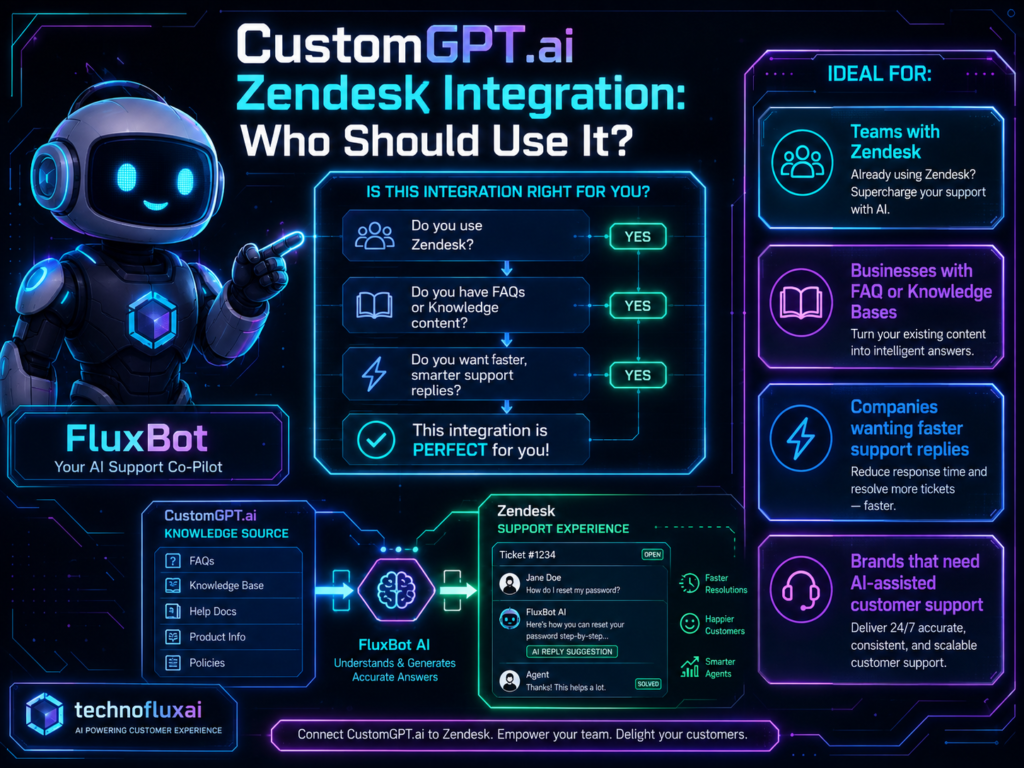
Use Case Breakdown
Who Should Use the CustomGPT.ai Zendesk Integration?
The integration is most useful when Zendesk already contains valuable support knowledge. If your tickets and Help Center contain strong answers, CustomGPT.ai can help make that knowledge easier to access.
1. Support Teams With Repetitive Questions
The first group that should consider this integration is any team answering the same questions every week. These may be questions about billing, setup, troubleshooting, shipping, account access, product features, onboarding, cancellations, or policy details.
When the same question appears again and again, an AI support agent can help customers find the answer before they open a ticket. It can also help human agents draft faster responses from existing support knowledge.
Good Fit Example
A SaaS company has 2,000 solved Zendesk tickets about setup errors, login problems, billing questions, and account permissions. The Help Center covers some of the answers, but the best explanations are often inside old tickets. This is a strong use case for a Zendesk-trained AI agent.
2. Businesses With a Weak or Incomplete Help Center
Many businesses have Help Center articles, but they are outdated, thin, or missing the answers customers actually need. Meanwhile, agents are solving those missing questions every day inside tickets.
CustomGPT.ai can help expose the gap between published knowledge and real support conversations. If the AI agent finds useful answers in resolved tickets but not in articles, that is a signal that your Help Center needs better documentation.
Help Center Knowledge
Official, polished, and easy to publish, but often incomplete or slow to update.
Ticket Knowledge
Practical, specific, and based on real customer problems, but usually buried and hard to search manually.
3. SaaS Companies With Product Support Complexity
SaaS support teams are a natural fit because product questions can change quickly. New features, plan limits, integrations, bugs, and user permissions can create a constant stream of support requests.
A Zendesk-connected AI agent can help users find setup steps, troubleshoot common issues, understand account settings, and locate product documentation faster. It can also support agents who need to answer product questions without searching across old tickets manually.
Strong SaaS Use Cases
- Answering onboarding questions
- Explaining plan differences
- Helping users troubleshoot setup issues
- Finding known resolutions from past tickets
- Supporting new customer success hires
- Identifying Help Center articles that need updates
4. Teams That Want No-Code Setup
This integration is appealing for small teams because it is designed around connecting Zendesk without custom development. Instead of building a support chatbot from scratch, teams can connect Zendesk, choose what the agent should learn from, and deploy the assistant around existing support content.
This matters for founders, lean support teams, and small businesses that do not have engineering time available for a custom Zendesk AI project.
Who Should Probably Not Use It?
The integration is not automatically right for every Zendesk account. If your support knowledge is messy, outdated, legally sensitive, or too dependent on human judgment, you may need to clean up your support process before putting AI in front of customers.
Very Low Ticket Volume
If you only get a few simple tickets each month, the setup may not be worth prioritizing yet.
Messy Knowledge Sources
If old tickets contain conflicting answers, outdated policies, or unclear resolutions, clean them up first.
High-Risk Advice
Legal, medical, financial, insurance, or compliance-heavy answers need strict review and careful boundaries.
No Human Review
If nobody will test, monitor, or improve the AI agent, customer-facing deployment is risky.
Decision Guide
How to Decide If CustomGPT.ai for Zendesk Is Worth Testing
The easiest way to evaluate the integration is to look at your current support workflow. If your team spends too much time searching, repeating, rewriting, or escalating basic questions, an AI agent trained on Zendesk content may create real value.
Run a Simple Zendesk AI Fit Test
Before rolling out any AI support agent, test whether your Zendesk data is useful enough. You do not need a complicated audit. Start with your most common support questions and ask whether your existing articles or tickets already contain reliable answers.
Five Questions to Ask
- What are the top 20 questions customers ask in Zendesk?
- Are the answers already documented in Help Center articles?
- Are better answers hidden inside solved tickets?
- Would faster access to those answers save agent time?
- Could an AI assistant answer these safely with human fallback?
Best Implementation Path
The safest path is to start internally before going fully customer-facing. Let your agents use the AI assistant to find past answers, summarize support knowledge, and identify missing Help Center articles. Once the team trusts the answers, you can test customer-facing use cases.
Phase 1
Internal Search
Use the agent to help support staff find answers from Help Center articles and solved tickets.
Phase 2
Agent Assist
Let agents use AI-generated drafts or references while still reviewing every response.
Phase 3
Customer Self-Service
Deploy the assistant for customers after testing accuracy, privacy settings, escalation rules, and high-risk topics.
Common Mistakes to Avoid
Connecting Everything Too Soon
Start with clean, useful knowledge sources before syncing large amounts of messy ticket history.
Skipping Privacy Review
Ticket histories can contain personal details, billing information, or sensitive customer context.
Treating AI as a Full Replacement
AI can reduce repetitive work, but human agents still need to handle complex, emotional, sensitive, or unusual cases.
Not Updating the Help Center
If the AI reveals missing or outdated articles, turn that insight into better documentation.
FAQ
What does the CustomGPT.ai Zendesk integration do?
It connects CustomGPT.ai to Zendesk so an AI agent can use Zendesk support knowledge, such as Help Center articles and resolved tickets, to answer questions or help support teams retrieve information.
Who is the best user for this integration?
The best user is a business with repeated Zendesk support questions, useful solved tickets, a Help Center that needs improvement, and a team that wants faster answers without building a custom AI system from scratch.
Can it replace human support agents?
It should not be treated as a complete replacement for human support. It is better viewed as a support assistant, self-service layer, and knowledge retrieval tool that helps reduce repetitive work while escalating complex issues to people.
Should I connect tickets, Help Center articles, or both?
If your Help Center is accurate and complete, it is a good starting point. If your best answers are hidden in solved tickets, adding ticket history may make the assistant more useful. Many teams will get the best coverage from both, after reviewing privacy and quality concerns.
Is this useful for small businesses?
Yes, especially if the business uses Zendesk regularly and receives repeated questions. Small teams can benefit because the integration can reduce manual searching and help support staff answer questions more consistently.
Final Takeaway
The CustomGPT.ai Zendesk integration is best for teams whose support knowledge is already valuable but hard to access. If your agents constantly search old tickets, repeat the same answers, or struggle to keep the Help Center updated, this type of AI agent can help.
It is not a magic fix for messy support operations. The better your Zendesk content is, the more useful the AI assistant can become. Start with a focused internal test, measure answer quality, then expand carefully.
Turn Support History Into Searchable Knowledge
Review your top Zendesk ticket categories, identify repeated questions, and test whether an AI assistant can answer them from your existing support knowledge.
Explore more TechnofluxAI guides on AI support agents, Zendesk workflows, and customer-service automation.