

Estimated reading time: 8 minutes
AI SEO Guide
How to Structure Blog Posts for AI Answer Engines
AI answer engines do not read your blog the same way a casual human reader does. They scan for clear answers, organized context, trustworthy details, and sections that can be confidently summarized or cited.
Quick Answer
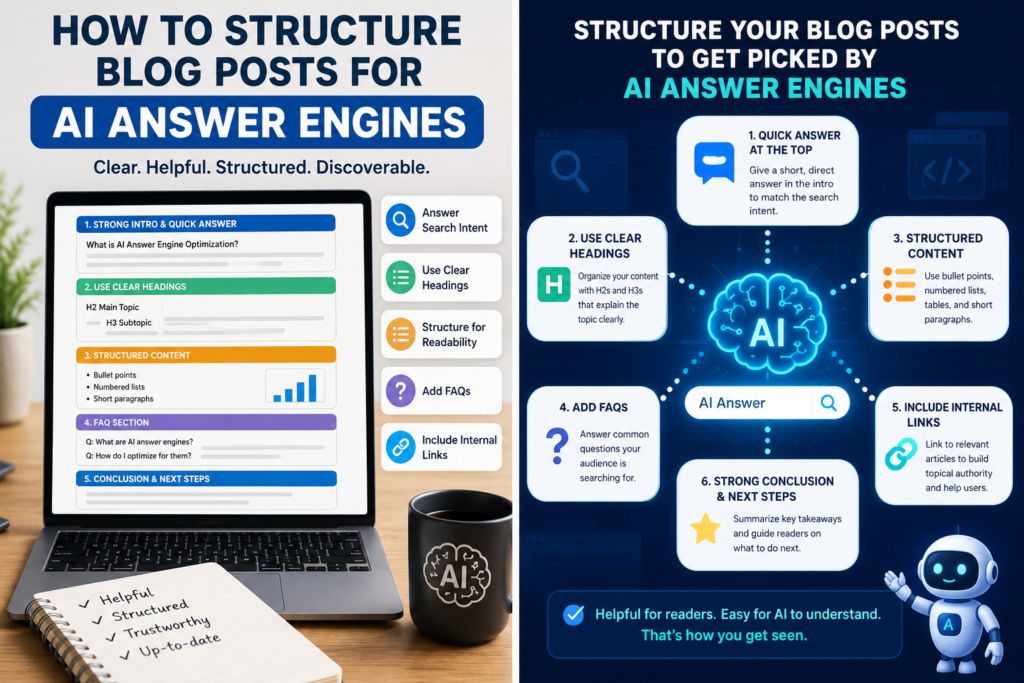
To structure a blog post for AI answer engines, lead with a direct answer, use question-based headings, explain one idea per section, include practical examples, add comparison tables or checklists, and make your content easy to quote, summarize, and verify.
The Real Problem
Most blog posts are written like essays. AI systems prefer clean information architecture. If your answer is buried under a long intro, vague headings, or fluffy paragraphs, your page becomes harder to extract from.
What This Guide Will Help You Understand
You will learn how to build blog posts that work for humans, Google, ChatGPT search, AI Overviews, Bing Copilot, Perplexity-style answer engines, and future AI discovery tools.
The goal is not to trick AI. The goal is to make your content so clear, useful, and well-structured that answer engines can confidently understand what your page is about.
Soft internal link suggestion: Add a link here to your related guide on “AI SEO vs Traditional SEO” or “What Is Generative Engine Optimization?”
Why Blog Structure Matters More in AI Search
AI answer engines are built to answer questions. That means your blog post should not only rank for a keyword. It should clearly solve a question, explain the surrounding context, and give the AI enough confidence to connect your content to a user’s intent.
Traditional SEO often focused on keywords, backlinks, titles, and on-page optimization. Those still matter. But AI answer engines also reward clarity. They need clean signals: what the article is about, who it helps, what the direct answer is, and which details support that answer.
Old Blog Format
Long intro, broad keyword targeting, vague sections, delayed answer, little structure, weak examples.
AI-Ready Format
Direct answer first, question-based headings, concise explanations, examples, definitions, lists, FAQs, and clear next steps.
Start With the Answer, Not the Backstory
The first major mistake bloggers make is delaying the answer. A human may tolerate a long setup. An AI answer engine is usually trying to extract the most useful explanation quickly.
Use This Opening Pattern
Question: How do you structure a blog post for AI answer engines?
Answer: Use a clear H1, provide a quick answer near the top, organize sections around searcher questions, add examples and checklists, and include an FAQ that answers related follow-up questions.
This does not mean your article should be shallow. It means the page should prove value immediately, then expand with depth.
Use Question-Based H2s and H3s
AI systems are often matching content to natural-language questions. A heading like “Blog Post Structure” is okay. A heading like “What Is the Best Blog Post Structure for AI Search?” is stronger because it mirrors how people ask.
Weak Heading
“Content Formatting”
Better Heading
“How Should You Format a Blog Post for AI Answer Engines?”
Do not force every heading into a question. But use question-based headings when the section answers a clear searcher question.
Build Each Section Around One Clear Idea
AI answer engines struggle when one section tries to explain five different concepts at once. Keep each section focused. Define the idea, explain why it matters, show an example, then give the reader a next step.
AI-Friendly Section Formula
- State the point: Open the section with the main answer.
- Explain the reason: Tell the reader why it matters.
- Give an example: Show the idea in action.
- Add a practical step: Tell the reader what to do next.
Include Definitions for Important Terms
If your article uses terms like AI answer engine, GEO, AI Overview, semantic SEO, structured data, or entity optimization, define them in plain English. AI tools can better interpret your content when important concepts are clearly explained.
Example Definition
AI answer engine optimization is the process of making content easier for AI-powered search tools to understand, summarize, and cite when answering user questions.
Add Practical Examples, Not Just Advice
Thin advice is easy to ignore. Practical examples make your article more useful for readers and easier for AI systems to connect with real search intent.
Thin Advice
“Use good headings and write helpful content.”
Useful Advice
“Use an H2 like ‘What Is the Best Blog Structure for AI Search?’ Then answer it in two sentences before expanding with examples.”
Use Comparison Cards and Checklists
AI answer engines often pull from content that is easy to summarize. Comparison cards, workflow boxes, checklists, and short tables help organize your article into clean answer blocks.
Blog Post Structure Checklist
- Clear H1 that matches the main topic.
- Quick answer within the first few paragraphs.
- Short introduction that explains the reader’s problem.
- Question-based H2s for major search intents.
- Definitions for key terms.
- Examples that show the advice in action.
- Checklist or workflow section.
- FAQ with natural follow-up questions.
- Clear final takeaway.
- Relevant internal links to supporting content.
Make Your Article Easy to Cite
An AI answer engine is more likely to use a source when the page clearly explains a concept, provides supporting context, and avoids vague claims. Use simple sentences when defining important points.
Citation-Friendly Writing Example
“A strong AI-ready blog post answers the main question near the top, then uses clear headings, examples, and FAQs to cover related follow-up questions.”
Recommended Blog Post Layout for AI Answer Engines
Use This Structure
- H1: Main question or clear topic.
- Quick answer: Direct response in 2 to 4 sentences.
- Problem section: Explain why the reader is searching.
- Definition section: Define the main topic.
- Step-by-step section: Teach the process.
- Examples section: Show before-and-after or use cases.
- Checklist section: Make the advice scannable.
- Mistakes section: Warn readers what to avoid.
- FAQ section: Answer follow-up questions.
- Final takeaway: Give a clear summary and next step.
Advanced Tips for AI Answer Engine Optimization
Once your basic structure is strong, the next step is to make your article more complete, more connected, and easier to verify. This is where many bloggers can gain an edge.
1. Cover Follow-Up Questions
After answering the main question, think about what the reader would ask next. Add those questions as H2s, H3s, or FAQs.
2. Build Topical Context
Mention related concepts naturally. For this topic, that could include GEO, AI Overviews, ChatGPT search, featured snippets, schema, and semantic SEO.
3. Add Internal Links
Link to related articles that explain supporting topics. Internal links help readers and search systems understand your site’s topic clusters.
Common Mistakes to Avoid
Avoid These AI SEO Mistakes
- Writing long intros before answering the question. Put the answer near the top.
- Using clever headings instead of clear headings. AI tools need clarity more than wordplay.
- Stuffing keywords. Use natural language and related phrases instead.
- Publishing generic AI content. Add examples, opinions, process, and real use cases.
- Skipping FAQs. FAQs are useful for related questions and conversational search behavior.
- Depending only on schema. Structured data can help search systems understand a page, but it does not replace useful content.
- Ignoring crawl access. If AI search crawlers cannot access your content, your visibility may be limited.
FAQ: Structuring Blog Posts for AI Answer Engines
What is an AI answer engine?
An AI answer engine is a search or discovery tool that uses artificial intelligence to generate direct answers from available information. Examples include AI Overviews, ChatGPT search, Bing Copilot, and Perplexity-style search tools.
Is AI answer engine optimization the same as SEO?
No. AI answer engine optimization overlaps with SEO, but it puts more emphasis on clear answers, entity understanding, topical depth, extractable sections, and conversational follow-up questions.
Should every blog post include a quick answer?
For informational content, yes. A quick answer helps readers immediately understand the main point and gives AI systems a clean summary of the page.
Do FAQs help with AI search visibility?
FAQs can help because they answer related natural-language questions in a concise format. They should be genuinely useful, not added only for search engines.
How long should an AI-ready blog post be?
It should be as long as needed to answer the topic completely. A short post can work for a simple question, but competitive topics usually need definitions, examples, workflows, mistakes, and FAQs.
Final Takeaway
The best blog structure for AI answer engines is simple: answer the main question early, organize the article around clear sub-questions, support your advice with examples, and make every section easy to understand without extra digging. AI search does not remove the need for good writing. It raises the standard for clarity.
CTA
Want more creator-friendly AI SEO guides? Explore the TechnofluxAI blog for practical workflows on GEO, AI content systems, niche sites, affiliate content, and AI-powered publishing.
TechnofluxAI
Practical AI for creators and website owners
Learn how to use AI, improve AI search visibility, build smarter workflows, and test what actually works.
Explore our other sites
TimewasterAI
— product reviews, buying guides, and useful finds.
Tina Trends
— fashion, beauty, pets, lifestyle, and fun discoveries.
Mistakenly Delicious
— simple recipes and practical cooking ideas.
Want more TechnofluxAI in Google?
Add TechnofluxAI as a Preferred Source to help Google show you more of our AI guides, tests, workflows, and research.