
AI SEARCH • GEO • CHATGPT VISIBILITY
AI-powered search is changing how people discover information online.
Instead of browsing multiple search results, users increasingly ask conversational AI systems direct questions such as:
- “What are the best AI tools?”
- “How do I optimize for ChatGPT?”
- “What is GEO?”
- “How does AI search work?”
AI systems such as ChatGPT, Google AI Overviews, Gemini, Claude, and Perplexity can then generate answers using information from multiple sources.
The bigger shift
Websites are no longer competing only for traditional search rankings. They are also competing for visibility inside AI-generated answers, recommendations, and conversational search experiences.
To adapt, websites need content that is useful to people, easy to understand, and structured clearly enough for search and AI systems to interpret.
This is where Generative Engine Optimization, or GEO, becomes relevant.
What Does It Mean to Optimize for ChatGPT?
Optimizing for ChatGPT means structuring content so AI systems can more easily:
- understand it clearly
- retrieve useful information
- summarize answers accurately
- identify topical relevance
- connect the page with related concepts and entities
The goal is not simply to “rank higher.”
A more useful goal is to create content that is clear, trustworthy, relevant, and useful enough to be referenced when an AI system needs information on the topic.
You can also read How ChatGPT Chooses Sources for more context on source selection.
Why AI Search Optimization Matters
AI search is changing how people interact with information.
Many users now:
- ask AI systems questions directly
- summarize information instantly
- compare products conversationally
- use AI assistants alongside traditional search
That means visibility can come from more than a blue link in a search results page. A useful page may also be discovered through AI-powered answers, citations, summaries, and recommendations.
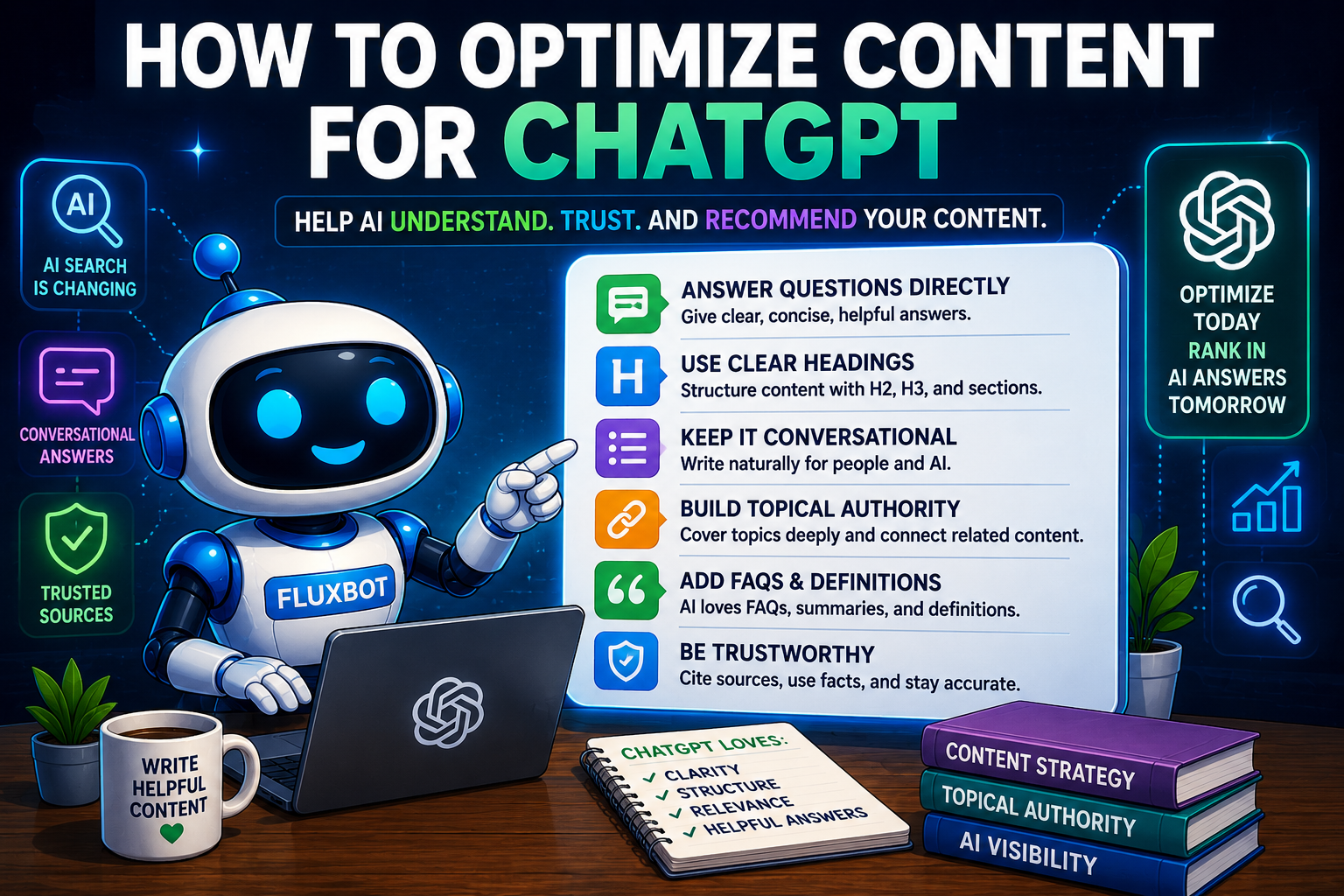
Use Clear Headings and Structure
Well-organized pages are easier for both readers and machines to interpret.
Helpful formatting includes:
- H2 headings
- H3 subheadings
- FAQ sections when they are genuinely useful
- bullet points
- numbered steps
- definitions and glossary-style explanations
Answer Questions Directly
One of the most useful habits for AI search is answering the question early instead of burying the answer under a long introduction.
Weak: “Modern SEO strategies continue evolving in today’s digital environment…”
Better: “GEO helps optimize content for AI-powered search systems.”
Concise explanations are easier for readers to understand and easier for systems to summarize.
Build Topical Authority With Connected Content
Instead of publishing isolated articles, build connected content around a topic.
For an AI Search and GEO cluster, that could include:
- What Is GEO?
- GEO vs SEO
- AI Search Optimization
- GEO Strategies
- AI Search for Beginners
- GEO tools and workflows
Internal links between genuinely related pages help readers move through the topic and make the relationship between pages easier to understand.
Use Natural, Conversational Language
Avoid robotic writing, excessive keyword repetition, and awkward keyword stuffing.
Instead:
- explain concepts naturally
- answer questions directly
- write clearly
- use simple language when simple language is enough
Improve Internal Linking
A page about optimizing for ChatGPT should naturally connect to related topics such as:
- GEO strategies
- AI search
- topical authority
- semantic SEO
- AI visibility
Internal linking should help the reader, not just create more links.
Focus on Meaning, Not Keyword Repetition
Instead of repeating one keyword excessively, use related concepts naturally where they make sense.
Examples include:
- AI search
- conversational search
- AI visibility
- answer engines
- semantic relevance
- AI retrieval
- GEO strategies
Create Helpful Original Content
One of the biggest misconceptions about GEO is that it is purely technical.
Useful content still matters. Practical examples, workflows, tutorials, screenshots, experiments, and real-world observations can make a page more useful than a generic summary of information already available elsewhere.
The practical test
Before publishing, ask what the reader gets from your page that they would not get from ten other articles covering the same topic.
Use Schema and Structured Data Carefully
Structured data can help search systems understand webpage information and entities when it accurately describes content that is actually visible on the page.
Common schema types include:
- Article
- Breadcrumb
- Organization
- FAQ, where appropriate and supported
Improve Entity Consistency
Names, brands, topics, and relationships should be described consistently across important pages such as:
- your homepage
- About page
- articles
- author sections
- relevant social profiles
AI Search Is Still Evolving
AI search optimization is still developing, and the terminology and tactics will continue to change.
The safer long-term approach is to focus on content that is clear, useful, original, well-structured, and easy to verify instead of chasing every new optimization trick.
Personal Insight
It makes sense to me that AI search is becoming more important because I have already experienced the behavioral shift myself while building AI workflows and applications.
During some projects, I barely used traditional search engines at all. Instead, I relied heavily on conversational AI systems to research ideas, organize workflows, solve technical problems, and speed up content creation.
That behavior change feels significant.
The shift I notice:
From: “searching webpages”
Toward: “interacting with AI systems.”
That does not mean traditional search disappears. It means websites now have another discovery layer to think about.
For me, the practical goal is not to optimize for an algorithm nobody fully controls. It is to make content understandable, trustworthy, useful, and distinctive enough that both people and machines can make sense of it.
Frequently Asked Questions
How do I optimize content for ChatGPT?
Start with clear structure, direct answers, useful original information, strong internal linking, natural language, and accurate supporting sources. Avoid keyword stuffing and generic filler.
What is AI search optimization?
AI search optimization is the practice of making content easier for AI-powered search and answer systems to understand, retrieve, summarize, and reference.
What does GEO stand for?
GEO stands for Generative Engine Optimization. It generally refers to improving content for visibility in AI-powered search and generative answer systems.
Is SEO still important?
Yes. Traditional SEO still matters. AI search visibility should be treated as an additional layer rather than a replacement for solid SEO fundamentals.
Why is conversational formatting useful?
Natural language and clear structure make content easier for readers to understand and can also make individual answers, definitions, and explanations easier to extract and summarize.
Final Thoughts
Optimizing for ChatGPT and AI search should not mean rewriting every page for bots.
The stronger approach is to create content that:
- answers the main question clearly
- adds something original
- uses useful structure
- connects naturally to related topics
- uses accurate sources
- helps real readers make a decision or understand a problem
AI search will keep changing. Helpful, original, well-organized content is a much more durable strategy than trying to reverse-engineer every new AI system.
Related TechnofluxAI Guides
One Thing I have Learned while building TechnofluxAi is that Ai tools usually sound easier to use than they are in the real world. I like to try things myself, see where I get stuck, and figure out what actually saves time instead of just repeating promisies.That’s the approach I use throughout this site: keep what works, point out what doesn’t, and explain things in a way that makes sense for someone who is still learning. I started out searching for an image creator. That was my first interaction with Ai. I was frustrated by the vast tool list without any real direction on which tool was best. Then I realized how powerful this tool was .and was going to be in the future. Making mistakes has helped me in the choice of articles I write.