
Estimated reading time: 7 minutes
TechnofluxAI Guide
Evaluate AI Answers Before You Trust Them
AI can sound confident even when it is outdated, incomplete, one-sided, or simply wrong. The safest way to use AI is not to blindly accept every answer. It is to review the answer like an editor, researcher, or decision-maker.
Quick Answer
To evaluate AI answers, check three things: whether the facts are accurate, whether the information is fresh enough for the topic, and whether the answer shows hidden bias, missing viewpoints, or unsupported claims.
Reader Pain Point
The problem is not that AI is useless. The problem is that AI can mix correct facts, old information, weak assumptions, and confident wording into one smooth answer.
What This Guide Will Help You Do
You will learn a repeatable review method for checking AI accuracy, freshness, and bias. You will also get practical examples, warning signs, and a simple scoring workflow you can use before publishing, sharing, studying, or making decisions from AI-generated content.
For more beginner-friendly AI workflow guidance, visit TechnofluxAI. If you publish AI-assisted content, also review the TechnofluxAI Editorial & Ethics Policy.
Main Evaluation Framework
The Three-Part AI Answer Check
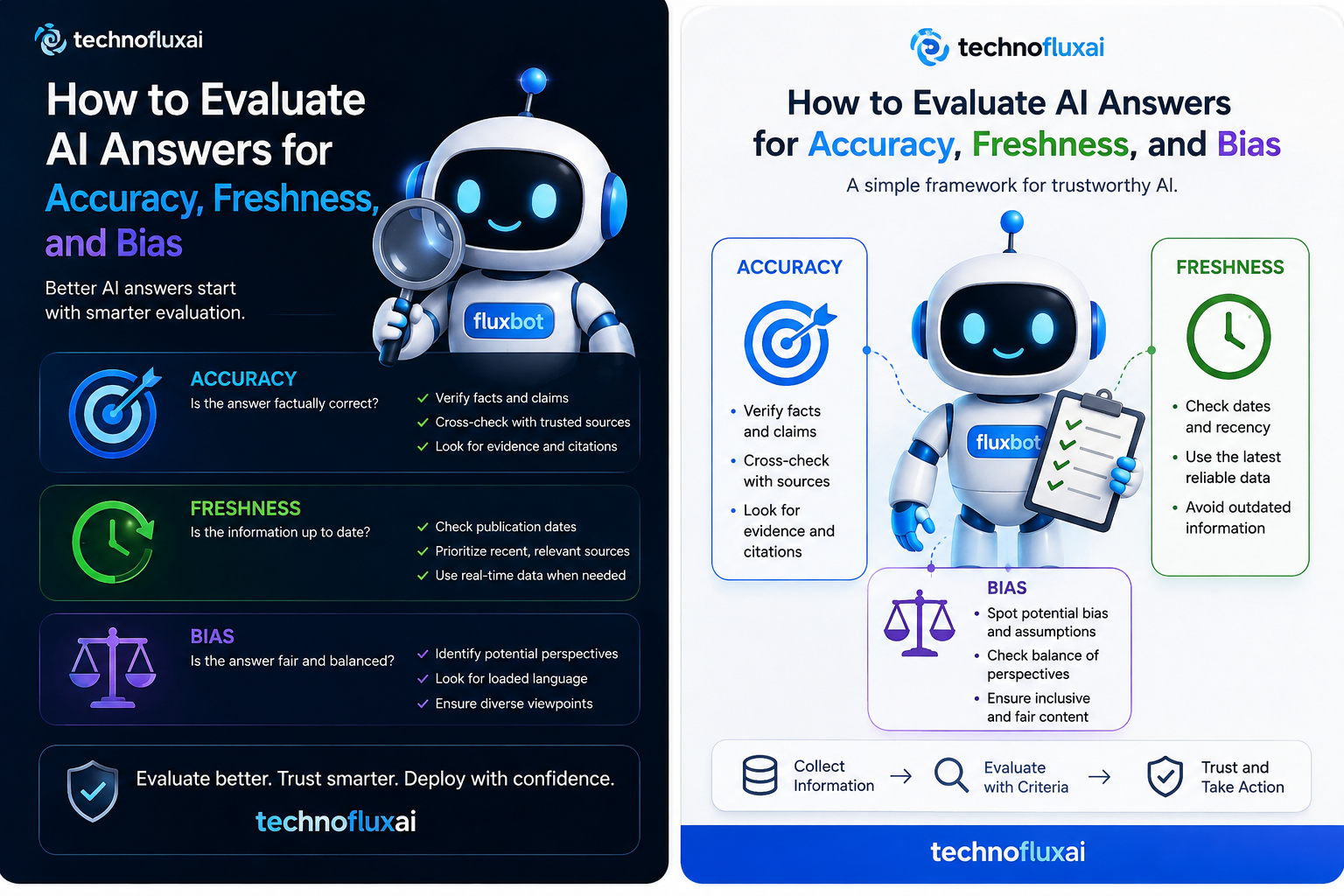
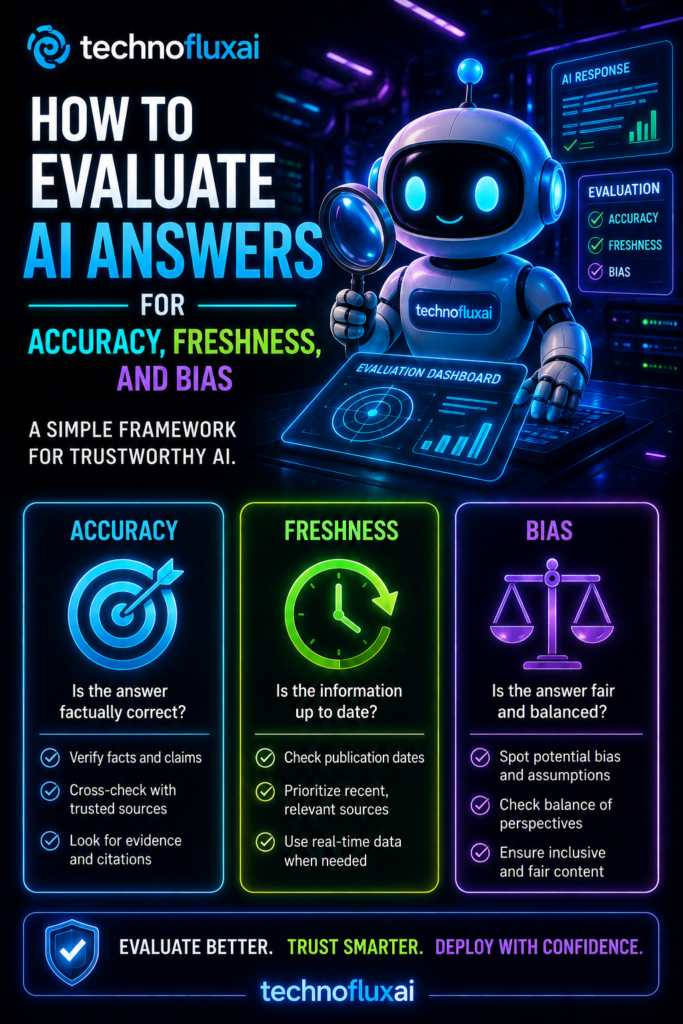
A good AI answer should pass three tests before you rely on it: accuracy, freshness, and bias. If the answer fails one of these checks, do not treat it as finished. Treat it as a draft that needs review.
1. Accuracy
Accuracy means the answer matches reliable evidence. Names, dates, prices, laws, product details, claims, definitions, and examples should be checked before use.
2. Freshness
Freshness means the answer is current enough for the topic. AI answers about software, laws, prices, tools, public figures, rankings, research, and trends can become outdated quickly.
3. Bias
Bias means the answer may favor one viewpoint, source, group, tool, company, region, or assumption without making that limitation clear.
How to Check AI Accuracy
Start by separating the answer into claims. A claim is anything that could be true or false. Then verify the important claims using reliable sources.
Check Specific Facts
Verify names, dates, numbers, quotes, citations, product features, statistics, and step-by-step instructions.
Compare Multiple Sources
If the answer affects money, health, legal choices, reputation, or business decisions, compare more than one trustworthy source.
Ask What Is Missing
A technically correct answer can still be incomplete. Look for missing context, exceptions, limitations, and edge cases.
How to Check AI Freshness
Freshness does not matter equally for every topic. A basic grammar explanation may stay useful for years. A guide to the best AI tools, search rankings, pricing, regulations, or software settings may need current verification.
| Topic Type | Freshness Risk | What to Check |
|---|---|---|
| Software tutorials | High | Current interface, settings, pricing, feature names |
| AI tool recommendations | High | Latest plan limits, model updates, user fit, alternatives |
| Legal, tax, or health topics | Very high | Official sources, dates, location, professional review |
| Definitions and basic concepts | Lower | Clear explanation, accepted meaning, examples |
| News, trends, and public figures | Very high | Publication date, event date, source reputation, recent updates |
How to Check AI Bias
Bias is not always obvious. Sometimes it appears as missing viewpoints, unfair wording, narrow examples, overconfidence, or recommendations that favor one tool or idea without explaining the tradeoffs.
Look for One-Sided Framing
Does the answer present only one side of a debated issue? Does it ignore reasonable alternatives?
Watch for Loaded Language
Words like obvious, best, proven, terrible, useless, or guaranteed can hide assumptions unless evidence is provided.
Check Who Benefits
Ask whether the answer quietly favors a brand, platform, region, business model, or audience without saying why.
Warning Signs That an AI Answer Needs Review
- The answer gives exact numbers without sources.
- The answer uses confident language but does not explain uncertainty.
- The answer recommends one product, tool, or strategy without alternatives.
- The answer discusses current events without dates.
- The answer cites sources that do not actually support the claim.
- The answer ignores location, audience, budget, skill level, or timing.
- The answer sounds polished but does not give a clear way to verify it.
A Simple 5-Step Review Workflow
- Highlight the claims. Mark facts, recommendations, numbers, names, dates, and anything that could be wrong.
- Check the date sensitivity. Decide whether the topic needs current sources or whether older information is acceptable.
- Verify with trusted sources. Use official pages, original documents, reputable publishers, or primary sources when possible.
- Look for missing angles. Ask what viewpoints, risks, tradeoffs, or exceptions are not included.
- Rewrite with uncertainty. If the answer is useful but not fully proven, add wording that reflects limits, assumptions, and source dates.
For more on AI search visibility and source-aware content, read AI Search SEO Checklist for 2026 and How ChatGPT Chooses Sources for AI Answers.
Advanced Review Tips
Build a Better AI Review Habit
The goal is not to distrust every AI answer. The goal is to match your review level to the risk of the task. A casual brainstorming answer needs a light review. A business, legal, medical, financial, or public-facing answer needs a much stronger review.
Use a Confidence Label
Label AI output as low, medium, or high confidence after review. Do not let polished wording decide confidence for you.
Keep a Source Trail
When using AI for content, research, or business decisions, save the sources you checked and the date you checked them.
Ask for Counterpoints
A useful follow-up prompt is: “What are the strongest arguments against this answer?” This can reveal weak assumptions.
Common Mistakes to Avoid
Trusting Confident Tone
AI can sound certain even when it is guessing, summarizing weak sources, or missing recent updates.
Checking Only One Source
One source may be outdated, biased, incomplete, promotional, or misunderstood by the AI answer.
Ignoring Publication Dates
Freshness matters when tools, prices, laws, features, rankings, public roles, or policies can change.
Publishing Without Edits
AI output should be shaped for your audience, checked for claims, and edited into your real voice before publishing.
FAQ: Evaluating AI Answers
How do I know if an AI answer is accurate?
Break the answer into claims and verify the important ones against reliable sources. Pay special attention to dates, numbers, names, quotes, instructions, and recommendations.
What does freshness mean in an AI answer?
Freshness means the information is current enough for the topic. A definition may not need today’s sources, but a software tutorial, AI tool review, legal topic, or market trend usually does.
How can I spot bias in AI answers?
Look for one-sided framing, missing alternatives, loaded language, unsupported recommendations, narrow examples, and claims that benefit one brand, group, or viewpoint without explanation.
Can AI check its own answer?
AI can help identify weak spots, but it should not be the only reviewer for important claims. Use outside sources, official references, and human judgment for higher-risk work.
What is the fastest way to review an AI answer?
Check the main claim, the source quality, the date sensitivity, and whether the answer leaves out an important alternative or warning.
Final Takeaway
AI answers are starting points, not automatic truth. The best users treat AI like a fast assistant: useful, creative, and powerful, but still in need of review. Check accuracy, check freshness, check bias, and then decide how much trust the answer deserves.
Use AI Faster, But Review It Smarter
Before you copy, publish, or act on an AI answer, run it through the accuracy, freshness, and bias check. That one habit can prevent outdated content, weak recommendations, and avoidable mistakes.
Read the NIST AI Risk Management Framework Explore More TechnofluxAI Guides