Estimated reading time: 19 minutes
Key Takeaways
- AI SEO helps speed up keyword research, outlines, optimization, FAQs, and content updates.
- Traditional SEO still matters because Google rewards trust, usefulness, authority, and real user value.
- AI can help websites publish faster, but human editing is still needed to avoid generic low-value content.
- Bloggers, affiliate marketers, and small businesses can use AI SEO to grow faster while keeping traditional SEO fundamentals in place.
AI SEO vs traditional SEO is one of the biggest questions bloggers, business owners, affiliate marketers, and website creators are asking right now. Traditional SEO still works, but artificial intelligence is changing how fast people can research keywords, build outlines, optimize articles, and publish content.
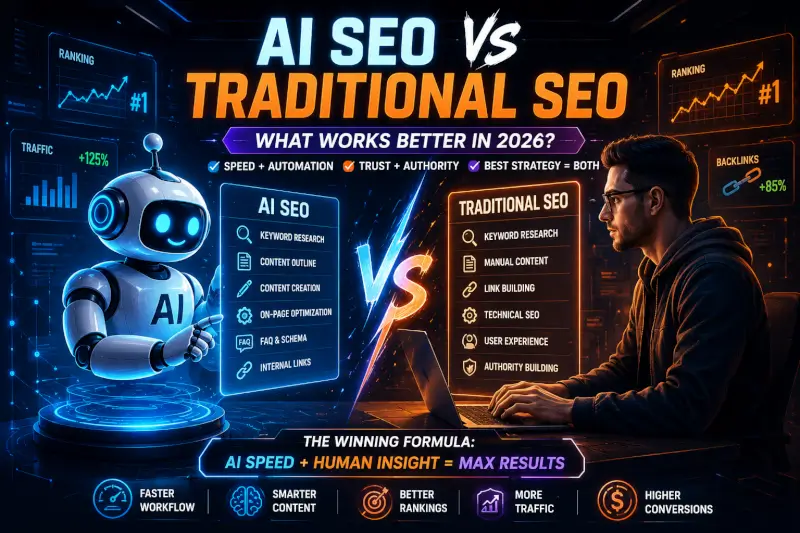
The simple answer is this: AI SEO is not replacing traditional SEO completely. The strongest SEO strategy in 2026 uses AI for speed and traditional SEO for trust, authority, experience, and long-term rankings.
Quick Answer
AI SEO is better for speed, research, outlines, optimization, and scaling content. Traditional SEO is better for trust, backlinks, originality, authority, and long-term strategy. The best results come from using both together.
What Is Traditional SEO?
Traditional SEO is the classic process of improving a website so it can rank higher in search engines. It includes keyword research, helpful content, title tags, meta descriptions, internal links, backlinks, technical SEO, and user experience.
Why Traditional SEO Still Matters
Traditional still matters because search engines want to rank pages that help real people. A website still needs trust, clear structure, useful information, strong internal links, fast loading pages, and content that matches search intent.
AI can speed up the process, but it does not automatically create authority. A page still needs useful examples, honest recommendations, real experience, and a reason for visitors to stay.

What Is AI SEO?
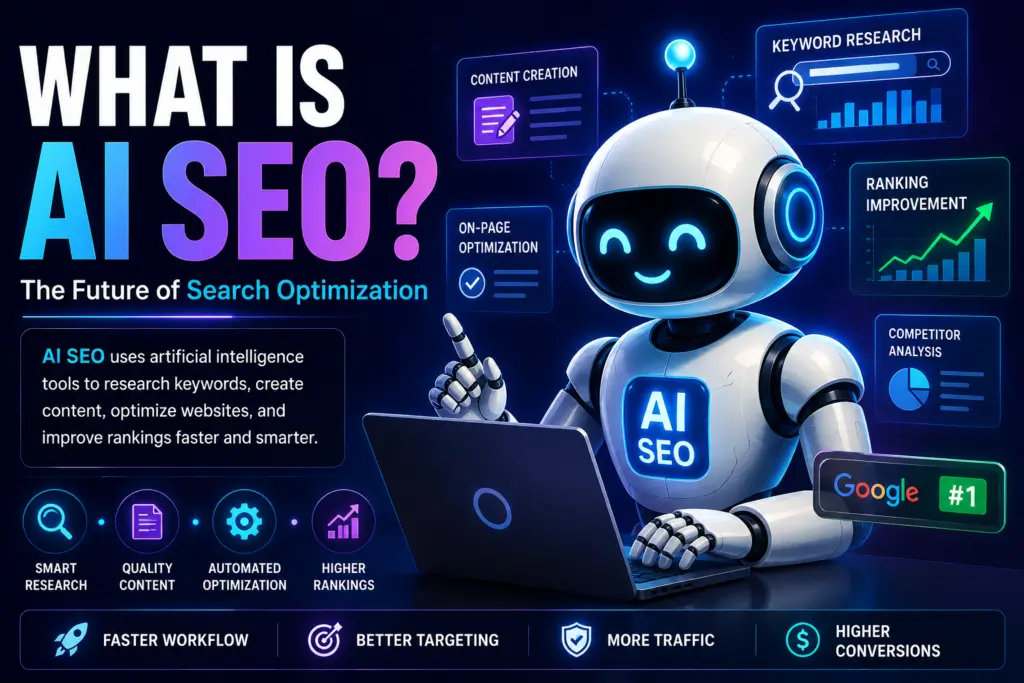
AI SEO uses artificial intelligence tools to improve and speed up search engine optimization. Instead of doing every SEO task manually, website owners can use AI to help with keyword ideas, content outlines, meta descriptions, FAQs, schema ideas, internal links, and content updates.
However, SEO continues to evolve rapidly as AI tools become more advanced and easier to use. While automation can speed up keyword research, content planning, and optimization, successful rankings still depend on helpful content, strong structure, and real user value. In addition, websites that combine AI workflows with traditional SEO strategies often create more balanced and trustworthy content. As a result, businesses, bloggers, and affiliate marketers are increasingly blending automation with human editing to improve both traffic quality and long-term search visibility.
Popular AI SEO tools include ChatGPT, Claude, Jasper, Surfer SEO, Frase, NeuronWriter, Semrush, Ahrefs, and Ubersuggest.
Best Uses for AI SEO
- Keyword research
- Blog outlines
- Meta descriptions
- FAQ creation
- Internal link ideas
- Content refreshes
- Search intent planning
The Main Difference
The biggest difference is speed. Traditional SEO depends heavily on manual work. AI SEO helps automate or speed up many of those same tasks. But speed only helps when the final content is useful, accurate, and edited for real readers.
Speed Does Not Guarantee Rankings
AI can help you create content faster, but fast content is not always good content. If a post sounds generic, repeats the same ideas, or does not answer the searcher’s question clearly, it may struggle to rank.
Furthermore, Google continues improving its ability to measure content quality and user satisfaction. Although AI can accelerate publishing, websites still need originality, clear structure, and accurate information to compete in search results. As competition increases, creators who combine automation with thoughtful editing often produce stronger long-term SEO results and better visitor engagement.
The best AI SEO workflow uses AI to save time, then uses human editing to improve clarity, trust, examples, and usefulness.
Best AI Tools for This Topic
These AI tools can help with content planning, SEO workflows, automation, and growth.
- CustomGPT – Build your own AI agent →
- Jasper – Create AI-assisted content →
- Surfer SEO – Optimize content faster →
- Frase – Build content briefs →
- ChatGPT – Plan SEO content →
? Pro Tip: Use AI for research and structure, but always add human editing, examples, and personal insight before publishing.
AI SEO for Keyword Research
AI can help find keyword ideas much faster than manual research alone. One main keyword can turn into related topics, questions, long-tail searches, and full content clusters.
Additionally, AI-powered keyword research tools can help uncover search trends, semantic keywords, and hidden opportunities that may be difficult to find manually. Because search behavior changes constantly, creators who regularly expand their keyword clusters often build stronger topical authority over time. Meanwhile, combining AI keyword suggestions with real search intent analysis can improve both content quality and organic traffic potential.
For example, the keyword “AI SEO” can lead to articles about AI SEO tools, AI SEO prompts, AI content rankings, AI keyword research, and AI SEO for beginners.
Keyword Cluster Ideas
- AI SEO for beginners
- Best AI SEO tools
- AI SEO prompts
- Can AI content rank?
- AI keyword research
- AI SEO vs traditional SEO
AI SEO Pros
- Faster content creation
- Better keyword brainstorming
- Quick outline generation
- Useful FAQ ideas
- Helpful meta descriptions
- Lower content production costs
- Great for updating old posts
AI SEO Cons
AI SEO can create problems when it is used without editing or strategy. Raw AI content may sound repetitive, include weak examples, miss important details, or feel too generic.
The biggest mistake is treating AI like a full replacement for human thinking. AI should help with the workflow, but the final article still needs review, accuracy, and real value.
Traditional SEO Pros
Traditional SEO is still powerful because it focuses on long-term authority. It encourages better content quality, stronger trust signals, backlinks, site structure, original insights, and better user experience.
In addition, traditional SEO strategies often create stronger relationships between websites and their audiences over time. Because high-quality content builds credibility and trust, visitors are more likely to return, share articles, and engage with the brand again later. As search engines continue prioritizing user satisfaction, websites with clear expertise, useful information, and strong authority signals often maintain more stable rankings.
Traditional SEO also helps build a real brand instead of just publishing content for keywords.
Traditional SEO Cons
- Slower content production
- More manual work
- Higher cost if outsourcing
- Harder to scale quickly
- Requires patience
- Can fall behind faster competitors
Best Hybrid SEO Workflow
- Use AI to brainstorm keywords
- Check search intent manually
- Create an AI-assisted outline
- Add personal examples
- Edit for accuracy and readability
- Add internal links
- Update based on Google Search Console data
The Best Strategy Is Both
The strongest approach is a hybrid SEO workflow. Use AI for speed, research, structure, and optimization. Then use human editing for accuracy, examples, experience, screenshots, product testing, opinions, and trust.
Meanwhile, combining AI workflows with traditional SEO methods can also improve consistency across an entire website. While AI helps accelerate repetitive tasks like optimization and research, human editing helps maintain brand voice, credibility, and content quality. As competition in search results becomes more intense, websites that balance automation with real expertise often create stronger long-term traffic growth and better user engagement.
This gives you the best of both worlds: faster publishing without sacrificing quality.
AI SEO vs Traditional SEO for Bloggers
For bloggers, AI SEO is a major advantage. It helps create more content ideas, improve outlines, generate FAQs, and speed up publishing. A blogger can now build topic clusters much faster than before.
However, bloggers should still add opinions, examples, screenshots, and first-hand insights. That is what separates a helpful blog from a generic AI article.
Blogger Use Cases
- Article outlines
- Content clusters
- FAQ sections
- Meta descriptions
- Post refreshes
- Pinterest descriptions
- TikTok scripts
Affiliate SEO Angle
AI SEO is powerful for affiliate content because it helps create review sections, product comparisons, pros and cons, FAQs, and roundup structures faster. But affiliate content still needs trust, honesty, and clear recommendations.
AI SEO vs Traditional SEO for Affiliate Marketing
Affiliate marketers can benefit heavily from AI SEO because product reviews, comparison articles, and tool roundups often need a lot of structure. AI can help organize features, use cases, pros and cons, alternatives, and FAQs.
But readers still want honest recommendations. The best affiliate content explains who the tool is best for, who should skip it, and what alternatives are worth considering.
AI SEO vs Traditional SEO for Small Businesses
Small businesses can use AI SEO to compete with larger companies by creating service pages, local SEO content, FAQs, blog posts, and social media content faster.
Additionally, AI SEO can help small businesses save time and reduce marketing costs by simplifying content creation and optimization tasks. Instead of hiring large SEO teams, smaller companies can use AI tools to generate ideas, organize content, and improve workflow efficiency more quickly. However, long-term local SEO success still depends on trust, customer satisfaction, positive reviews, and maintaining a strong online reputation.
Traditional SEO still matters for local trust, reviews, citations, backlinks, Google Business Profile optimization, and customer experience.
Small Business Use Cases
- Local service pages
- FAQ content
- Blog posts
- Customer education
- Lead generation pages
- Google Business Profile posts
My Personal Insight
At TechnofluxAI, the biggest SEO gains usually come from combining AI speed with human judgment. AI can help build the outline, organize the article, improve the meta description, and suggest internal links. But the final value comes from editing, examples, testing, and making sure the content actually helps the reader.
Why Human Editing Still Matters
AI can make content faster, but it can also make content feel too similar. Human editing adds personality, accuracy, real examples, better flow, and stronger trust signals.
This is especially important for affiliate content, product reviews, business advice, and SEO topics where readers need confidence before taking action.
Which One Is Better?
AI SEO is better for speed, keyword expansion, outlines, optimization, content refreshes, and scaling. Traditional SEO is better for trust, backlinks, experience, authority, and long-term strategy.
So the winner is not AI SEO or traditional SEO by itself. The winner is using both together.
Final Verdict
AI SEO gives you speed. Traditional SEO gives you trust. If you combine both, you can publish faster, improve content quality, build topical authority, and create a stronger long-term SEO strategy.
FAQs
Is AI SEO better than traditional SEO?
AI SEO is better for speed and scaling, while traditional SEO is better for trust, authority, and long-term strategy. The best results usually come from using both together.
Can AI content rank on Google?
Yes. AI-assisted content can rank if it is helpful, accurate, original, well-edited, and created for real users instead of just search engines.
Will AI replace SEO experts?
AI will replace some repetitive SEO tasks, but it will not fully replace strategy, experience, judgment, editing, and trust-building.
What are the best AI SEO tools?
Popular AI SEO tools include ChatGPT, Claude, Jasper, Surfer SEO, Frase, NeuronWriter,
Semrush, Ahrefs, and Ubersuggest.
Next Steps
Start with one simple workflow. Use AI to research and outline your content, then edit it manually, add examples, improve internal links, and update the page based on Google Search Console data.
Suggested Internal Links
- AI SEO for Beginners
- Best AI SEO Prompts
- Can AI Content Rank on Google?
- Best AI Tools for Blogging
- How to Use AI Correctly
Founder Insight: I’ve been working with computers, software, and creative technology since the early days of personal computing and personally test many of the AI tools featured on TechnofluxAI before recommending them.

About the Author
Jon Hicks
Founder of TechnofluxAI.
I’m the creator behind TechnofluxAI, focused on breaking down powerful AI tools, emerging trends, and practical strategies to help creators and entrepreneurs stay ahead in a rapidly evolving digital world.
Follow TechnofluxAI for the latest AI tools & strategies