

Estimated reading time: 9 minutes
TechnofluxAI Beginner SEO Guide
Entity SEO for AI Search: Beginner Guide
Entity SEO sounds technical, but the idea is simple: help search engines and AI answer systems understand exactly who, what, where, and why your content is about something. Keywords still matter, but entities give your content clearer meaning.
Quick Answer
Entity SEO is the practice of making your content easier to understand by clearly defining important people, brands, products, places, topics, categories, and relationships. For AI search, this matters because AI systems need clean context before they can confidently summarize, cite, or connect your content to a question.
The Beginner Problem
Many creators write around keywords but forget to explain the actual subject. The result is content that may use the right phrase but still feels vague, disconnected, or hard for search systems to categorize.
What You’ll Learn
You’ll learn what entities are, why they matter for AI search, how to add entity signals to blog posts, and how to build clearer content clusters without stuffing keywords.
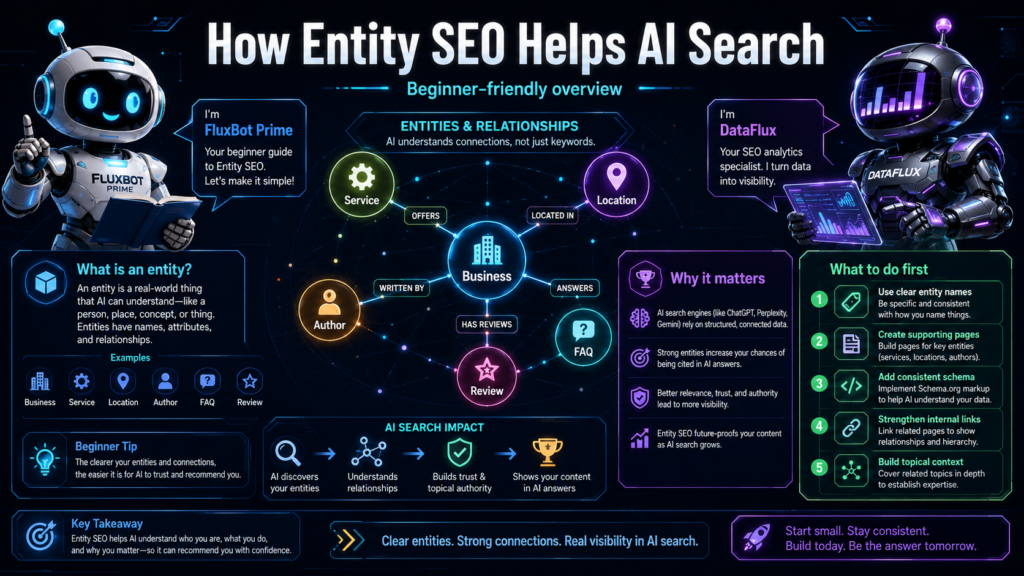
What Is an Entity in SEO?
An entity is a clearly identifiable thing. It can be a person, company, product, place, concept, tool, event, category, or process. In regular keyword SEO, you might target the phrase “AI writing tools.” In entity SEO, you also help search systems understand related things like ChatGPT, Claude, Jasper, content briefs, prompts, editors, publishing workflows, bloggers, and SEO use cases.
Keyword-Only SEO
Keyword-only content often repeats the same phrase without building enough meaning around it.
- Focuses heavily on exact-match phrases
- Can feel repetitive or thin
- May ignore related people, tools, and concepts
- Often answers one narrow query
- Can be hard for AI systems to summarize confidently
Entity SEO
Entity-focused content explains the topic, names important concepts, and shows how everything connects.
- Defines the main subject clearly
- Uses related concepts naturally
- Builds stronger topical context
- Connects posts through internal links
- Makes content easier to understand, cite, and compare
Why Entity SEO Matters More in AI Search
AI search does not only match words on a page. It tries to understand a question, pull useful information, connect related ideas, and generate a helpful response. That means your content needs more than a target keyword. It needs clean definitions, obvious relationships, specific examples, and enough context for an AI system to understand what your page actually contributes.
Simple Example
A weak article says: “AI SEO is important because AI SEO helps websites rank in AI search.”
A stronger entity-focused article says: “AI SEO helps search engines and answer engines understand your content by clarifying entities such as the topic, audience, tools, use cases, author expertise, brand, and supporting resources.”
Step 1: Identify the Main Entity of the Page
Every strong page should have a clear main entity. This is the primary thing your article is about. For this article, the main entity is “entity SEO.” A supporting entity is “AI search.” Related entities include structured data, semantic SEO, topical authority, knowledge graphs, internal links, schema markup, search intent, and content clusters.
Main Entity Checklist
- Can a reader tell what the page is about within the first few seconds?
- Does the H1 include the main topic clearly?
- Does the intro define the subject in beginner-friendly language?
- Do your H2 sections support the main topic instead of drifting?
- Does the article explain who the topic matters to and why?
Step 2: Add Supporting Entities Naturally
Supporting entities are the related ideas that help explain the main topic. You do not add them by stuffing random terms into the page. You add them by answering the next questions a real reader would ask.
People
Authors, experts, creators, reviewers, customers, founders, or communities connected to the topic.
Tools
Software, platforms, plugins, analytics tools, AI assistants, search tools, or publishing systems.
Concepts
Search intent, topical authority, schema, internal linking, credibility, citations, reviews, and examples.
Relationships
How one topic supports another, how tools compare, where a process fits, and why one concept affects the next.
Step 3: Build Topic Clusters Around Entities
Entity SEO gets stronger when your site covers a subject from multiple useful angles. One article about “AI SEO” is a start. A connected cluster about entity SEO, content refreshes, AI tool reviews, schema markup, topical authority, and AI search snippets gives search systems a clearer picture of your site’s expertise.
Example Entity Cluster for an AI SEO Blog
- Pillar page: AI SEO for Beginners
- Supporting post: Entity SEO for AI Search
- Supporting post: Blog Post Refresh Calendar for AI and SEO Content
- Supporting post: How to Write AI Tool Reviews That Are Actually Useful
- Supporting post: How to Structure Blog Posts for AI Overviews and Answer Engines
- Supporting post: Schema Markup Basics for Content Creators
Step 4: Use Internal Links to Show Relationships
Internal links are not just for sending readers to another page. They also help explain how your topics connect. A link from an AI SEO guide to an entity SEO article says, “These ideas belong together.” A link from an AI tool review to a refresh calendar says, “This type of content needs regular maintenance.”
Internal Link Workflow
- Choose the main entity for the article.
- List three to six related entities your site already covers.
- Link to the most helpful page for each related concept.
- Use descriptive anchor text instead of vague phrases like “click here.”
- Add links only where they help the reader continue the learning path.
Step 5: Add Structured Data Where It Makes Sense
Structured data is code that helps search engines understand parts of your page. It is not a magic ranking button, but it can make your content easier to interpret when used correctly. For beginner creators, the most practical starting points are Article schema, Organization schema, Person schema, Breadcrumb schema, Product schema for real product reviews, and FAQ content when the questions genuinely help readers.
Important Warning
Do not add fake schema, fake reviews, fake author details, or markup that does not match the visible page. Entity SEO works best when your content, structure, links, and credibility signals all point to the same truth.
Advanced Entity SEO Tips for AI Search
Once you understand the basics, entity SEO becomes a content clarity system. The goal is not to trick an algorithm. The goal is to make your content easier to understand, verify, connect, and reuse across search results, snippets, AI summaries, and reader workflows.
Define Before You Compare
Before comparing tools, methods, or strategies, define each one clearly. AI systems and readers both need clean definitions before comparisons become useful.
Use Consistent Naming
Avoid switching between too many names for the same thing. Pick a clear term, explain it once, and use related terms only when they add context.
Show Real-World Context
Entities become stronger when they connect to examples. Mention the audience, use case, tool, workflow, problem, and outcome whenever it helps the reader.
Common Entity SEO Mistakes to Avoid
- Stuffing related terms: Adding a list of entities without explaining them creates clutter, not clarity.
- Writing vague intros: AI search and human readers both need to know what the page is about quickly.
- Ignoring your author or brand entity: Your site, author name, niche, and experience help shape trust.
- Using disconnected internal links: Links should show useful relationships, not just fill space.
- Adding schema without substance: Markup cannot fix weak, outdated, or misleading content.
- Covering too many topics at once: A page with no clear main entity becomes hard to understand.
Beginner Entity SEO Workflow
Use This Before Publishing
- Write the main entity at the top of your draft.
- List five to ten supporting entities readers need to understand.
- Check whether the intro defines the topic clearly.
- Add examples that connect the topic to a real workflow.
- Link to related articles that support the same topic cluster.
- Add structured data only when it accurately reflects the visible page.
- Remove repeated keywords that do not add meaning.
FAQ: Entity SEO for AI Search
What is entity SEO in simple words?
Entity SEO means making the important things in your content clear. Those things can be people, brands, products, places, tools, topics, and relationships. The goal is to help readers and search systems understand your page with less confusion.
Is entity SEO different from keyword SEO?
Yes, but they work together. Keyword SEO focuses on the words people search. Entity SEO focuses on the meaning behind those words and how related ideas connect.
Does entity SEO help with AI Overviews and answer engines?
It can help by making your content clearer, more structured, and easier to understand. No SEO method can guarantee AI search visibility, but clear entities, useful answers, strong examples, and trustworthy context give your content a better foundation.
Do beginners need schema markup for entity SEO?
Not at the beginning. Start with clear writing, focused topics, helpful internal links, and accurate author or brand information. Add schema later when it matches the content and you understand what it represents.
What is the fastest entity SEO win?
Rewrite your intro so it clearly defines the main topic, who it is for, and why it matters. Then add internal links to related posts that support the same subject.
Final Takeaway
Entity SEO is not about sounding technical. It is about making meaning obvious. When your content clearly defines the main topic, supports it with related entities, connects useful pages, and avoids vague keyword stuffing, both readers and AI search systems have a better chance of understanding why your page deserves attention.
CTA
Want to make your AI SEO content easier to understand and more useful? Start by choosing one important topic cluster, then clean up the entities, examples, and internal links inside it.
Explore AI SEO Guides
About the Author
Jon Hicks
Founder of TechnofluxAI.
I’m the creator behind TechnofluxAI, focused on breaking down powerful AI tools, emerging trends, and practical strategies to help creators and entrepreneurs stay ahead in a rapidly evolving digital world.
Follow TechnofluxAI for the latest AI tools & strategies
Want more TechnofluxAI in Google?
Add TechnofluxAI as a Preferred Source to help Google show you more of our AI guides, tests, workflows, and research.