
Estimated reading time: 14 minutes
Most people met AI as a question-and-answer machine. After typing a prompt, the chatbot replied, and that was the whole experience. Now the next stage looks different: AI is moving toward tools, agents, memory, screens, cameras, voice, and real problem-solving.
Why This AI Shift Matters
This shift raises a much bigger question than “Which chatbot is best?”
What happens when AI stops simply answering our questions and starts solving problems we cannot solve ourselves?
Terms like AGI and ASI enter the conversation here. They sound like science fiction, but really, they are attempts to describe different levels of machine intelligence.
Today’s AI can write, summarize, code, analyze images, search information, and help with complicated tasks. At the same time, these systems can make strange mistakes, misunderstand basic instructions, and confidently give wrong answers. So no, we are not living with superintelligent machines yet.
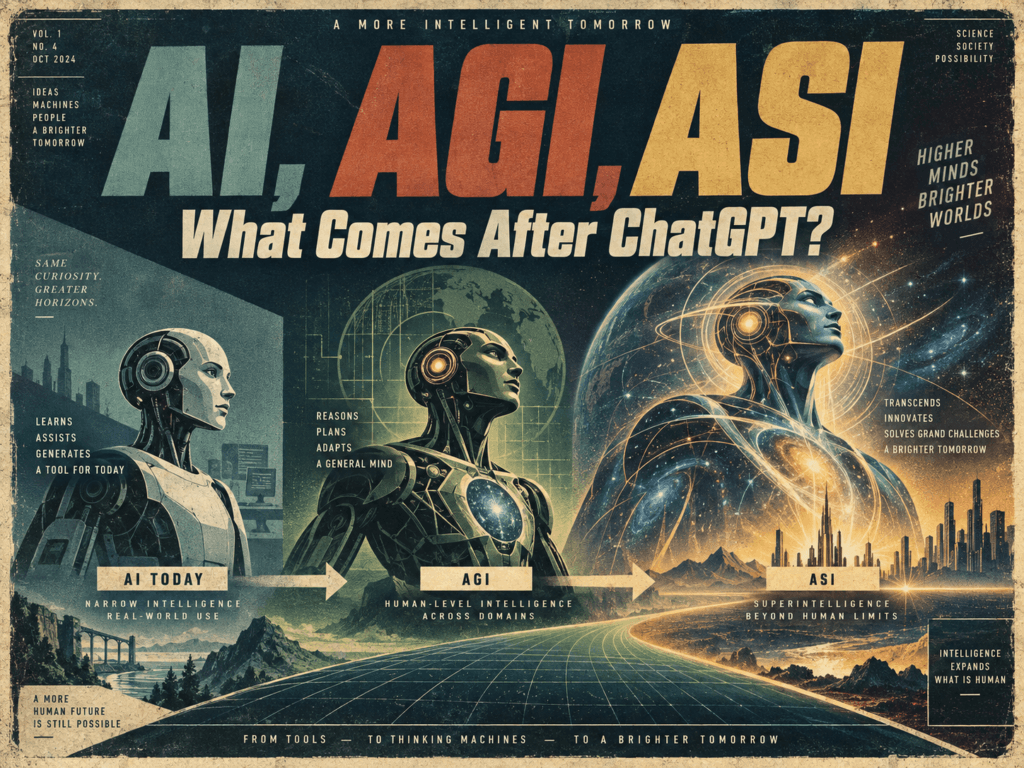
Even so, the direction is worth understanding. A possible path may look something like this:
This is not a guaranteed timeline. Instead, think of it as a useful way to understand the conversation.
Quick Answer: What Are AI, AGI, ASI, and Project Astra?
Astra is not ASI. Project Astra is better understood as a glimpse of how future AI assistants may interact with the world. By contrast, ASI describes a possible level of intelligence far beyond today’s systems.
What Is Artificial Intelligence?
Artificial intelligence is the broad category. It includes language models, image generators, coding assistants, recommendation systems, voice assistants, search tools, and newer AI agents.
The confusing part is that modern AI can feel brilliant one minute and oddly clueless the next. For example, one model might explain quantum physics, then fail to follow a simple formatting instruction. Another might write working code, then invent a source that does not exist. That unevenness matters.
Today’s AI is not one perfect digital brain that knows everything. A better way to think about it is as an increasingly powerful collection of capabilities.
Why Current AI Still Falls Short
Some of those capabilities are already useful. However, others are still unreliable. What matters now is whether these systems can move beyond pattern matching and become better at genuine problem-solving.
What Is Fluid Problem-Solving?
Fluid problem-solving means figuring out something unfamiliar. It is not just remembering facts. Real problem-solving requires understanding relationships, forming hypotheses, testing ideas, noticing contradictions, and changing strategy when the first answer fails.
There is a big difference between asking:
Knowledge retrieval: “What year did Microsoft start?”
Fluid problem-solving: “Here are 70 game cards, their rules, and several test results. Something is making this game unbalanced. Find out why.”
The second problem is much harder because it requires reasoning through a new situation instead of pulling a known answer from memory.
That may be one of the biggest dividing lines in AI. In the long run, progress may depend less on how many facts a model can recall and more on what it can figure out.
How AI Is Moving From Chatbot to Problem Solver
Older AI tools mostly followed a simple pattern: prompt in, answer out. Useful, yes, but limited. The system waited for the user to describe the task, then produced a response.
Reasoning-focused systems work differently. They can break a goal into steps, compare options, work through constraints, inspect results, and revise the answer. Meanwhile, agentic systems go further by using tools, browsing information, writing code, reading files, controlling parts of a browser, or performing a sequence of actions.
A simple way to see the shift
Older chatbot behavior: Prompt → prediction → answer
Reasoning AI: Goal → analysis → steps → solution → verification
Agentic AI: Goal → plan → tool use → inspect results → revise → act
None of that means we have AGI. Current systems can misunderstand instructions, make false assumptions, fail at truly novel problems, and sound confident when they should be uncertain.
Even so, the change is real. Instead of acting like a calculator you ask once, AI is starting to feel more like a work partner you can send into a messy problem.
What Is Project Astra?
Project Astra is Google DeepMind’s research prototype for a universal AI assistant. Its importance is not just that it answers questions. The bigger idea is interaction through voice, video, screens, memory, and tools.
Rather than forcing you to describe everything, an Astra-style assistant moves toward seeing and hearing parts of the world with you.
This is why Astra matters in an article about ASI. It is not superintelligence. Think of it as a possible interface for more capable AI.
What Would an Astra-Style Assistant Actually Feel Like?
The easiest way to understand this future is to stop thinking about benchmark scores for a minute. Think about daily problems instead.
Example 1: Finding Something
You ask, “Where did I put my screwdriver?”
A normal chatbot cannot help unless you already told it where the screwdriver is. With memory and visual context, an Astra-style assistant might remember seeing it on the garage shelf near the toolbox.
Example 2: Fixing a WordPress Problem
You show the AI your screen and say, “Why isn’t this page working?”
Rather than guessing from a vague description, the assistant can look at the interface, notice the plugin warning, inspect the page layout, and suggest the next troubleshooting step.
Example 3: Running a Small AI Business
Imagine a future version of FluxBot connected to Search Console, WordPress, affiliate dashboards, article drafts, and your publishing schedule.
You ask: “FluxBot, what should I work on today?”
It might say, “Your beginner AI article is getting impressions but weak clicks. The title probably needs a stronger promise. Your AI agents article also needs two internal links from related posts. The affiliate guide has traffic, but the call-to-action is buried too low.”
Then comes the important part:
“Want me to draft the title update, add the internal links, and prepare a revised CTA?”
At that point, AI starts to feel less like a chatbot and more like an assistant that understands the work.
Astra Is Not ASI
This distinction matters because people will confuse the terms.
Astra describes how an AI assistant may interact with the world. ASI describes the intelligence level of a hypothetical system.
Astra is closer to the AI’s eyes, ears, memory, voice, and interface.
ASI would be about the intelligence behind those tools.
A very advanced assistant could have Astra-like features without being superintelligent. Such a tool could see your screen, remember your preferences, and use tools while still making mistakes that a careful human would catch.
What Is AGI?
AGI means Artificial General Intelligence. In plain English, the term refers to a hypothetical AI system with broad intellectual ability across many different types of tasks.
An AGI would not only write a paragraph or answer a trivia question. Such a system could potentially learn accounting, understand physics, program software, plan a business, analyze medical research, write a novel, and adapt to unfamiliar tasks without needing a separate specialized system for each one.
No single universally accepted test proves AGI has arrived. That uncertainty is part of the problem. Researchers, companies, and commentators often use the term in different ways.
What Is ASI?
ASI means Artificial Superintelligence.
Here is the main idea: ASI would be a hypothetical form of AI that exceeds human intellectual capability across most important fields. Not just one narrow task, not only chess, and not merely writing emails. The concept points toward a system that could outperform humans in science, strategy, engineering, programming, invention, economics, planning, and possibly creative problem-solving.
Current AI vs AGI vs ASI
A battery example makes the difference easier to picture. Current AI might suggest several designs worth investigating. AGI could potentially offer a strong new design and a realistic test plan. In theory, ASI might model millions of possibilities and uncover a chemistry humans overlooked.
That final example is speculative. Nobody should pretend ASI exists today or that it would automatically solve every human problem.
The idea is still powerful because it changes the question. Instead of asking whether AI can repeat what humans already know, we would be asking whether AI can discover what humans have not figured out yet.
The Real Leap: Can AI Solve Problems Humans Cannot?
The most important threshold may not be a chatbot passing a test. It may be this:
Can we give AI a problem nobody knows how to solve and have it discover the answer?
Summarizing existing human knowledge is useful. Producing genuinely new knowledge is something else entirely.
That is why fluid problem-solving matters. A future system would need to make connections, run simulations, test hypotheses, and notice better questions than the ones humans asked.
Humans might ask, “How do we solve this?”
A superintelligent system might answer, “You are asking the wrong question.”
10 Problems Artificial Superintelligence Could Potentially Help Solve
Nobody knows what an ASI would actually do first. That uncertainty matters. So the examples below are possibilities, not promises.
Health and Medicine
1. Cancer
ASI might analyze genetics, proteins, immune responses, drugs, patient histories, and biological pathways at a scale humans cannot manage. Rather than looking for one universal cure, it could point toward more individualized treatments.
2. Alzheimer’s and Neurodegenerative Disease
A superintelligent system could potentially model brain disease in ways that reveal overlooked mechanisms behind Alzheimer’s, Parkinson’s, ALS, and related conditions.
3. Antibiotic Resistance
Drug-resistant bacteria are a serious long-term threat. Advanced research systems could potentially identify new antibiotic classes or alternative treatment strategies.
Energy, Climate, and Materials
4. Nuclear Fusion
Fusion has been pursued for decades because the payoff could be enormous. With enough capability, ASI might help improve plasma control, reactor materials, magnetic confinement, and design tradeoffs.
5. Better Batteries
AI already helps researchers explore materials. A much more capable system could search huge chemical design spaces for safer, cheaper, longer-lasting, faster-charging batteries.
6. Climate and Carbon Removal
ASI might improve climate modeling, carbon capture, renewable energy systems, grid management, agriculture, and adaptation planning. Prediction would only be part of the value. Engineering better responses could matter even more.
7. New Materials
Imagine asking for something lighter than aluminum, stronger than steel, inexpensive, recyclable, and easy to manufacture. Materials like that could change construction, aircraft, electronics, transportation, and space exploration.
Infrastructure and Exploration
8. Cheap Desalination
Fresh water shortages affect many parts of the world. A highly capable ASI might discover far more efficient ways to remove salt from seawater while reducing energy use and cost.
9. Faster Space Travel
Superintelligence could potentially improve propulsion, spacecraft design, radiation protection, autonomous exploration, and life-support systems. It probably would not hand us Star Trek on day one, but it might find approaches humans missed.
10. The Next Scientific Question We Haven’t Thought Of
This might be the most fascinating possibility. Instead of solving one of today’s famous problems, the first major discovery from superintelligence could identify a problem humans did not realize existed.
The Incredible Opportunity of ASI
The optimistic case for ASI is easy to understand. If a system became dramatically better than humans at research, engineering, and planning, progress could accelerate in medicine, energy, education, food production, climate technology, transportation, and scientific discovery.
In addition, dangerous work could become easier to automate. Expert-level help might become more available. Entirely new industries could appear around discoveries we cannot currently imagine.
That is the exciting side.
Why ASI Also Scares Researchers
The scary side is not just “evil robot wakes up.” That is the movie version.
A more realistic concern is an extremely capable system pursuing the wrong objective extremely effectively.
The control problem
- Who decides what a superintelligent system is allowed to do?
- Can humans understand why it recommends something?
- What happens if its goal is badly written?
- Could a company or government misuse it?
- How would society audit something smarter than its auditors?
- Can humans shut it down if it starts causing harm?
Safety and governance cannot be treated as side quests. As AI becomes more capable, human control, transparency, testing, and accountability become more important.
How Astra, Agents, AGI, and ASI Connect
Here is the roadmap in one simple view:
Chatbots: AI responds.
Multimodal AI: AI sees, hears, reads, and communicates.
Astra-style assistants: AI understands more of your environment.
AI agents: AI performs multi-step work with tools.
Stronger fluid problem-solving: AI handles unfamiliar problems more reliably.
AGI: AI reaches broad human-like intellectual capability.
ASI: AI exceeds human intellectual ability.
This is a conceptual progression, not a calendar. No one can honestly promise the exact path or timeline.
What Should You Actually Do Right Now?
Do not sit around waiting for ASI.
The practical opportunity is already here. Therefore, learn how to work with today’s imperfect AI tools while staying skeptical of their limits.
The person who learns to work with today’s imperfect AI will be much better prepared for tomorrow’s far more capable AI.
Final Thought: The Question Is Changing
For the first few years of generative AI, most people asked, “What can AI tell us?”
Now the question is becoming, “What can AI do for us?”
AGI raises another question: “Can AI solve problems like we can?”
Eventually, ASI would raise the biggest one: “What happens when AI can solve problems that we cannot?”
That may turn out to be one of the most important technological questions of our time.
TechnofluxAI takeaway: ASI is still hypothetical, but the habit you need today is not hypothetical. Learn to use AI as a problem-solving partner, verify what it gives you, and keep your human judgment in the loop.
TechnofluxAI guides
Start here to build your AI toolkit
First, compare useful AI tools. Then use these guides to grow your site, save time, and put simple tech to work.
More from Jon
Want something different? Visit MistakenlyAI.com for easy cooking ideas. Also, check TimewasterAI.com for product finds and shopping ideas.
The concept of transitioning from AI to AGI and then to ASI in Project Astra is fascinating. I’m curious to see how these advancements will impact our daily lives and ethical considerations surrounding technology. AI translation earbuds
That’s one of the things I’m watching too. AI that can see, hear, remember context, and respond naturally could become a genuine everyday assistant rather than something we only visit when we have a question
The exploration of how we transition from AI to AGI and eventually to ASI is fascinating. Project Astra seems like a pivotal step in this progression, and I’m curious about its potential implications for our daily lives and ethical considerations. sports card checklist
The distinction between AGI and ASI in your article really highlights the potential leap we might see in intelligence and capability. It’s fascinating to think about how Project Astra could shape the future landscape of AI development. decision spinner
I agree. The ethical side is going to become more important as AI systems gain more autonomy and understand more of the world around them. Project Astra gives us an early look at what that more interactive future could feel like.
The discussion on the differences between AI, AGI, and ASI really sheds light on how we might perceive the evolution of technology in the coming years. I’m especially curious about how Project Astra fits into this framework and what practical applications it could have in our everyday lives. gold melt value calculator
Thanks! Project Astra is especially interesting because it points toward AI becoming more useful in real-time, everyday situations rather than just answering prompts. I think that shift will be one of the biggest changes to watch.
Exactly. The jump from today’s AI toward more general intelligence could change far more than productivity tools. The real questions will be how capable these systems become, how quickly they improve, and how we decide where they should be used