
Affiliate disclosure: This article contains an affiliate link. If you make a qualifying purchase through it, TechnofluxAI may earn a commission at no extra cost to you. My opinions are based on my own experience using WordPress across multiple websites.
Quick Answer
I strongly recommend WordPress for creators, bloggers and small businesses that want a website they can continue adapting over time. My experience spans more than seven WordPress websites , and one of the biggest reasons I keep using it is flexibility.
Two features I especially like are the block editor and reusable patterns , along with the huge ecosystem of themes, plugins and tools that connect with WordPress.
WordPress.com takes that same WordPress foundation and combines it with managed hosting, which can remove some of the technical work involved in running a site.
Want WordPress without managing a separate hosting provider? Check WordPress.com hosting options →
Affiliate link: TechnofluxAI may earn a commission from qualifying purchases at no extra cost to you.
My Experience With WordPress
After using WordPress on more than seven websites, I keep coming back for a pretty simple reason: it gives me room to build things the way I want.
One of my favorite parts is how interactive WordPress can be with other tools. Its plugin, integration, theme and service ecosystem covers almost anything I have wanted to add to a website.
Most of my work happens in the WordPress block system. Once you understand how blocks work, building pages becomes much easier.
Reusable blocks and patterns are another feature I use often. If I build something I know I will need again, such as an affiliate recommendation box, disclosure, call-to-action or article section, I can save it and reuse it instead of rebuilding it every time.
That may sound like a small feature, but when you manage several websites it saves a surprising amount of time.
WordPress.com and WordPress Are Not Exactly the Same Thing
This is worth explaining because it confused me when I first started working with WordPress, and it still confuses plenty of people.
At its core, WordPress is the website-building and content-management software.
That software works with many different hosting companies. For my own WordPress sites, I currently use Bluehost as the hosting provider.
By contrast, WordPress.com is another way to use WordPress. Instead of choosing and managing a separate hosting provider, WordPress.com combines the WordPress software with managed hosting.
That means WordPress.com handles more of the hosting, updates, security and technical infrastructure for you.
Most of my personal hosting experience has been with self-hosted WordPress rather than WordPress.com hosting.
What interests me about WordPress.com is that it takes a platform I already know and packages more of the technical work into one service.
Build Your Site With WordPress.com
WordPress.com combines WordPress, hosting, security, updates and site management in one platform. It can be a convenient option for creators, bloggers and small businesses that want a simpler way to launch and manage a website.
Explore WordPress.com →Affiliate disclosure: TechnofluxAI may earn a commission if you make a qualifying purchase through this link, at no extra cost to you.
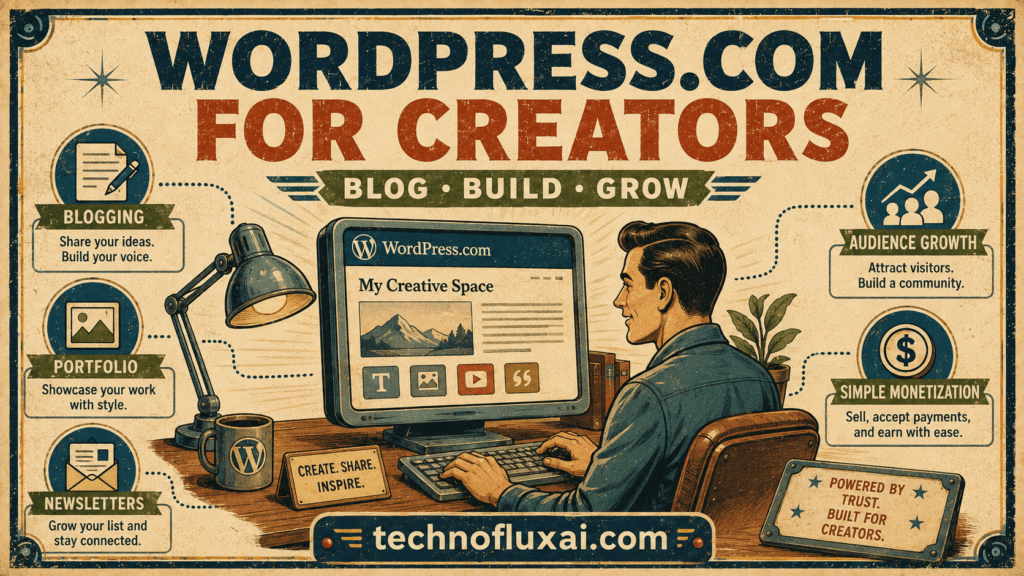
Ready to Try WordPress.com?
Build your blog, portfolio, newsletter, or creator website with WordPress.com. Explore the available plans and choose the setup that fits your needs.
See WordPress.com PlansAffiliate disclosure: TechnofluxAI may earn a commission if you purchase through this link, at no extra cost to you.
Why I Keep Choosing WordPress
The Block Editor Makes Building Easier
The block system is one of my favorite parts of WordPress.
Instead of treating an entire page as one giant piece of content, WordPress lets you work with individual elements such as paragraphs, headings, images, buttons, columns, videos and other components.
Blocks can be moved around so you can build pages piece by piece.
Professional development skills are not required to create something useful.
A learning curve still exists, but if you are willing to learn a minimal amount of website building, I think WordPress is one of the strongest options available.
Reusable Patterns Save Me Time
Reusable patterns are one of those WordPress features that I appreciate more the longer I use the platform.
For example, on TechnofluxAI I can create a recommendation card once and reuse it in articles where that recommendation makes sense.
That creates consistency and means I do not have to manually rebuild the same design again and again.
The same idea can work for author boxes, disclosures, newsletter signups, product recommendations, warnings, resource boxes and many other repeated elements.
There Are Tons of Themes
I also like the basic themes available for WordPress.
You can start simple and customize things as you learn.
If you would rather make the design process easier, there are also premium themes and other design tools available.
That gives WordPress an advantage I value: you can start simple without being permanently stuck with a simple website.
WordPress Has an Enormous Ecosystem
This is probably the biggest reason I am comfortable continuing to build websites with WordPress.
The ecosystem includes tools for SEO, analytics, ecommerce, forms, email marketing, caching, security, affiliate marketing, AI, image optimization, social sharing and almost every other website function you can think of.
You do not need all of them.
In fact, installing too many tools can make a site harder to manage.
But having those choices means your website can evolve as your needs change.

Affiliate disclosure: TechnofluxAI may earn a commission if you sign up through this link, at no extra cost to you.
WordPress Is Still Everywhere
WordPress is not a small niche website builder.
According to W3Techs data from September 2026, WordPress is used by about 40.7% of all websites. Among websites using a known content management system, its market share is about 58.9%.
That scale matters to me.
It means there is a massive ecosystem of developers, designers, plugins, themes, tutorials and businesses supporting the platform.
No platform is guaranteed to dominate forever, but WordPress has built an ecosystem that would be extremely difficult to replace overnight.
AI Is Making WordPress Easier to Build With
This is where I think WordPress is becoming particularly interesting.
Website building is changing quickly because of AI.
Instead of starting with a blank page and figuring out everything manually, AI tools can help generate layouts, copy, images, ideas and even entire starting versions of websites.
WordPress.com now offers an AI website builder on its paid plans. It can create a starting website from a prompt and then let you continue customizing the design, pages, colors, fonts and content.
Even so, AI does not remove the need to understand your website.
What it does is lower the amount of work required to get from an idea to something you can actually edit.
For beginners, that could make WordPress much less intimidating than it used to be.
Who I Think WordPress.com Is Best For
I would seriously consider WordPress.com if you want WordPress but do not want to spend as much time thinking about hosting infrastructure.
It makes the most sense for:
- Beginners building their first serious website
- Bloggers
- Content creators
- Freelancers
- Small businesses
- People who want WordPress without managing as much hosting technology
- Creators who expect their website to grow over time
Who Might Prefer Self-Hosted WordPress?
WordPress.com is not automatically the right choice for everybody.
For my own sites, I use WordPress with Bluehost because I like having control over my hosting environment and the way my sites are configured.
Someone who enjoys managing hosting, experimenting with server-level tools or choosing every part of the hosting setup may prefer self-hosting WordPress.
That is one of the reasons I like the WordPress ecosystem in general.
You have choices.
What I Like Most
- Flexible block-based page building
- Reusable patterns and site elements
- Huge plugin and integration ecosystem
- Large selection of free and paid themes
- Works for simple websites as well as larger projects
- Large community and knowledge base
- AI tools are making setup easier
- You can change and expand the site over time
What I Would Change
WordPress is powerful partly because there are so many choices, but that can also be one of its weaknesses.
A beginner can quickly end up looking at themes, plugins, hosting providers, page builders, security tools and SEO tools without knowing which ones they actually need.
There is also still a learning curve.
No one should expect to open WordPress and immediately understand everything.
But you do not need to understand everything.
Start with the blocks. Next, learn how pages and posts work. Choose a clean theme, then add tools only when you actually need them.
That is enough to get started.

About the Author
Jon Hicks
Founder of TechnofluxAI.
I’m the creator behind TechnofluxAI, focused on breaking down powerful AI tools, emerging trends, and practical strategies to help creators and entrepreneurs stay ahead in a rapidly evolving digital world.
Follow TechnofluxAI for the latest AI tools & strategies