Why AI-Generated Videos Can Get Low Views
We’ve been testing AI-generated short-form video rather than assuming every weak result has the same cause. The results haven’t been neat enough to support the popular theory that “TikTok hates AI.”
We’ve had a 47-second AI video generate a product sale despite weak retention. We’ve posted seven-second videos that received very little distribution. And we’ve had other AI-generated videos reach hundreds of viewers organically.
That doesn’t prove AI has no effect on performance. It does show why looking at the view count alone can lead you to the wrong conclusion.
TikTok’s own documentation separates two issues that creators often mix together. First, there are rules governing AI-generated content and disclosure. Second, there is the recommendation system that decides which eligible videos viewers are likely to see.
TikTok currently says creators should disclose content that is completely generated or significantly edited by AI and requires labeling for realistic AI-generated content in situations covered by its policies. More importantly for this discussion, TikTok says that turning on its AI-generated content setting does not affect distribution by itself as long as the video follows its Community Guidelines.
AI disclosure is not the same as a distribution penalty
If a video drops to 20, 50, or 100 views after you start using AI, the AI label is an easy thing to blame. But TikTok’s published guidance doesn’t support the idea that applying the label automatically throttles a compliant video.
That means the better question isn’t, “Did the AI label kill my reach?”One Thing I have Learned while building TechnofluxAi is that Ai tools usually sound easier to use than they are in the real world. I like to try things myself, see where I get stuck, and figure out what actually saves time instead of just repeating promisies.That’s the approach I use throughout this site: keep what works, point out what doesn’t, and explain things in a way that makes sense for someone who is still learning. I started out searching for an image creator. That was my first interaction with Ai. I was frustrated by the vast tool list without any real direction on which tool was best. Then I realized how powerful this tool was .and was going to be in the future. Making mistakes has helped me in the choice of articles I write.
3. Look at What Happens in the First Three Seconds
Once recommendation eligibility is ruled out, the opening of the video becomes one of the most useful places to investigate.
TikTok says its recommendation systems consider user interactions such as whether people watch, watch in full, or skip. It also says that for most users, interaction signals that can include time spent watching are generally weighted more heavily than factors such as device settings or location.
That’s why a video can be technically polished, correctly labeled, and completely eligible for recommendation yet still stall.
Open the retention graph and look at the beginning before obsessing over the average.
Questions to ask about the opening
- Is the viewer shown the subject immediately?
- Does the first line create a clear reason to continue?
- Is there visible movement or merely an image being gently animated?
- Does the opening explain too much before anything happens?
- Would the clip still make sense with the sound muted?
- Does the first frame look like an ad before the viewer has any reason to care?
There isn’t one magic three-second retention percentage that guarantees distribution. Treat the opening as a comparison point between your own videos instead.
If Version A immediately loses substantially more people than Versions B and C, that gives you something concrete to test.
4. Test Whether the Video Feels Like a Moving Image Instead of a Video
This matters especially for AI workflows built from generated still images.
A creator can technically turn a still into a video by adding a slow zoom, lip movement, camera drift, or a few animated elements. But the result may still feel static to a viewer.
We’ve also seen reasons to pay attention when animated-still content receives low-quality feedback. That is an observation worth testing, not a claim that TikTok automatically penalizes every AI-animated image.
TikTok has publicly described some extremely short clips and GIF-only videos as examples of low-quality content in its For You eligibility guidance. That doesn’t give us permission to stretch the policy into “animated stills are banned.” It does give us a reason to test richer motion and more original visual information.
Instead of simply animating a still, test:
- camera-angle changes;
- multiple AI-generated scenes;
- product close-ups;
- hand or object movement;
- on-screen demonstrations;
- real-world footage mixed with AI;
- an AI avatar interacting with something rather than only talking to camera.
The goal isn’t movement for movement’s sake. It’s giving the viewer new information as the video progresses.
5. Stop Assuming Shorter Automatically Means Better
One of the easiest mistakes in short-form video testing is deciding that poor retention means the video should simply be shorter.
Our own results make that difficult to defend.
We’ve had seven-second videos receive very little distribution. Meanwhile, a 47-second AI video with weak retention still generated a product sale.
That doesn’t mean 47 seconds is the ideal length either. It means video length and video effectiveness are different measurements.
A seven-second video can fail because viewers don’t understand it, nothing happens, the hook is weak, or the first frame looks uninteresting. A longer video can work because the right viewer stays long enough to understand an offer and act.
Instead of asking, “Should I make everything seven seconds?” compare videos based on what they are supposed to accomplish.
| Format | What to Test | Main Risk | Useful Signal |
|---|---|---|---|
| AI avatar | Hook, voice, facial motion, pacing | Feels generic or obviously scripted | Early retention and comments |
| Animated AI scenes | Scene changes and visual progression | Feels like a moving slideshow | Drop-offs between scenes |
| Real product footage | Demonstration and credibility | Weak creative despite authentic footage | Clicks, saves, sales, and watch time |
6. Distinguish Low Views From Poor Engagement
These sound similar, but they’re different troubleshooting problems.
Low views means relatively few people were shown the video.
Poor engagement means people saw it but didn’t give strong positive signals through watching, sharing, liking, commenting, following, clicking, or taking whatever action matters for the video.
TikTok says recommendations are influenced by multiple categories of information, including user interactions, information about the content, and user information. For the For You feed specifically, those interactions can include watching in full or skipping.
So don’t reduce performance to one metric.
A video with only moderate reach could still be valuable if it brings qualified profile visits, clicks, leads, or sales. Our 47-second sale-producing video is a useful example. Its retention wasn’t impressive, but the business outcome matters more than declaring the video a complete failure because one analytics number looked weak.
7. Run a Controlled Creative Test Before Blaming the Algorithm
The hardest thing about troubleshooting AI-generated videos is that creators often change five variables at once.
A low-view video leads to a shorter script, different music, new hashtags, a new AI generator, a different posting time, a faster voice, and a completely different topic. The next video performs better, but you still don’t know why.
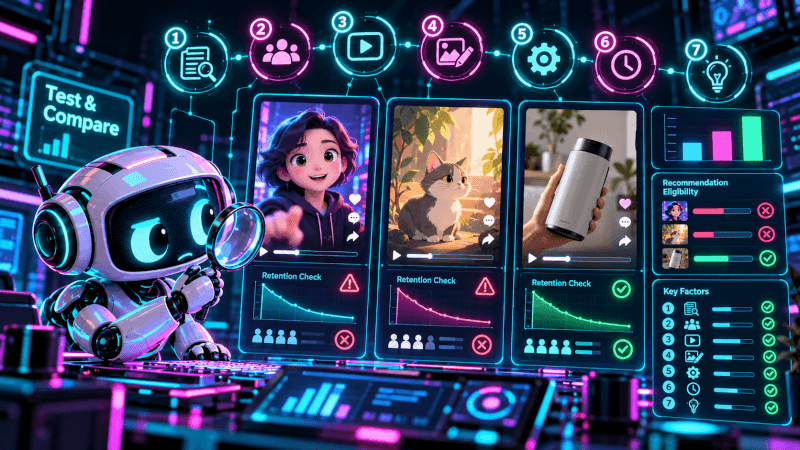
A better experiment is to keep the idea and offer as consistent as possible while changing the production format.
TechnofluxAI three-format experiment
Version A: AI avatar
Use an AI presenter delivering the same basic hook, argument, and CTA.
Version B: AI-generated scenes
Tell the same story using several generated or animated visual scenes instead of a talking avatar.
Version C: Real product footage
Use genuine footage of the product, screen, workflow, or object while keeping the central message as similar as possible.
Then compare the results rather than relying on one video’s view count.
Track these measurements
- video length;
- whether AI disclosure was applied;
- For You recommendation eligibility;
- views after a consistent measurement period;
- retention during the opening seconds;
- average watch time;
- completion behavior;
- likes, comments, shares, and saves;
- profile or product clicks where available;
- sales or leads when the video has a commercial objective.
This isn’t a laboratory experiment. Different viewers can still receive each post, and TikTok’s recommendation system is personalized. But it is far more useful than randomly changing your entire strategy after every weak upload.
A Practical AI Video Troubleshooting Checklist
Before declaring that TikTok is suppressing your AI videos, check these in order:
- Disclosure: If the video needs an AI label, is it properly disclosed?
- Eligibility: Does Analytics show that the post is eligible for the For You feed?
- Account status: Does TikTok Studio’s Account check show a warning?
- Opening: What happens to viewers during the first few seconds?
- Creative quality: Is the video progressing visually, or does it feel like a static image with artificial motion?
- Length: Is the runtime appropriate for the idea rather than merely as short as possible?
- Outcome: Did the video generate useful actions even if its raw views or retention were unimpressive?
What Our Testing Has Changed About How We Look at Low Views
The biggest lesson so far is that “AI-generated videos get low views” is too simple to be useful.
We’ve seen AI videos reach hundreds of people organically. We’ve seen very short videos go almost nowhere. We’ve also seen a longer AI-generated video produce a real product sale despite retention numbers that could easily have convinced us the creative was a failure.
Those results don’t prove that AI format never matters. They tell us to test the format instead of turning it into the explanation before we’ve looked at the evidence.
There is also an important difference between what TikTok documents and what creators infer from their dashboards.
TikTok documents AI disclosure requirements. It documents recommendation factors. It documents For You eligibility and ways to appeal an ineligible post. It also documents examples of low-quality and unoriginal content.
What it does not give creators is a simple formula saying that an AI video with a certain retention rate, length, visual style, or AI label will receive a specific number of views.
That’s where controlled testing becomes more useful than algorithm folklore.
Frequently Asked Questions
Does TikTok reduce views because a video has an AI-generated label?
TikTok’s current support documentation says turning on its AI-generated content setting will not affect distribution as long as the content follows its Community Guidelines. That doesn’t guarantee a labeled video will perform well. It means the label itself should not automatically be treated as the cause of low reach.
Can an AI video be allowed on TikTok but not recommended?
Yes. TikTok distinguishes between content that is allowed to remain on the platform and content that qualifies for recommendation in the For You feed. If TikTok determines that a post is ineligible, creators can review the reason in Analytics and may be able to appeal.
Are seven-second TikTok videos better than longer videos?
Not automatically. Our own tests include seven-second videos with very little distribution and a 47-second AI video that generated a product sale. Length should be treated as a test variable, not a universal shortcut.
Should I stop using AI-generated video if my views fall?
Not based on views alone. First check eligibility and account status. Then compare the hook, early retention, creative format, watch behavior, engagement, and business outcome against your other posts. If real footage consistently outperforms AI versions of comparable ideas, that’s useful evidence. One weak upload isn’t.
Before You Blame the Algorithm
When AI-generated videos get low views, the algorithm is tempting to blame because it’s the one part of the system you can’t see.
But there are several things you can inspect.
You can verify recommendation eligibility. You can check whether the AI disclosure is correct. You can study the opening seconds. You can compare static-looking animation with richer scenes. You can stop assuming shorter is always better. And you can measure actions such as clicks and sales instead of judging every video by views alone.
Most importantly, you can run controlled tests.
That’s the approach we’re taking at TechnofluxAI: treat AI video performance as something to investigate rather than something to explain with a convenient algorithm theory.
Want more TechnofluxAI in Google?
Add TechnofluxAI as a Preferred Source to help Google show you more of our AI guides, tests, workflows, and research.