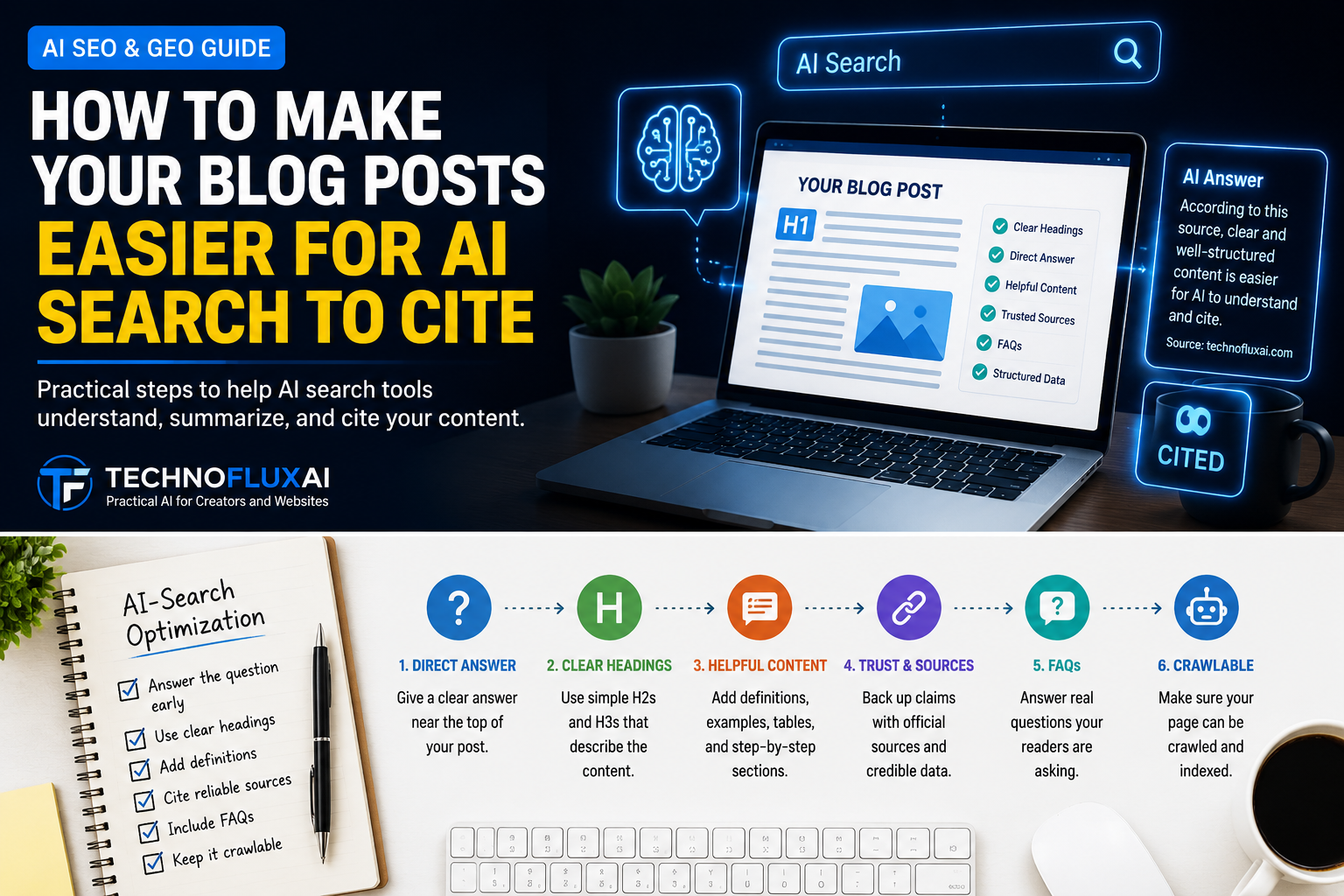
AI search is changing how people find answers online, but the basic goal has not changed: your content still needs to be clear, useful, crawlable, and trustworthy.
Before publishing, link naturally to official sources such as Google Search Central guidance on AI features, Google helpful content guidance, Google structured data documentation, OpenAI ChatGPT search information, and OpenAI crawler documentation if discussing crawler controls.
AI SEO / GEO Guide
Make Your Blog Posts Easier for AI Search to Cite
AI search is changing how people discover answers, but the winning page still has to be clear, useful, crawlable, and trustworthy.
This guide shows bloggers, creators, WordPress site owners, and affiliate publishers how to structure posts so both readers and AI-powered search systems can understand them faster.
How do you make a blog post easier for AI search to cite?
To make a blog post easier for AI search to cite, answer the main question near the top, use plain headings, define important terms, add useful FAQs, cite trustworthy sources, and make sure the page is crawlable and indexable.
AI search visibility is never guaranteed, but a clear, helpful, source-supported page gives both readers and search systems a better page to understand.
A practical AI SEO and GEO checklist for making blog posts easier to understand, summarize, and cite.
Explore More AI Guides from TechnofluxAI
Continue exploring practical guides on AI tools, AI search visibility, GEO, automation, workflows, and creator productivity.
Trusted AI & Search Resources
These official resources are useful for checking documentation, search guidance, structured data, and major AI platforms.
The Big Idea
What It Means for AI Search to Cite Your Content
When people talk about being cited by AI search, they usually mean an AI-powered search experience uses their page as a supporting source, reference, or link inside an AI-generated answer.
This can happen across search and answer tools that summarize information from multiple sources. The systems are different, but the practical lesson is similar: pages that are easy to understand, summarize, and verify are better prepared than pages that are vague, thin, blocked, or messy.
The TechnofluxAI rule
Do not write for robots. Write for humans in a way that machines can clearly parse.
Comparison
Traditional SEO vs AI Search / GEO
Traditional SEO focuses on helping a page rank in search results. GEO, or generative engine optimization, focuses on making content easier for AI-powered answer systems to understand, summarize, and potentially cite.
Focus
Traditional SEO
AI Search / GEO
Main goal
Rank and earn clicks
Be understood, summarized, and cited
Content need
Helpful page that matches search intent
Clear answer with structure and source support
Technical need
Crawlable and indexable page
Crawlable, indexable, snippet-friendly page
Best format
Useful headings and complete coverage
Direct answers, definitions, steps, FAQs, and examples
Bad habit
Keyword stuffing
Vague AI filler and unsupported claims
DataFlux Workflow
The Simple AI Search Citation Checklist
1
Answer the main question early
Put the direct answer in the first screen of the article. Do not bury the useful part under a long intro.
2
Use plain H2s and H3s
Headings should explain what the section covers. Clear beats clever when readers are scanning.
3
Define beginner terms
Explain terms like GEO, AI search visibility, crawlability, indexing, schema, and snippets in plain language.
4
Support factual claims
Use official documentation, platform guidance, original research, or trusted references when making important claims.
5
Add useful FAQs
Answer real beginner questions. Avoid keyword-stuffed fake questions that do not help the reader.
6
Keep the page crawlable
Check indexing settings, robots.txt, visible text, internal links, metadata, and structured data accuracy.
Rewrite Example
Weak vs Better Opening
Weak
AI is changing everything online, and bloggers need to adapt to the new future of search.
Better
To make a blog post easier for AI search to cite, answer the main question near the top, use clear headings, define terms, cite trustworthy sources, and make sure the page can be crawled and indexed.
Page Structure
How to Structure a Blog Post for GEO
1. Quick Answer Box
Add a short answer near the top so readers and search systems can understand the main point quickly.
2. Step-by-Step Section
If the article teaches a process, break it into steps instead of one giant block of advice.
3. Comparison Table
Use tables when readers need to compare ideas, such as SEO vs GEO or weak structure vs stronger structure.
4. FAQ Section
Add concise answers to real beginner questions. Long answers may deserve their own article.
5. Final Checklist
End with a practical checklist so the reader knows exactly what to do next.
Avoid These
What Not to Do
Do Not Stuff Keywords
Use the focus phrase naturally, then write normally.
Do Not Publish Generic AI Filler
AI-assisted writing still needs examples, accuracy checks, human review, and useful detail.
Do Not Promise AI Citations
No checklist, plugin, or prompt can guarantee that an AI search system will cite your page.
Do Not Block Crawlers by Accident
Check visibility settings, SEO plugin indexing settings, robots.txt, snippet controls, and canonical settings.
Final Review
AI Search Optimization Checklist
The main question is clear.
The post answers the question near the top.
H2s and H3s are plain and descriptive.
Beginner terms are defined.
Factual claims are supported by trustworthy sources.
The article includes examples, steps, or checklists.
FAQs answer real reader questions.
The page is indexable.
Important content appears as visible text.
Internal links point to related pages.
Structured data matches the visible content.
The post does not promise guaranteed AI citations.
The content has been reviewed by a human before publishing.
AI search visibility means your content is easy for AI-powered search systems to understand, summarize, link to, or cite when answering a user question.
Is GEO different from SEO?
Yes, but they overlap. SEO focuses on visibility in search engines. GEO focuses on making content easier for generative answer systems to understand and use.
Can small blogs get cited by AI search?
Small blogs can improve their chances by publishing clear, useful, well-structured, crawlable content. But no site can guarantee AI-search citations.
Do FAQs help AI search understand content?
FAQs can help when they answer real questions clearly. They are less useful when they repeat keywords or add shallow filler.
Should I use schema for AI search?
Use structured data when it fits the page and matches the visible content. Do not add fake, irrelevant, or misleading schema just because you hope it will help AI search.
Can I guarantee my content will appear in AI Overviews?
No. You can improve your content structure, usefulness, and technical accessibility, but you cannot guarantee inclusion in AI Overviews or any AI search answer.
What is the first thing to fix in an old blog post?
Start by adding a direct answer near the top. Then clean up headings, add missing definitions, verify claims, improve FAQs, and check that the page is indexable.
Trust Notes
Source Notes Before Publishing
Before publishing, add natural source links to official guidance where needed, especially for claims about Google Search features, structured data, snippet eligibility, ChatGPT search, crawler controls, and helpful content.
? Creator AI Tools Update
AI creator tools are evolving quickly in 2026. Content creators now use AI systems for video editing, voice generation, thumbnails, workflow automation, scripting, image generation, social media planning, and AI-assisted publishing across multiple platforms.
Modern creators are combining AI tools with workflow systems to publish content faster, stay more consistent, improve engagement, and scale content production without large teams.
AI video tools speed up content creation workflows
I’m the creator behind TechnofluxAI, focused on breaking down powerful AI tools, emerging trends, and practical strategies to help creators and entrepreneurs stay ahead in a rapidly evolving digital world.
Follow TechnofluxAI for the latest AI tools & strategies
GOOGLE PREFERRED SOURCE
Want more TechnofluxAI in Google?
Add TechnofluxAI as a Preferred Source to help Google show you
more of our AI guides, tests, workflows, and research.
Cookie Consent
We use cookies to improve your experience on our site. By using our site, you consent to cookies.
Contains information related to marketing campaigns of the user. These are shared with Google AdWords / Google Ads when the Google Ads and Google Analytics accounts are linked together.
90 days
__utma
ID used to identify users and sessions
2 years after last activity
__utmt
Used to monitor number of Google Analytics server requests
10 minutes
__utmb
Used to distinguish new sessions and visits. This cookie is set when the GA.js javascript library is loaded and there is no existing __utmb cookie. The cookie is updated every time data is sent to the Google Analytics server.
30 minutes after last activity
__utmc
Used only with old Urchin versions of Google Analytics and not with GA.js. Was used to distinguish between new sessions and visits at the end of a session.
End of session (browser)
__utmz
Contains information about the traffic source or campaign that directed user to the website. The cookie is set when the GA.js javascript is loaded and updated when data is sent to the Google Anaytics server
6 months after last activity
__utmv
Contains custom information set by the web developer via the _setCustomVar method in Google Analytics. This cookie is updated every time new data is sent to the Google Analytics server.
2 years after last activity
__utmx
Used to determine whether a user is included in an A / B or Multivariate test.
18 months
_ga
ID used to identify users
2 years
_gali
Used by Google Analytics to determine which links on a page are being clicked
30 seconds
_ga_
ID used to identify users
2 years
_gid
ID used to identify users for 24 hours after last activity
24 hours
_gat
Used to monitor number of Google Analytics server requests when using Google Tag Manager
1 minute
Marketing cookies are used to follow visitors to websites. The intention is to show ads that are relevant and engaging to the individual user.
OptinMonster is a powerful lead generation tool that helps businesses convert visitors into subscribers and customers.