

Estimated reading time: 15 minutes
DataFlux Guide • AI Email Marketing
15 Best AI Tools for Email Marketing in 2026
Choosing the right AI email marketing tool can save hours every week, but the best platform is not always the one with the longest feature list. Your best choice depends on what you are building: a simple newsletter, a creator business, an ecommerce store, a service funnel, or a full customer journey with automation.
This guide compares the best AI tools for email marketing based on practical use cases, beginner-friendliness, automation features, AI writing support, ecommerce tools, CRM connection, and overall fit for creators, bloggers, small businesses, and website owners.
DataFlux Quick Take
Most beginners should start with MailerLite or Brevo. Creators will usually get more value from Kit or beehiiv. Advanced automation needs point toward ActiveCampaign, while ecommerce brands should compare Omnisend and Klaviyo. Businesses that want email connected to CRM data should start with HubSpot.
Affiliate disclosure: This article may contain affiliate links. TechnofluxAI may earn a commission if you buy through our links, at no extra cost to you. Every recommendation is based on practical use cases, feature fit, beginner value, and workflow usefulness.
Quick Answer: What Are the Best AI Tools for Email Marketing?
The best AI tools for email marketing in 2026 are MailerLite, Kit, ActiveCampaign, GetResponse, Brevo, HubSpot, Omnisend, Klaviyo, Mailchimp, Constant Contact, beehiiv, Moosend, Sender, Drip, and Zoho Campaigns. Beginners should usually start with MailerLite or Brevo, creators should compare Kit and beehiiv, ecommerce stores should compare Omnisend and Klaviyo, and advanced marketers should look at ActiveCampaign or HubSpot.
Best AI Email Marketing Tools by Use Case
Not sure where to start? Use this quick guide before comparing every feature.
MailerLite
A strong pick for simple newsletters, signup forms, landing pages, and basic automations without a steep learning curve.
Kit
A creator-friendly choice for bloggers, coaches, newsletter writers, course sellers, and digital product businesses.
ActiveCampaign
Built for businesses that need advanced automations, segmentation, sales follow-ups, and customer journeys.
Klaviyo
Designed for ecommerce brands that want customer data, predictive analytics, email, SMS, and product personalization.
Brevo
A practical option for small businesses that want email, SMS, CRM-style tools, automation, and AI content help.
HubSpot
Works best when email marketing needs to connect with contacts, forms, sales data, landing pages, and CRM workflows.
AI Email Marketing Tools Comparison Table
This table gives you the fastest way to compare the tools. Since pricing, free plans, and AI features can change, always check the current plan page before buying.
| Tool | Best For | AI Strength | Best Fit |
|---|---|---|---|
| MailerLite | Beginners and small businesses | AI writing, simple automation, campaign help | Newsletters, landing pages, welcome sequences |
| Kit | Creators and bloggers | Creator-focused email workflows | Audience growth, launches, digital products |
| ActiveCampaign | Advanced automation | AI campaign building, predictive sending, workflow support | Funnels, sales follow-ups, segmented journeys |
| GetResponse | All-in-one marketing | AI email generation and campaign tools | Funnels, landing pages, webinars, email campaigns |
| Brevo | Budget-conscious businesses | Aura AI content support and automation help | Email, SMS, CRM-style contact management |
| HubSpot | CRM-connected marketing | AI subject lines, copy, CRM personalization | Lead nurturing, sales teams, inbound marketing |
| Omnisend | Ecommerce email and SMS | AI ecommerce campaign help and product workflows | Shopify, WooCommerce, online stores |
| Klaviyo | Ecommerce personalization | Predictive analytics, AI email/SMS, customer data | Personalized ecommerce lifecycle marketing |
| Mailchimp | General small business marketing | AI creative tools and automation support | Newsletters, promotions, simple campaigns |
| Constant Contact | Local businesses and nonprofits | AI writing help and beginner templates | Announcements, events, local promotions |
| beehiiv | Newsletter operators | AI writing inside newsletter workflows | Publishing, growth, referrals, monetization |
| Moosend | Affordable automation | AI writer, segmentation, automation workflows | Small teams and budget-friendly campaigns |
| Sender | Simple low-cost email marketing | Templates, segmentation, basic automation | Basic newsletters and small business campaigns |
| Drip | Ecommerce customer journeys | Behavior-based automation and segmentation | Online stores and ecommerce lifecycle flows |
| Zoho Campaigns | Zoho ecosystem users | Campaign automation and CRM connection | Businesses already using Zoho tools |
How to Decide on the Right AI Email Marketing Tool
Before you pick a platform, decide what job the tool needs to do. A beginner newsletter does not need the same software as a Shopify store with abandoned cart flows, product recommendations, and SMS campaigns.
Choose simplicity if you are new
When you only need a signup form, a welcome sequence, and weekly newsletters, choose a beginner-friendly tool before paying for advanced automation.
Choose automation if follow-up matters
Leads that need different paths based on clicks, purchases, tags, or behavior require stronger workflow builders and segmentation.
Select ecommerce data if you sell products
Online stores should prioritize product data, abandoned cart flows, customer segments, and predictive analytics over generic newsletter features.
The 15 Best AI Tools for Email Marketing
1. MailerLite
Best for: Beginners, bloggers, small businesses, and simple newsletters.
MailerLite is one of the easiest AI email marketing tools to start with because it keeps the core workflow clean. You can create signup forms, build landing pages, send newsletters, and set up basic automations without feeling buried in enterprise-level features.
Creators, local businesses, bloggers, and website owners can use it to move from “I need an email list” to “I have a working welcome sequence” without overcomplicating the process.
- Use it for: newsletters, forms, landing pages, welcome sequences, lead magnets
- Best AI value: faster campaign writing and simple workflow support
- Watch out for: less depth than advanced automation or ecommerce-first platforms
2. Kit
Best for: Creators, bloggers, coaches, newsletter writers, and digital product sellers.
Kit is built around creator businesses. It works well when your email list is connected to content, launches, courses, memberships, paid newsletters, or digital products.
Rather than trying to be a huge all-in-one CRM, Kit focuses on helping creators build relationships with subscribers and turn content into revenue.
- Use it for: creator newsletters, launch sequences, digital products, lead magnets
- Best AI value: creator workflow support and faster email production
- Watch out for: not the best match for deep ecommerce personalization
3. ActiveCampaign
Best for: Advanced automation, segmented funnels, and sales follow-up.
ActiveCampaign is a strong choice if you need deeper automations. Its workflow tools can support branching logic, predictive sending, AI-assisted campaign building, lead nurturing, and behavior-based follow-ups.
Brand-new email lists may not need this much power, but the platform becomes useful when campaigns require more logic than a basic welcome sequence.
- Use it for: advanced automations, lead scoring, segmented campaigns, sales journeys
- Best AI value: AI campaign and automation support
- Watch out for: more complexity than beginner tools
4. GetResponse
Best for: All-in-one campaigns, funnels, landing pages, and email marketing.
GetResponse is a good option if you want more than email newsletters. The platform combines campaign creation, landing pages, automation, forms, funnels, and AI writing support in one place.
Small businesses that do not want to connect too many tools can use it to run basic campaigns and collect leads from a single dashboard.
- Use it for: funnels, lead generation, landing pages, newsletters, promotions
- Best AI value: faster campaign creation and email copy support
- Watch out for: may feel heavier than a simple newsletter tool
5. Brevo
Best for: Budget-conscious small businesses that want email, SMS, and automation.
Brevo is a practical platform for small businesses that want more than basic email newsletters. It includes email marketing, SMS options, automation, contact management, and AI content help through Aura.
Teams that want a flexible marketing system without jumping straight into a more expensive CRM or automation platform may find Brevo a good middle ground.
- Use it for: email campaigns, SMS, automations, contact management, small business marketing
- Best AI value: Aura AI content generation and campaign support
- Watch out for: some features may depend on plan level
6. HubSpot
Best for: CRM-connected email marketing.
HubSpot is best when email marketing needs to connect with sales, forms, contacts, landing pages, and CRM data. Its AI tools can help write email copy, create subject lines, and personalize follow-ups based on contact engagement.
That makes it a strong fit for service businesses, B2B companies, sales teams, and brands building a full inbound marketing system.
- Use it for: CRM email, lead nurturing, sales follow-ups, inbound marketing
- Best AI value: AI copy, subject lines, and CRM-based personalization
- Watch out for: advanced features can become expensive
7. Omnisend
Best for: Ecommerce email and SMS marketing.
Omnisend is built for ecommerce brands that want email, SMS, popups, automations, and product-focused campaigns. Shopify, WooCommerce, and other online stores can use it for abandoned cart emails, welcome flows, promotional campaigns, and customer segmentation.
Because the workflows are built around selling products, ecommerce beginners may find Omnisend more focused than a generic email platform.
- Use it for: ecommerce email, SMS, abandoned cart flows, product promos
- Best AI value: ecommerce campaign help and product-focused automation
- Watch out for: less useful if you do not run an online store
8. Klaviyo
Best for: Ecommerce personalization and customer data.
Klaviyo is one of the strongest AI email tools for ecommerce brands. It combines email, SMS, customer profiles, product data, audience groups, smart predictions, and custom emails.
Stores with enough customer and product data can use Klaviyo to create more relevant messages based on behavior, purchase history, and predicted customer value.
- Use it for: ecommerce lifecycle marketing, product recommendations, customer segmentation
- Best AI value: predictive analytics and data-driven personalization
- Watch out for: may be too advanced for tiny stores or non-ecommerce sites
9. Mailchimp
Best for: General small business email marketing.
Mailchimp is still one of the most recognizable email marketing platforms for small businesses. The platform works for newsletters, promotions, forms, automations, audience management, and beginner-friendly campaign creation.
Businesses that want a familiar email platform with broad integrations and AI-assisted creative tools may find it a practical fit.
- Use it for: newsletters, promotions, small business campaigns, audience updates
- Strongest AI value: creative assistance and campaign support
- Watch out for: pricing and limits can become frustrating as your list grows
10. Constant Contact
Best for: Local businesses, nonprofits, events, and beginner campaigns.
Constant Contact is a practical email marketing tool for users who want guided campaign creation, simple templates, and local business-friendly features. Announcements, newsletters, events, seasonal promos, and customer updates are all good fits for the platform.
Although it is not the most advanced AI automation platform, it stays approachable for users who want straightforward email marketing.
- Use it for: local promos, nonprofit updates, events, newsletters
- Best AI value: beginner writing help and campaign guidance
- Watch out for: not as deep as automation-first platforms
11. beehiiv
Best for: Newsletter creators and media-style publishing.
beehiiv is built for newsletter operators who care about writing, publishing, audience growth, referrals, and monetization. Rather than acting like a traditional email marketing platform, it feels more like a newsletter growth system.
Because its AI features are built directly into newsletter workflows, creators can write faster while still keeping control over voice and structure.
- Use it for: newsletters, referral programs, audience growth, monetization
- Best AI value: newsletter-first writing support
- Watch out for: less ideal for complex ecommerce automations
12. Moosend
Best for: Affordable automation and email campaigns.
Moosend is a good fit for users who want email automation, segmentation, templates, and AI writing support without choosing a larger enterprise tool. Small businesses, bloggers, and lean teams can use it to build automation on a tighter budget.
- Use it for: newsletters, automations, promotions, segmentation
- Best AI value: AI writing help and automation support
- Watch out for: fewer brand-name integrations than larger platforms
13. Sender
Best for: Simple, low-cost email marketing.
Sender is useful for small businesses that want basic email campaigns, templates, signup forms, segmentation, and automations without a complicated setup. For teams that want to start sending emails without overbuilding their tech stack, it is a practical choice.
- Use it for: simple newsletters, basic automation, small business campaigns
- Best AI value: faster campaign setup and simple marketing workflows
- Watch out for: not the strongest option for advanced AI or CRM-heavy teams
14. Drip
Best for: Ecommerce customer journeys.
Drip is built around ecommerce marketing automation and behavior-based workflows. Stores can use it to create campaigns based on customer actions, purchases, product interest, and lifecycle stage.
- Use it for: ecommerce flows, customer journeys, product promotions
- Best AI value: behavior-based segmentation and automation logic
- Watch out for: less useful for simple newsletters or creator-only businesses
15. Zoho Campaigns
Best for: Businesses already using Zoho.
Zoho Campaigns makes the most sense if your business already uses Zoho CRM or other Zoho apps. With it, you can manage email campaign tools, automation, segmentation, and ecosystem connection without moving contact data into a separate platform.
- Use it for: Zoho-connected campaigns, CRM email, business newsletters
- Best AI value: campaign optimization inside the Zoho ecosystem
- Watch out for: less compelling if you do not use Zoho already
Which AI Email Marketing Tool Should You Choose?
Here is the simplest decision path:
- Pick MailerLite if you want the easiest beginner-friendly email tool.
- Select Kit if you are a creator, blogger, coach, or digital product seller.
- Use beehiiv if your business is newsletter-first.
- Try Brevo if you want a budget-friendly email and SMS platform.
- Pick ActiveCampaign if you need advanced automations and segmented journeys.
- Choose HubSpot if email marketing needs to connect to CRM and sales data.
- Go with Omnisend if you run an ecommerce store and want a simpler store-focused email/SMS tool.
- Choose Klaviyo if ecommerce personalization and customer data are your top priorities.
What AI Features Actually Matter for Email Marketing?
Do not choose a platform just because it says “AI” on the homepage. The most useful AI features are the ones that remove real friction from your workflow.
AI subject lines
These help you test angles, improve clarity, and create more options before you send.
AI email copy
This is useful for first drafts, rewrites, welcome emails, promos, newsletters, and product announcements.
Smart segmentation
Segmentation helps group subscribers by behavior, clicks, purchases, engagement, or interest.
Send-time optimization
This feature helps send emails when subscribers are more likely to open or click.
Predictive analytics
Predictive tools are most useful for ecommerce stores with enough customer and purchase data.
Automation suggestions
These can help you create welcome sequences, abandoned cart flows, reactivation emails, and sales follow-ups.
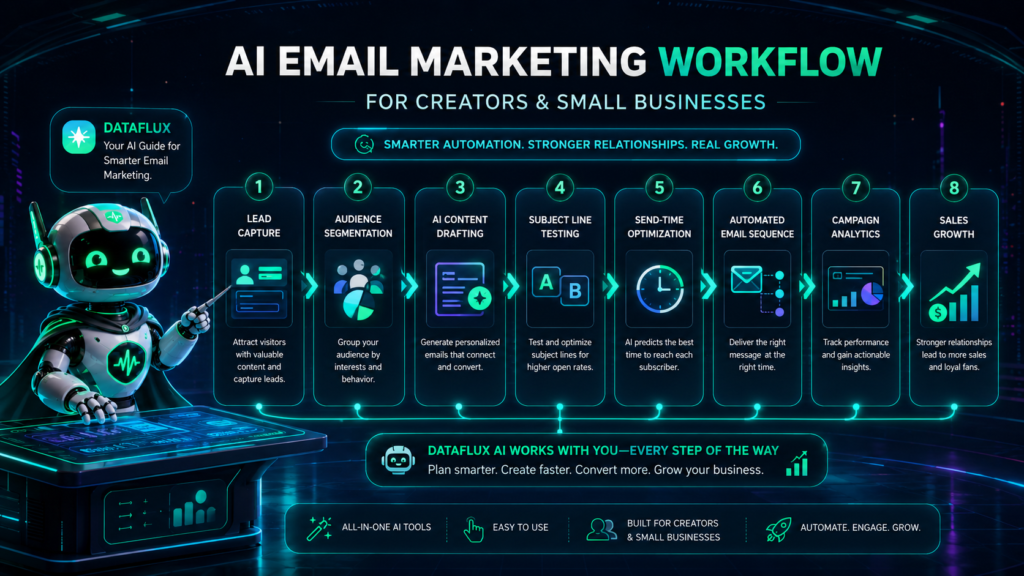
Beginner AI Email Marketing Workflow
If you are new to email marketing, keep your first workflow simple. A giant funnel is not necessary on day one.
- Create one signup form for your website.
- Offer one clear reason to subscribe.
- Write a 3-email welcome sequence.
- Send one useful newsletter each week.
- Use AI to improve subject lines and simplify rough drafts.
- Review opens, clicks, replies, and unsubscribes.
- Add segmentation after you have enough subscriber behavior to work with.
DataFlux tip: Start with consistency before complexity. A simple email system that gets used every week is better than an advanced automation map that never gets finished.
FAQ: AI Tools for Email Marketing
What is the best AI tool for email marketing?
The best AI tool for email marketing depends on your business. MailerLite is a strong beginner choice, Kit works well for creators, ActiveCampaign is best for advanced automation, Klaviyo is strong for ecommerce personalization, and HubSpot is a smart pick when email needs to connect with CRM data.
Can AI write marketing emails for me?
Yes. Many email marketing platforms now include AI tools that can help write subject lines, preview text, email copy, campaign ideas, and product announcements. You should still edit the message so it sounds like your brand and matches your audience.
Are AI email marketing tools good for small businesses?
Yes. AI email tools can help small businesses create campaigns faster, test ideas, write better subject lines, automate follow-ups, and segment subscribers. The key is choosing a tool that fits your current stage instead of paying for features you will not use yet.
What is the best free AI email marketing tool?
MailerLite, Brevo, Kit, Omnisend, beehiiv, Mailchimp, Sender, and Zoho Campaigns often have free plan options, but limits can change. Before choosing, check each pricing page for current subscriber limits, send limits, automation access, branding, and AI feature availability.
What AI email tool is best for ecommerce?
Klaviyo and Omnisend are two of the strongest ecommerce choices. Klaviyo is better for deeper personalization and customer data, while Omnisend is often easier for stores that want ecommerce email and SMS automations with a simpler setup.
Do AI email marketing tools improve open rates?
They can help, but they do not guarantee better open rates. AI can improve subject lines, send timing, segmentation, and testing ideas, but results still depend on your list quality, sender reputation, offer, audience trust, and email relevance.
Should beginners use ActiveCampaign?
Beginners can use ActiveCampaign, but it is usually better for users who already need advanced automations. If you only need a simple newsletter, signup form, and welcome sequence, MailerLite, Kit, or Brevo may feel easier.
Keep Building Your AI Marketing Stack
After you choose an email platform, the next step is building a repeatable content and automation workflow.
For automation
Final Verdict
The best AI email marketing tool is the one that matches your current workflow. Beginners should focus on simple setup and consistent sending. Creators should prioritize audience growth and monetization. Ecommerce stores need product data, abandoned cart flows, customer segmentation, and personalized recommendations. Advanced marketers should look for automation depth, CRM connection, and performance insights.
DataFlux pick for most beginners: Start with MailerLite if you want the simplest path. Choose Kit if you are building a creator business. Pick Brevo if budget and multichannel tools matter. Move to ActiveCampaign when you are ready for deeper automation. Use Omnisend or Klaviyo if ecommerce is your main business model.
? Creator AI Tools Update
AI creator tools are evolving quickly in 2026. Content creators now use AI systems for video editing, voice generation, thumbnails, workflow automation, scripting, image generation, social media planning, and AI-assisted publishing across multiple platforms.
Modern creators are combining AI tools with workflow systems to publish content faster, stay more consistent, improve engagement, and scale content production without large teams.
- AI video tools speed up content creation workflows
- Workflow automation helps creators stay consistent
- Short-form video content continues dominating social traffic
- AI image systems improve thumbnails and visual branding
- Cross-platform publishing workflows are becoming essential