

What It’s Like Learning This While Everything Keeps Changing
One thing I don’t think an AI-generated explanation can fully capture is what it feels like to actually run a website while SEO, GEO, and AI search are changing this quickly.
Over the last six months, it has sometimes felt like the strategy changed before I had even finished adjusting to the last one.
At first, rapid article deployment seemed like the way to go. Publish useful content, build out topic clusters, and create enough coverage to establish authority.
Then the conversation shifted heavily toward GEO and visibility inside AI-generated answers. Suddenly, traditional SEO wasn’t the only thing site owners were thinking about. We were asking whether our content could be understood,
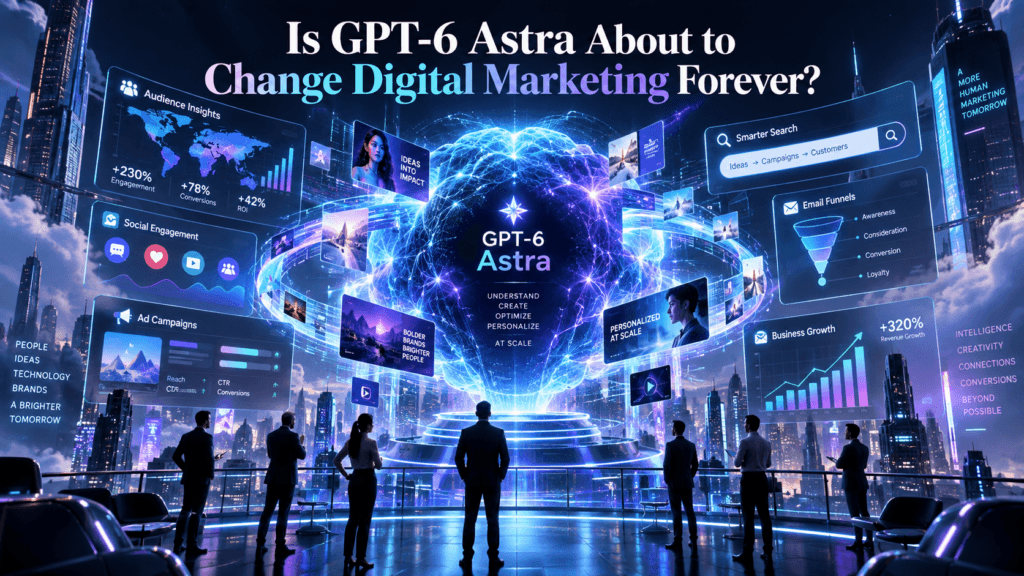
GPT-6 Astra • AI Marketing • Agentic Workflows Quick answer: GPT-6 Astra could change digital marketing in a big way, but probably not because it can write another blog post, email, or social caption. The bigger shift is AI beginning to do more of the work around the content. We’ve spent the last few years watching AI get better at individual marketing tasks. Write this headline. Find some keywords. Rewrite this paragraph. Make an image. Turn this article into an X post. Give me five TikTok hooks. Useful? Absolutely. But you’re still the person moving everything through the system. You research the topic, decide what deserves to exist, write or edit the article, create the images, optimize the page, publish it, repurpose it, distribute it, check the numbers, and decide what happens next. AI has mostly been sitting beside that workflow. GPT-6 Astra points toward something different. OpenAI is positioning GPT-6 Astra as a model for demanding professional work, including computer use, browsing, research, design, writing, and multi-step execution. Its business material gets especially interesting for marketers. OpenAI describes a marketing workflow where Astra can take one brief, develop the messaging, and create coordinated, on-brand assets across channels. That sounds simple until you think about what it means. The job isn’t merely: “Write me an Instagram caption.” The job starts looking more like: “Here is the campaign. Understand the goal, follow the brand, create the assets, work across the necessary tools, and move the project forward.” That’s a much bigger change. Think about a fairly normal TechnofluxAI workflow: Topic → Research → Search intent → Article → Images → SEO → Publish → Pinterest → X → Short video → Performance review → Next decision Historically, we’ve used AI inside individual boxes. The next phase is potentially giving AI several connected boxes at once. That’s why I think people arguing about whether AI can produce a slightly better blog post are looking at the least interesting part of this. The bigger question is: What happens when the AI stops waiting for the next prompt and starts moving through the marketing workflow itself? That’s where GPT-6 Astra could matter. And it’s also where the hype needs a serious reality check.Astra Isn’t Just Another Better Chatbot
The Real Shift: From AI Assistance to AI Execution
One Thing I have Learned while building TechnofluxAi is that Ai tools usually sound easier to use than they are in the real world. I like to try things myself, see where I get stuck, and figure out what actually saves time instead of just repeating promisies.That’s the approach I use throughout this site: keep what works, point out what doesn’t, and explain things in a way that makes sense for someone who is still learning. I started out searching for an image creator. That was my first interaction with Ai. I was frustrated by the vast tool list without any real direction on which tool was best. Then I realized how powerful this tool was .and was going to be in the future. Making mistakes has helped me in the choice of articles I write.
What Astra Could Actually Change for Marketers
The easiest mistake is assuming that better AI means marketers will simply create more stuff.
More posts. More emails. More graphics. More videos.
We already know how that story ends.
Cheap production creates more cheap production.
The interesting opportunity is using stronger AI to reduce coordination work instead.
1. One brief could feed multiple channels
A creator normally translates the same idea repeatedly.
You explain the article to the image tool. Then explain it again when making a Pinterest pin. Then again when writing social copy. Then again when planning the short video.
A more capable agent can potentially keep the campaign context intact while producing related assets around the same strategy.
That doesn’t make human review unnecessary.
It makes the handoffs smaller.
2. Research could connect directly to execution
AI research is useful, but somebody still has to turn research into decisions.
An agentic workflow could research a topic, compare the evidence with an existing content library, identify the best angle, prepare the content brief, and carry the approved direction into production.
That’s a much more valuable use of AI than generating 100 keyword variations nobody needed.
3. Marketing operations could become conversational
Today, marketing software is full of dashboards, filters, exports, tabs, menus, and repetitive setup.
The long-term possibility is that more of that interface becomes a conversation about an outcome.
Instead of:
Open five tools → export the data → clean it → compare reports → decide what changed.
You might increasingly ask:
What changed in our traffic this week, which pages deserve attention, what evidence supports that conclusion, and what should we test next?
The software doesn’t disappear.
The amount of manual steering might.
4. Small teams gain leverage that used to require specialists
This part matters for TechnofluxAI readers.
A solo creator isn’t just the writer.
You’re the researcher, editor, SEO person, designer, publisher, social manager, analytics department, and occasionally the person wondering why WordPress broke at 11:30 at night.
Agentic AI doesn’t need to replace all of those roles to matter.
If it removes several repetitive transitions between them, that’s already a meaningful change.
What Astra Does NOT Change
This is where I’m far less interested in the “marketing is over” predictions.
AI can make production easier while simultaneously making some human inputs more valuable.
Original evidence still matters
Astra can summarize ten people testing a product.
It cannot retroactively become the person who performed your test.
If you measured something, documented the process, took the screenshots, found a weird failure, or discovered that the supposedly brilliant workflow falls apart halfway through, you have something different from another summary.
First-party data matters more, not less
If everybody has access to powerful models, public information becomes easier to remix.
Information you actually own becomes more valuable:
- your analytics
- your tests
- your customer questions
- your survey results
- your email audience
- your community
- your historical performance data
- your proprietary processes
Brand becomes harder to fake than output volume
An AI system can produce twenty posts before lunch.
So can everybody else’s AI system.
Volume stops being much of an advantage when volume becomes cheap.
A recognizable point of view, useful experience, consistency, trust, and a reason for somebody to deliberately seek you out become more important.
Stop trying to beat AI at output volume. Build the things AI needs but cannot simply invent.
Our TechnofluxAI GPT-6 Astra Experiment
I don’t want to finish this article by predicting what Astra might someday do from the sidelines.
I want to give it a real marketing job.
So this is the test.
The challenge
Give GPT-6 Astra one real TechnofluxAI marketing brief and see how much of the surrounding workflow it can complete while preserving the strategy, facts, branding, and intent.
The workflow:
- Review the campaign or article brief.
- Research and validate the important claims.
- Define the audience and positioning.
- Build the campaign messaging.
- Create or plan the supporting visual assets.
- Prepare a Pinterest concept.
- Write an X post.
- Develop a short-form video concept.
- Create a basic measurement plan.
- Recommend the next action based on the campaign goal.
What we’re measuring
I care less about whether every output looks polished and more about how much genuine coordination Astra can handle.
- Accuracy: Did it keep facts straight?
- Brand consistency: Did the outputs actually feel related?
- Context retention: Did it remember the original strategy as the workflow expanded?
- Intervention: How often did I have to stop it, correct it, or redirect it?
- Execution: Did it actually move the project forward or merely suggest what I should do?
- Efficiency: Did the process save meaningful work after review and corrections?
- Trust: Which parts would I let it perform again with less supervision?
Experiment status
This experiment needs to be completed before publication. The results section should use the real screenshots, corrections, failures, time savings, and conclusions from the test. We should not pretend Astra completed steps that we haven’t actually tested.
That last part matters.
If Astra struggles, that’s content.
If it succeeds but burns through an unreasonable amount of usage, that’s content.
If it creates beautiful assets but loses the original strategy halfway through, that’s content.
And if it handles the entire chain surprisingly well, that’s definitely content.
The point isn’t to prove Astra is amazing.
The point is to find out where it actually becomes useful.
The Part of Agentic Marketing That Makes Me Nervous
The more an AI system can do for you, the easier it becomes to depend on it.
Creators should already understand that problem.
We’ve watched businesses become dependent on Google traffic, Facebook reach, TikTok distribution, Amazon, affiliate programs, ad networks, and other platforms they didn’t control.
Agentic AI introduces another version of the same risk.
If your entire marketing operation depends on one proprietary AI platform understanding your business, accessing your tools, storing the context, coordinating the workflow, and continuing to offer the features you rely on, you’ve gained enormous convenience.
You’ve also created another dependency.
The lesson isn’t “don’t use AI agents.” It’s don’t confuse convenience with ownership.
Keep the important assets portable
Your strategy shouldn’t exist only inside one AI conversation.
Keep control of your:
- website and domain
- email list
- customer and audience data
- brand guidelines
- best-performing prompts
- source material
- original images and video
- analytics history
- workflow documentation
Let the AI work with those assets.
Don’t let the AI become the only place those assets make sense.
What Creators Should Start Doing Now
Build evidence, not just content
Run the test.
Save the screenshot.
Record what failed.
Measure the result.
Keep the weird edge case.
That material becomes more valuable when generic explanation becomes easier to generate.
Document your workflows
If you want an AI agent to help run a process, the process needs to exist somewhere outside your head.
Document what “good” looks like.
Define your research standards, brand rules, approval points, naming conventions, publishing checklist, analytics process, and things the system should never do automatically.
Good agents still need good systems.
Decide what requires your judgment
Not every task deserves the same amount of automation.
I would be much more comfortable delegating repetitive formatting or asset preparation than giving an AI permanent authority over what TechnofluxAI publishes.
That boundary will be different for every creator.
Figure yours out before the software figures it out for you.
Experiment before you rebuild everything
You don’t need to turn your entire business into an autonomous AI machine this week.
Pick one workflow.
Give the agent a real objective.
Watch it carefully.
Record where it succeeds and where you intervene.
Then decide whether it deserves more responsibility.
So, Is GPT-6 Astra Going to Change Digital Marketing Forever?
Potentially.
But I don’t think the biggest change is going to be better AI writing.
We’ve had AI writing for years.
The bigger shift is AI becoming capable of operating across more of the system surrounding that writing: research, planning, assets, tools, distribution, analysis, and follow-up.
That could eliminate a surprising amount of repetitive marketing work.
It won’t eliminate the need for ideas worth pursuing, evidence worth citing, products worth buying, brands worth remembering, communities worth joining, or people worth trusting.
GPT-6 Astra may not kill digital marketing.
It may kill a lot of the repetitive work we’ve been calling digital marketing.
And if that happens, the creators who win probably won’t be the ones who use AI to produce the most.
They’ll be the ones who figure out what should be automated, what should stay human, and what they can build that an AI model cannot simply manufacture on demand.
What I’m Testing Next
We’re putting Astra through a real TechnofluxAI marketing workflow rather than a staged demo.
The useful question isn’t whether it can make an impressive-looking campaign.
It’s how much of the messy work between idea and result it can actually handle without losing the strategy along the way.
That’s the test I’m interested in.