Try CustomGPT.ai
Build an AI agent around your own website, documents, help center, or business knowledge without building the entire system from scratch.
- Build knowledge-based AI agents
- Provide answers with source citations
- Embed an AI assistant on your website
- Create private agents for internal knowledge
- Connect CustomGPT through its API
Affiliate disclosure: This is an affiliate link. If you sign up or make a purchase through it, TechnofluxAI may earn a commission at no extra cost to you. Affiliate relationships do not determine our reviews or recommendations.
CustomGPT.ai is a no-code platform for building AI agents that answer questions from your own websites, documents, help centers, and other knowledge sources. Its strongest use case is not general-purpose chatting. It is giving customers or teams an AI interface to a defined body of business information, with citations and deployment options such as website embeds and private access.
If you’ve ever wanted an AI assistant that can answer questions from your own business information instead of starting from a blank chatbot every time, CustomGPT.ai is built around that problem.
You add the knowledge sources, configure the agent, and then make it available to customers, employees, or other users.
That sounds simple, but there are two important things to understand before treating it as a replacement for every other AI product:
- It is primarily a knowledge-grounded AI agent platform.
- Grounding responses in your sources can improve verifiability, but it does not make every AI answer automatically perfect.
What Is CustomGPT.ai?
CustomGPT.ai lets you build AI agents around information you provide.
Its documentation supports sources such as websites, PDFs, Office documents, help centers, knowledge bases, and other business content.
The agent can then use that material when answering questions.
Core use cases include:
- Customer-service knowledge assistants
- Internal knowledge search
- Product and pre-sales Q&A
- Employee information assistants
- Website chat
- Document-based research and Q&A
- Knowledge retrieval through an API
You can deploy agents through a website embed or live-chat widget, keep them private, use them internally, or connect them through API workflows.
How CustomGPT.ai Works
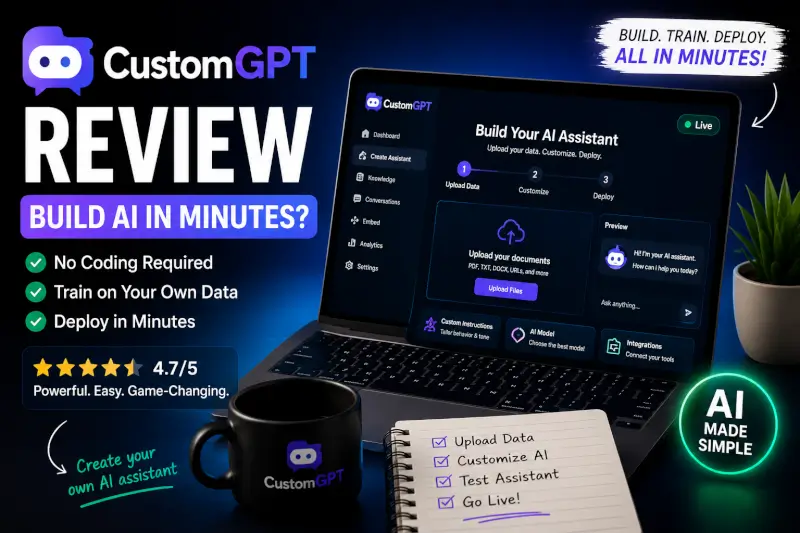
The basic setup is easier to understand if you think of it as three layers.
1. Add your knowledge
Import the documents, pages, or other source material the agent should use.
2. Configure the agent
Set its instructions, behavior, access, appearance, and other options.
3. Deploy it
Make the agent available through a website, private interface, chat widget, or API-based workflow.
That makes CustomGPT different from simply opening a blank general-purpose chatbot and repeatedly pasting company information into individual conversations.
What CustomGPT Does Well
- Source-grounded answers: responses can be tied back to the supplied knowledge base.
- Citations: users can inspect where information came from instead of receiving only an unsupported answer.
- No-code setup: many common deployments do not require building your own retrieval system.
- Multiple agents: plans support several separate agents for different projects or knowledge bases.
- Website deployment: agents can be embedded into websites and chat experiences.
- API access: developers can integrate CustomGPT into broader applications and workflows.

CustomGPT.ai Pricing in 2026
CustomGPT currently offers Standard, Premium, and Enterprise plans.
| Plan | Current Monthly Price | Who It Fits |
|---|---|---|
| Standard | $99/month, or $89/month billed annually | Smaller deployments and teams testing knowledge-based AI agents |
| Premium | $499/month, or $449/month billed annually | Larger knowledge bases, more queries, more agents, and white-label needs |
| Enterprise | Custom pricing | Organizations needing custom limits, advanced security, SSO, engineering help, and larger deployments |
The company currently advertises a 7-day free trial.
Pricing and limits can change, so check the current plan page before making a buying decision.
What You Get on the Standard Plan
- 10 agents
- 1,000 queries per month
- 5,000 documents per agent
- 60 million words of storage capacity
- 3 team members
- RAG API access
What Premium Adds
- 25 agents
- 5,000 queries per month
- 20,000 documents per agent
- 300 million words of storage
- 5 team members
- Automatic website-content synchronization
- Removal of CustomGPT branding
CustomGPT.ai Security and Privacy
Security claims deserve more care than normal marketing claims, so I checked CustomGPT’s current security documentation.
The company states that it is SOC 2 Type 2 compliant across Security, Availability, and Confidentiality and describes support for GDPR requirements.
It also documents:
- Encryption in transit
- AES-256 encryption at rest
- Private agents by default
- No sharing of data between separate agents
- SAML 2.0 authenticated access options
- Business data not being used to train the underlying ChatGPT model
Those are meaningful controls, but businesses handling regulated or sensitive data should still review the company’s current Trust Center, privacy terms, retention policies, access controls, and contractual requirements before deployment.
CustomGPT.ai vs. ChatGPT: The Useful Comparison
The old version of this article treated the comparison as:
ChatGPT = generic and unsafe. CustomGPT = business-ready and accurate.
That comparison is too simplistic in 2026.
ChatGPT Business and Enterprise can now work with organizational data, connected apps, company knowledge, private plugins, and custom integrations. OpenAI also states that Business and Enterprise workspace data is not used to train its models by default.
| CustomGPT.ai | ChatGPT Business / Enterprise |
|---|---|
| Focused heavily on building knowledge-grounded agents | Broader general-purpose AI workspace |
| Website and customer-facing agent deployment is a central use case | Designed more broadly around employee AI work, research, apps, files, agents, and organizational knowledge |
| Knowledge-base citations are central to the product | Can cite connected company-knowledge sources when applicable |
| No-code agent creation around supplied knowledge | Broader agent, plugin, app, and connected-data ecosystem |
| Good fit when the primary job is exposing a defined knowledge base through an AI assistant | Good fit when employees need a flexible AI workspace across many kinds of work |
Neither product should be described as incapable of hallucination.
Grounding responses in approved sources can reduce unsupported answers and make verification easier, but important business responses should still be tested.
Where CustomGPT.ai Makes the Most Sense
Customer Support
Answer recurring questions from an approved help center or documentation set.
Pre-Sales Questions
Help prospects find product, policy, or service information without digging through a site manually.
Internal Knowledge
Give employees a conversational interface to approved company documents.
Education and Documentation
Make large collections of reference material easier to query.
Website Knowledge Assistant
Embed an assistant into a site so users can ask questions directly.
Try CustomGPT.ai
Build an AI agent around your own website, documents, help center, or business knowledge without building the entire system from scratch.
- Build knowledge-based AI agents
- Provide answers with source citations
- Embed an AI assistant on your website
- Create private agents for internal knowledge
- Connect CustomGPT through its API
Affiliate disclosure: This is an affiliate link. If you sign up or make a purchase through it, TechnofluxAI may earn a commission at no extra cost to you. Affiliate relationships do not determine our reviews or recommendations.
Pros and Cons of CustomGPT.ai
| Pros | Limitations |
|---|---|
| Designed specifically around knowledge-grounded AI agents | More specialized than a general-purpose AI workspace |
| Citations make answers easier to verify | Answer quality still depends on the quality of the source material |
| No-code setup for common deployments | Standard pricing may be high for a small site that only needs a basic chatbot |
| Website embedding and live-chat deployment | Usage and document limits vary by plan |
| API access for custom workflows | More advanced integrations can still require technical work |
| Documented business security controls | Businesses still need to evaluate their own privacy and compliance requirements |
Who Should Consider CustomGPT.ai?
It may be a good fit if:
- You have a substantial documentation or knowledge base
- You repeatedly answer the same customer questions
- You want citations back to approved source material
- You want a customer-facing AI assistant on your website
- You want multiple agents trained on different knowledge sets
- You need API access to a knowledge-grounded agent
It may be overkill if:
- You only need a general AI assistant for occasional writing or brainstorming
- Your knowledge base is very small
- You don’t have reliable source material yet
- A simpler FAQ or search function already solves the problem
- You won’t use enough of the platform to justify the monthly cost
What I Would Test During the Free Trial
A free trial is much more useful if you test a real business workflow instead of clicking around the dashboard.
- Upload real documentation. Use the same material customers or employees actually need.
- Create 20 realistic questions. Include easy questions, ambiguous ones, and questions where the answer is not in the knowledge base.
- Check every citation. Confirm that the cited source actually supports the answer.
- Test missing-information behavior. See what happens when the source material does not contain the answer.
- Test conflicting documents. Determine how the agent behaves when two sources disagree.
- Check deployment. Test the website embed or interface in the environment where people would actually use it.
- Measure usefulness. Decide whether it reduces search time, support work, or repeated questions enough to justify the cost.
Is CustomGPT.ai Worth It?
CustomGPT.ai is worth evaluating if your problem is specifically knowledge access.
If you have a lot of business documentation and want customers or employees to query that information conversationally, the product has a clear use case.
The citations are especially useful because they give users a way to inspect the source behind an answer.
The biggest consideration is cost.
At the current Standard price, I would want a real recurring use case before subscribing rather than using it simply because having a custom chatbot sounds interesting.
A basic site with a small FAQ probably doesn’t need this much infrastructure.
A company with thousands of documents, a large help center, recurring support questions, or multiple knowledge assistants has a much stronger reason to test it.
Frequently Asked Questions
Does CustomGPT.ai require coding?
No coding is required for many common agent setups and website deployments.
Developers can also use its API and SDK for more customized integrations.
Does CustomGPT.ai offer a free trial?
Yes. The company currently advertises a 7-day free trial.
Does CustomGPT.ai provide citations?
Yes. Source-backed answers and citations are a core part of the platform’s knowledge-retrieval workflow.
Can CustomGPT.ai hallucinate?
No AI system should be treated as completely incapable of unsupported or incorrect output.
CustomGPT’s grounding and citation system can make answers easier to verify and can reduce reliance on unsupported model knowledge, but businesses should still test important use cases.
Is CustomGPT.ai secure?
CustomGPT states that it is SOC 2 Type 2 compliant and documents encryption in transit and at rest, private-agent controls, and GDPR-related privacy measures.
Organizations with sensitive or regulated information should still review the current security documentation and contractual requirements for their specific use case.
Is CustomGPT.ai better than ChatGPT?
They solve overlapping but different problems.
CustomGPT is more narrowly focused on building and deploying AI agents around specific knowledge bases. ChatGPT Business and Enterprise provide a broader AI workspace that can work across organizational knowledge, files, connected apps, plugins, research, and other tasks.
The better fit depends on what you’re trying to deploy.
The Bottom Line
CustomGPT.ai becomes interesting when you stop thinking of it as “another chatbot” and think of it as a conversational interface to a knowledge base.
Its strongest features are source grounding, citations, agent deployment, API access, and the ability to build several assistants around different collections of business information.
Its biggest limitation is also straightforward: if you only need a general AI assistant, you may be paying for capabilities you don’t need.
Use the free trial on a real knowledge problem, test the difficult questions, verify the citations, and decide based on the workflow rather than the sales pitch.
If you want to explore alternatives, visit the TechnofluxAI Ultimate AI Tools Directory.
Try CustomGPT.ai
Build an AI agent around your own website, documents, help center, or business knowledge without building the entire system from scratch.
- Build knowledge-based AI agents
- Provide answers with source citations
- Embed an AI assistant on your website
- Create private agents for internal knowledge
- Connect CustomGPT through its API
Affiliate disclosure: This is an affiliate link. If you sign up or make a purchase through it, TechnofluxAI may earn a commission at no extra cost to you. Affiliate relationships do not determine our reviews or recommendations.

About the Author
Jon Hicks
Founder of TechnofluxAI.
I’m the creator behind TechnofluxAI, focused on breaking down powerful AI tools, emerging trends, and practical strategies to help creators and entrepreneurs stay ahead in a rapidly evolving digital world.
Follow TechnofluxAI for the latest AI tools & strategies