
Estimated reading time: 8 minutes
TechnofluxAI Custom GPT Systems
Custom GPT Content Governance: Rules for Sources, Updates, and Approvals
A Custom GPT is only as useful as the content behind it. If the sources are messy, outdated, or unapproved, the GPT can sound confident while giving weak, stale, or off-brand answers.
Quick Answer
Custom GPT content governance is the system of rules that controls what sources your GPT can use, how often its knowledge gets updated, who approves changes, and how quality is maintained over time.
Reader Pain Point
Most teams build a Custom GPT, upload a few documents, test it once, and move on. Then nobody owns the content, updates get skipped, and approvals become unclear.
What This Guide Will Help You Understand
You will learn how to set source standards, create an update rhythm, design an approval workflow, prevent content drift, and keep your Custom GPT trustworthy as your business changes.
Governance Framework
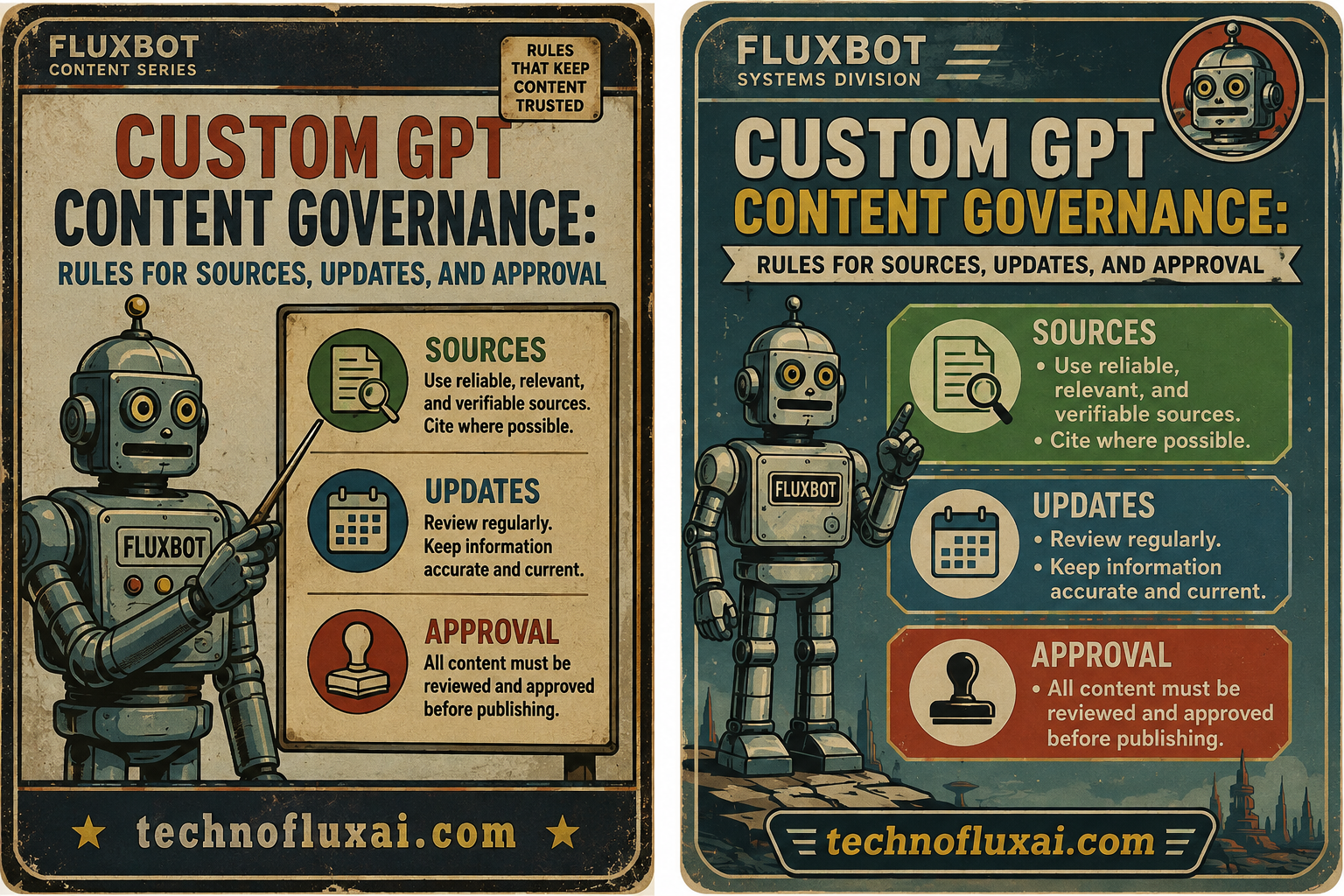
The 3 Rules Every Custom GPT Content System Needs
Good governance does not mean slowing everything down. It means giving your Custom GPT a clean operating system for trusted information, timely updates, and human approval.
1. Source Rules
Define which documents, websites, databases, policies, and internal materials your Custom GPT is allowed to rely on.
2. Update Rules
Set a repeatable schedule for checking, refreshing, replacing, and retiring knowledge base content.
3. Approval Rules
Decide who reviews content before it becomes part of the GPT and who signs off when changes affect customers, employees, or public messaging.
Rule 1: Create a Source Standard Before Uploading Anything
The biggest Custom GPT mistake is treating every document as equally trustworthy. A random draft, an old PDF, a sales page, and a final approved policy should not carry the same authority.
Your source standard tells the GPT builder and content team what is allowed, what needs review, and what should never be used.
Trusted Source Checklist
- Is this source current?
- Is it approved by the right person or team?
- Does it match the brand’s current offer, pricing, process, or policy?
- Is the source complete enough to prevent vague answers?
- Does it conflict with another uploaded source?
- Should the GPT cite, summarize, or simply use this source as background knowledge?
Practical Example: Source Priority Levels
A simple priority system helps your GPT handle conflicts. When two sources disagree, the higher-priority source should win.
Level 1: Final Authority
Approved policies, legal language, product documentation, pricing sheets, official service descriptions, and executive-approved messaging.
Level 2: Working Knowledge
SOPs, internal playbooks, support scripts, team notes, sales enablement docs, and approved training materials.
Level 3: Review Required
Drafts, old documents, unverified competitor research, exported chats, brainstorm notes, and anything with uncertain ownership.
Rule 2: Build an Update Schedule That Matches Risk
Not every Custom GPT needs daily updates. A GPT that explains evergreen company values may only need quarterly review. A GPT that answers pricing, compliance, inventory, or current product questions needs a tighter update cycle.
Suggested Update Rhythm
Pricing, promotions, availability, customer support issues, active campaigns, and fast-changing operations.
SOPs, service descriptions, lead qualification rules, FAQs, sales scripts, and onboarding material.
Brand voice, positioning, internal policies, strategy docs, and evergreen education content.
Rule 3: Use an Approval Workflow Before Content Goes Live
Custom GPT approvals should not be a mystery. A clear workflow keeps one person from uploading unreviewed files that quietly change how the GPT answers.
Simple Approval Workflow
- Request: Someone identifies a content update or new source.
- Review: The source owner checks accuracy, completeness, and relevance.
- Conflict Check: The team looks for contradictions with existing GPT knowledge.
- Test: The GPT is prompted with real user questions to confirm answer quality.
- Approve: The responsible person signs off before the change is considered live.
- Log: The update is recorded with date, owner, source name, and reason for change.
Governance Roles: Who Owns What?
The best Custom GPT systems assign ownership. Without ownership, governance becomes wishful thinking.
Content Owner
Responsible for accuracy, source quality, and deciding what belongs in the GPT knowledge base.
GPT Builder
Uploads, organizes, tests, and configures the GPT according to the governance rules.
Approver
Signs off on major changes, high-risk information, external-facing answers, and brand-sensitive content.
Warning: Do Not Let Your GPT Become a Content Junk Drawer
Uploading everything feels convenient at first, but it creates confusion later. Your GPT does not need every file. It needs the right files, in the right order, with the right approval trail.
Implementation Layer
Advanced Tips for Keeping Your Custom GPT Reliable
As your Custom GPT becomes more useful, governance becomes more important. More users bring more trust, more edge cases, and more risk if the content falls behind.
Create a Source Register
Track every source by title, owner, date added, last reviewed date, approval status, risk level, and replacement date.
Use Test Prompts
Save a small set of real questions users ask. Run those prompts after every major content update so you can catch weak answers before users do.
Retire Old Content
Strong governance is not just about adding new information. It also means removing outdated, duplicate, conflicting, or low-quality material.
Common Mistakes to Avoid
- Uploading old files without labels: Outdated guidance can look like current truth if files are not marked clearly.
- Skipping ownership: A knowledge base without an owner usually becomes stale.
- Using too many low-quality sources: More content does not automatically create better answers.
- Approving the GPT once and forgetting it: Reliable Custom GPTs need maintenance after launch.
- Ignoring answer testing: Real prompts reveal whether the governance process is working.
- Mixing draft and final content: Drafts should be clearly marked or excluded from live knowledge.
Custom GPT Governance Mini Template
Start with this simple structure when creating your own content governance policy.
Governance Policy Starter
Purpose: Define how content is selected, reviewed, updated, and approved for this Custom GPT.
Allowed Sources: Use approved internal documents, final policies, current service pages, official product information, and reviewed SOPs.
Restricted Sources: Exclude drafts, outdated files, unverified notes, copied web content, unsupported claims, and content without an owner.
Review Frequency: Review high-risk content weekly, operational content monthly, and evergreen content quarterly.
Approval: Major updates require review, test prompts, and approval before going live.
FAQ: Custom GPT Content Governance
What is Custom GPT content governance?
It is the set of rules for managing the information your Custom GPT uses, including sources, updates, approvals, quality checks, and ownership.
Why does source control matter for a Custom GPT?
Source control matters because the GPT can only answer as well as the information it receives. Weak, outdated, or conflicting sources can lead to unreliable answers.
How often should Custom GPT knowledge be updated?
Review fast-changing information weekly. Operational content often works well with monthly review, while evergreen brand or strategy content may only need quarterly review.
Who should approve Custom GPT content?
The approver should be the person or team responsible for the accuracy and business impact of that information. For example, pricing may need sales or leadership approval, while support scripts may need customer service approval.
What should be logged after a GPT content update?
Log the source name, update date, responsible person, reason for the change, approval status, and any test prompts used to verify answer quality.
Final Takeaway
A Custom GPT is not a one-time upload project. Treat it like a living knowledge system with clear source rules, update rhythms, and approval checks. That structure makes your GPT easier to trust, easier to improve, and safer to use across your business.
Build a Smarter Custom GPT Governance System
Before you upload another file to your Custom GPT, create a governance checklist. Define trusted sources, assign approval owners, and set a review schedule for the knowledge base.
Get the Custom GPT Governance ChecklistWant more TechnofluxAI in Google?
Add TechnofluxAI as a Preferred Source to help Google show you more of our AI guides, tests, workflows, and research.