
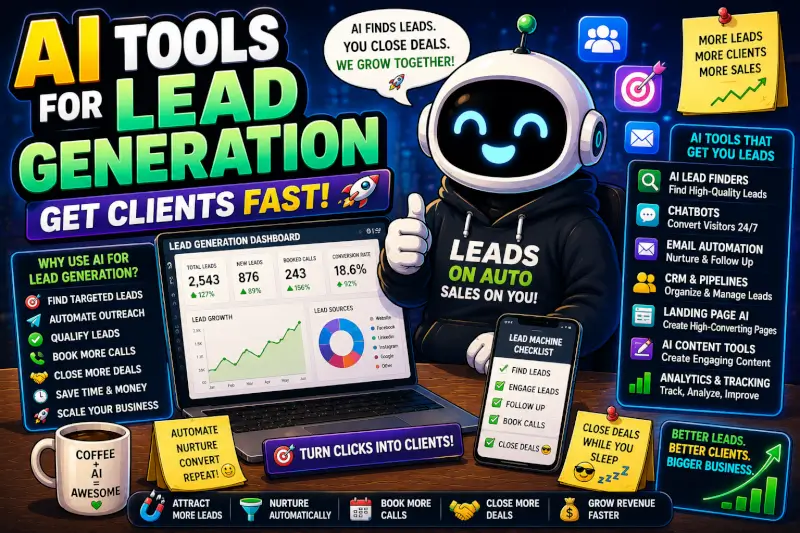
AI can make lead generation faster.
But “faster” isn’t the same thing as “better.”
If your targeting is weak, AI can help you contact the wrong people more efficiently. If your offer isn’t clear, automating outreach won’t fix it. And if you don’t know what makes a lead qualified, adding more software usually creates more noise instead of more pipeline.
The useful way to think about AI lead generation is much simpler:
Where is the slowest part of your current lead workflow?
Maybe you’re spending hours finding prospects. Maybe you have a list but don’t know who actually fits. Maybe personalization takes too long. Or maybe people already visit your site, but you’re doing almost nothing to capture or qualify them.
Those are different problems, and they need different tools.
What Are AI Lead Generation Tools?
AI lead generation tools use artificial intelligence, automation, data, or a combination of all three to improve parts of the process of finding and converting potential customers.
AI can help with:
- Finding companies and people that match an ideal customer profile
- Researching prospects automatically
- Enriching contact and company records
- Qualifying or scoring leads
- Personalizing outreach
- Capturing website visitors through chat
- Routing leads into a CRM
- Automating parts of email follow-up
What AI cannot do is decide your business strategy for you.
You still need to know who you want to reach, what problem you solve, why someone should care, and what actually qualifies as a good lead.
Best AI Tools for Lead Generation at a Glance
| Tool | Best Use | Where It Fits |
|---|---|---|
| Apollo | B2B prospecting and outreach | Finding prospects, qualification, research, sequences, outreach |
| Clay | Research, enrichment, and qualification | ICP matching, data enrichment, signals, lead scoring, personalization |
| Instantly | Cold-email lead generation | Lead database, AI research, enrichment, outbound campaigns |
| HubSpot Breeze | CRM-centered prospecting | Buyer intent, account research, lead prioritization, outreach |
| CustomGPT | Website lead capture | AI chat, qualification, lead capture, routing, contextual CTAs |
| ChatGPT | Planning and messaging support | ICP development, outreach drafts, research organization, scripts |
You don’t need all six.
A small business may need one prospecting platform and a CRM. A content-driven site may care more about website lead capture. A solo consultant may get more value from better targeting and a simple outreach system than from a complicated stack.
Before Choosing a Tool, Define the Lead
This sounds obvious, but it’s the part many lead-generation systems skip.
Before automating anything, define what a useful lead actually looks like.
- Industry: Who do you serve?
- Company size: Does size matter?
- Role: Who actually makes or influences the decision?
- Problem: What pain point should they already have?
- Timing: What signals suggest they may need your solution now?
- Disqualifiers: Who should never enter the pipeline?
Once those answers are clear, AI has something useful to work with.
One Thing I have Learned while building TechnofluxAi is that Ai tools usually sound easier to use than they are in the real world. I like to try things myself, see where I get stuck, and figure out what actually saves time instead of just repeating promisies.That’s the approach I use throughout this site: keep what works, point out what doesn’t, and explain things in a way that makes sense for someone who is still learning. I started out searching for an image creator. That was my first interaction with Ai. I was frustrated by the vast tool list without any real direction on which tool was best. Then I realized how powerful this tool was .and was going to be in the future. Making mistakes has helped me in the choice of articles I write.
1. Apollo: Best for B2B Prospecting and Outreach in One Platform
Apollo is useful when your lead-generation problem starts with finding the right people.
Its AI tools can help search for people and companies, identify prospects that fit your ideal customer profile, research accounts, qualify leads, summarize useful details, and move prospects into outreach sequences.
Where Apollo fits well
- Building prospect lists
- Finding people by role, company, or targeting criteria
- Researching companies and contacts
- Qualifying leads before outreach
- Creating and refining outbound messaging
- Running prospecting workflows from one platform
Apollo becomes more useful when your ICP is clearly defined. If your targeting criteria are vague, more prospect data won’t necessarily create better leads.
2. Clay: Best for AI Research, Enrichment, and Lead Qualification
Clay is less about simply finding an email address and more about building a richer picture of the account behind it.
Its workflows can combine data sources with AI research to help determine whether a company fits your ICP, what it sells, what signals matter, and whether a prospect deserves attention.
Useful Clay workflows
- Finding companies that match an ICP
- Enriching lead records from multiple sources
- Researching company websites
- Identifying trigger events or buying signals
- Scoring and qualifying prospects
- Generating personalized outreach inputs
This is particularly useful when basic filters such as job title and industry aren’t enough to determine whether someone is actually a good fit.
3. Instantly: Best for AI-Assisted Cold Email Workflows
Instantly combines cold-email automation with a B2B lead database and AI-assisted research and enrichment.
That makes it more focused than a general CRM.
You can build or import leads, research companies, create personalized opening lines or emails, enrich data, and move those prospects into outbound campaigns.
Where Instantly fits
- Finding B2B prospects
- Running cold-email campaigns
- Researching accounts before sending
- Generating personalized outreach
- Automating lead additions to campaigns
- Managing deliverability-focused outbound workflows
The risk with any high-volume outreach tool is assuming scale automatically improves results.
Sending more emails to poorly targeted prospects usually creates more wasted outreach, not better lead generation.
4. HubSpot Breeze: Best for AI Lead Generation Inside a CRM
HubSpot Breeze is most interesting when your customer and sales data already live inside HubSpot.
Its prospecting features can use CRM information, buyer intent, account signals, and research to help identify prospects and create personalized outreach.
Where Breeze can help
- Researching prospects from CRM context
- Identifying buyer-intent signals
- Prioritizing accounts
- Drafting personalized outreach
- Keeping prospecting activity inside the CRM
- Connecting marketing, sales, and lead data
The advantage here is integration.
If your sales team already works in HubSpot, keeping research, outreach, and lead activity in the same system can reduce the mess created by passing spreadsheets between multiple tools.
5. CustomGPT: Best for Capturing and Qualifying Website Leads
Not every lead-generation workflow starts with cold outreach.
If your website already gets visitors, an AI agent can help answer questions, capture contact details, qualify visitors, and guide them toward the next step.
CustomGPT is designed around AI agents built from your own website or knowledge sources.
Lead-generation uses
- Answering pre-sales questions
- Capturing names and email addresses during conversations
- Collecting information about visitor intent
- Qualifying leads before a human gets involved
- Sending captured leads into a CRM
- Adding in-chat calls to action such as booking a call
This approach makes more sense when you already have traffic but visitors need help deciding what to do next.
6. ChatGPT: Best for Lead-Generation Planning and Messaging Support
ChatGPT isn’t a prospect database, so I wouldn’t put it in the same category as Apollo or Clay.
But it can still be useful around the lead-generation process.
Useful tasks
- Defining an initial ICP
- Organizing customer research
- Developing qualification questions
- Writing and rewriting outreach
- Creating call scripts
- Analyzing exported lead data
- Generating landing-page or lead-magnet ideas
Use it to improve the thinking around your lead-generation system, not to fabricate prospect information.
A Simple AI Lead Generation Workflow
Step 1: Define the ICP
Decide which companies, people, problems, and signals actually matter.
Step 2: Find prospects
Use a platform such as Apollo, Clay, Instantly, or your existing CRM data to build a candidate list.
Step 3: Enrich and research
Add useful company information, verify contact data, and research whether each prospect actually matches your criteria.
Step 4: Qualify before outreach
Filter out bad-fit prospects before they enter your campaign.
Step 5: Personalize with real information
Use AI to turn verified company or prospect information into relevant messaging.
Step 6: Send or route the lead
Move qualified prospects into the appropriate outreach, CRM, sales, or nurture workflow.
Step 7: Measure the right numbers
Track qualified leads, replies, meetings, conversion to opportunity, and revenue contribution instead of celebrating how many emails were sent.
Inbound vs. Outbound AI Lead Generation
| Approach | How It Works | Useful Tools |
|---|---|---|
| Outbound | You identify and contact prospects directly | Apollo, Clay, Instantly |
| Inbound | Prospects find you, then enter a capture or qualification workflow | HubSpot, CustomGPT, forms, CRM automation |
| Hybrid | You combine website intent, CRM data, prospect research, and outreach | HubSpot + Apollo/Clay or similar combinations |
For many small businesses, a hybrid workflow is more realistic than relying completely on either cold outreach or passive inbound traffic.
How to Choose the Right AI Lead Generation Tool
The easiest way to choose is to identify the part of the process that currently wastes the most time.
If you need to find B2B prospects
Look at Apollo.
It combines prospect data, targeting, research, qualification, and outreach in one environment.
If your hardest problem is research and qualification
Look at Clay.
It’s especially useful when you need richer account research, enrichment, signals, and custom qualification logic.
If cold email is your primary channel
Look at Instantly.
Its workflow is built heavily around finding or importing leads, enriching them, and running outbound campaigns.
If your CRM already runs the business
Look at HubSpot Breeze.
The value comes from using AI prospecting and buyer signals directly alongside existing CRM data.
If your website already has traffic
Look at CustomGPT or another AI lead-capture system.
Turning existing visitors into qualified conversations may be more valuable than adding another outbound tool.
Five AI Lead Generation Mistakes to Avoid
1. Automating Before Defining Your ICP
AI needs rules.
If those rules are vague, your system may still produce plenty of leads, but many of them won’t matter.
Start with clear qualification criteria before building automation.
2. Measuring Volume Instead of Quality
A giant lead list isn’t automatically valuable.
Neither are thousands of outbound emails.
Better metrics include qualified-lead rate, positive replies, meetings booked, opportunities created, and revenue from sourced leads.
3. Letting AI Invent Personalization
Personalization only works when the detail is true.
If an AI system can’t verify a funding event, product launch, job change, or company fact, don’t let it pretend one happened.
4. Using the Same Message for Every Prospect
Different buyer types care about different problems.
Your messaging should reflect the role, company, context, and reason you’re contacting that person.
5. Automating Every Step Too Early
Start with review controls.
Look at the leads being selected, the research being generated, and the messages being written before trusting a system to run with no supervision.
AI Lead Generation for Small Businesses
Small businesses don’t necessarily need enterprise sales infrastructure.
A simple system can be enough:
- Define one target customer.
- Choose one primary acquisition channel.
- Use one tool to find or capture leads.
- Use AI to research and qualify them.
- Send them into one clear follow-up process.
- Measure which leads actually become conversations or customers.
That is easier to improve than a complicated funnel made from ten disconnected apps.
Do You Need Multiple AI Lead Generation Tools?
Usually not at the beginning.
Many platforms now overlap.
Apollo can handle prospecting and outreach. Instantly combines outbound and lead data. HubSpot combines CRM data with AI prospecting capabilities. Clay can sit across multiple data sources and enrich or qualify prospects.
Adding software should solve a specific gap.
If you can’t explain what a new tool will do that your existing system cannot, you probably don’t need it yet.
Frequently Asked Questions
What is AI lead generation?
AI lead generation uses artificial intelligence and automation to help identify, research, qualify, capture, prioritize, or contact potential customers.
Different tools handle different parts of that process, so “AI lead generation” can mean anything from prospect research to website chat-based lead capture.
What is the best AI tool for B2B lead generation?
There isn’t one best option for every workflow.
Apollo is designed around prospecting and engagement, Clay is particularly strong for enrichment and qualification workflows, and Instantly focuses heavily on outbound email.
The right choice depends on which part of your current process needs the most help.
Can AI qualify leads automatically?
Yes, if you give the system meaningful qualification criteria and reliable data.
AI can research prospects and score or classify them against an ICP, but the quality of that result depends heavily on the rules and information you provide.
Can AI generate leads from a website?
Yes.
AI chat agents can answer questions, collect contact information, identify visitor intent, and route qualified leads into a CRM or sales workflow.
Can beginners use AI for lead generation?
Yes, but start with a small workflow.
Define one target customer, choose one channel, and automate only the part that is currently repetitive or slow.
Does AI automatically improve conversion rates?
No.
AI may improve speed, research depth, targeting, or personalization, but conversion still depends on lead quality, timing, the offer, messaging, follow-up, and the buying process.
Should I use AI for cold outreach?
AI can help research prospects and prepare personalized messages, but automated outreach should still use accurate information, appropriate targeting, and human review while you’re calibrating the workflow.
The Bottom Line
The best AI lead generation tools don’t eliminate the need for a good sales or marketing process.
They make specific parts of that process easier to run.
Apollo can help find and engage B2B prospects. Clay can deepen research and qualification. Instantly focuses on outbound email. HubSpot Breeze brings AI prospecting into CRM workflows. CustomGPT can capture and qualify people already visiting your site.
The important part is choosing the problem before choosing the software.
Define the customer. Define what makes a lead qualified. Then use AI where it removes real friction.
That’s a much stronger system than collecting tools and hoping more automation creates more customers.

About the Author
Jon Hicks
Founder of TechnofluxAI.
I’m the creator behind TechnofluxAI, focused on breaking down powerful AI tools, emerging trends, and practical strategies to help creators and entrepreneurs stay ahead in a rapidly evolving digital world.
Follow TechnofluxAI for the latest AI tools & strategies