

Estimated reading time: 8 minutes
TechnofluxAI Research Guide
AI Research Workflow: From Question to Verified Sources
AI can make research faster, but speed is not the same as trust. A strong AI research workflow helps you move from a rough question to useful notes, checked claims, reliable sources, and content you can publish with more confidence.
Quick Answer
An AI research workflow is a repeatable process for turning a question into verified information. It usually includes defining the question, finding source types, collecting evidence, checking claims, comparing sources, and organizing the final answer.
Why It Matters
AI can summarize quickly, but it can also miss context, overstate weak evidence, or sound confident about information that still needs checking. The workflow matters because it keeps research grounded.
Best For
Use this workflow for blog posts, guides, comparison articles, business research, academic-style notes, YouTube scripts, newsletters, and any content where accuracy affects trust.
The Real Problem
Many people ask AI a question, copy the answer, and move on. That is risky. Research is not just getting an answer. It is understanding where the answer came from, what evidence supports it, what might be missing, and whether the source is strong enough for the claim.
What This Guide Will Help You Do
You will learn how to turn a basic research question into a cleaner prompt, find better sources, verify important claims, and build a simple research trail before writing or publishing.
Explore more AI tools for creators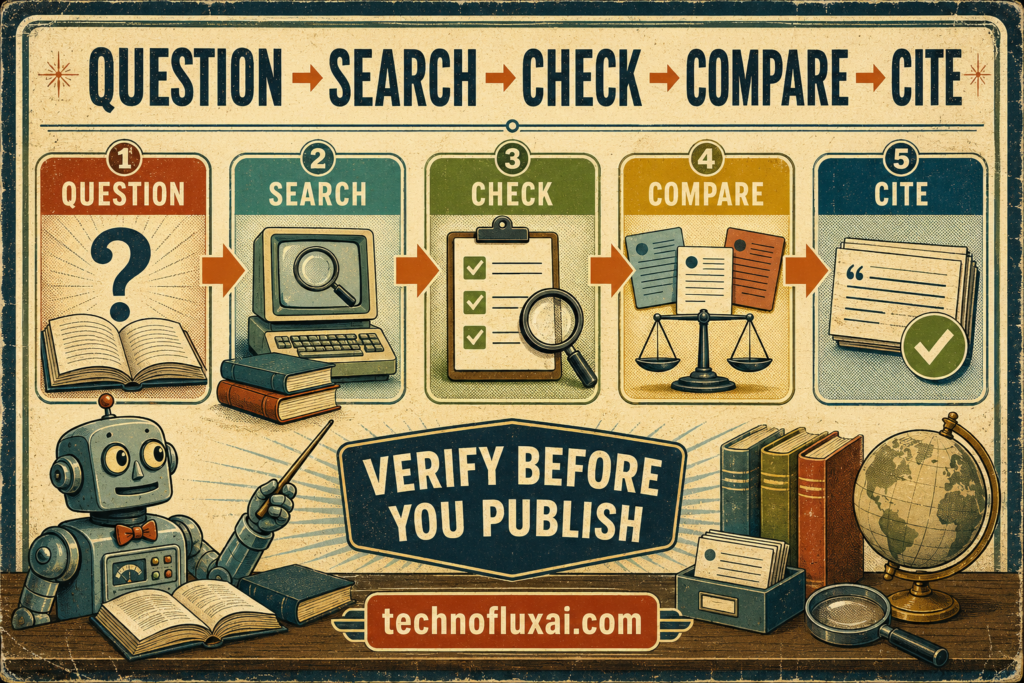
Main Workflow
A Practical AI Research Workflow You Can Reuse
The goal is not to make AI do all the thinking. The goal is to use AI as a research assistant while you stay in control of the question, the evidence, and the final judgment.
Step 1: Define the Research Question
Start by turning a vague topic into a specific question. A clear question makes it easier to find useful sources and avoid random information.
Example: Instead of “AI and SEO,” ask “How can small business websites use AI to improve blog research without publishing unverified claims?”
Step 2: Ask AI for a Research Map
Before collecting sources, ask AI to map the topic. This helps you see the subtopics, possible angles, definitions, and questions you may need to answer.
Prompt: “Create a research map for this question. Include key terms, subtopics, likely source types, opposing views, and what needs verification.”
Step 3: Identify Source Types
Not every source should carry the same weight. A product blog, expert guide, government page, research paper, and user forum all serve different purposes.
Use this rule: Match the source to the claim. Use official documentation for tool features, expert sources for interpretation, and primary data for statistics.
Step 4: Collect Sources With a Purpose
Do not collect links just to make the article look researched. Each source should answer a specific part of the question or support a specific claim.
Useful categories: Definitions, examples, data, expert explanation, official guidance, case studies, and counterpoints.
Step 5: Verify Key Claims
The most important claims deserve the most checking. This includes numbers, dates, tool features, legal claims, medical claims, financial claims, and anything that could change quickly.
Prompt: “List the claims in this draft that require verification. Rank them by risk if they are wrong.”
Step 6: Compare Sources
One source can be useful, but multiple sources show whether the information is consistent. When sources disagree, slow down and explain the difference instead of forcing one answer.
Simple check: Ask whether the sources agree on the definition, timeline, recommendation, and evidence level.
Step 7: Create a Research Summary
After reviewing sources, summarize what is confirmed, what is uncertain, and what should not be included. This gives you a cleaner base for writing.
Output format: Confirmed findings, source notes, weak claims, missing context, and recommended article angle.
Step 8: Write From Evidence
Once the research is organized, use AI to help draft the article, outline, script, or report. Keep the verified notes close so the content does not drift into unsupported claims.
Best practice: Draft after verification, not before. This keeps the article focused and reduces cleanup later.
AI Research Workflow Checklist
Question
Is the research question specific enough to guide the search?
Sources
Do the sources match the type of claim being made?
Claims
Have important facts, dates, numbers, and recommendations been checked?
Gaps
Is anything unclear, outdated, unsupported, or based on only one weak source?
Beginner Example
A blogger wants to write about AI tools for local businesses. Instead of asking AI to “write an article,” they first ask for a research map, identify source types, verify current tool features, and then build the post from checked notes.
Site Owner Example
A website owner researching “best AI chatbots for service pages” should verify pricing, features, integrations, privacy details, and support options before recommending any tool to readers.
Warning Card: Do Not Treat AI Output as a Source
AI can help explain, organize, and summarize research, but the AI answer itself is not the original source. For important claims, track the source behind the answer. If you cannot verify it, either remove the claim or label it as uncertain.
Verification Layer
How to Make AI Research More Trustworthy
Better research does not come from asking AI one perfect question. It comes from using a repeatable system that separates ideas, claims, sources, and final conclusions.
Advanced Tip 1: Use a Claim Table
Put each important claim into a simple table with four columns: claim, source, confidence level, and notes. This makes weak spots easy to find before publishing.
Advanced Tip 2: Separate Research From Writing
Research mode is for finding and checking information. Writing mode is for explaining it clearly. Mixing both too early can make the article sound polished before the facts are solid.
Advanced Tip 3: Save Your Source Trail
Keep a short research note with source names, links, dates checked, and what each source supports. This helps when you update the article later or need to defend a recommendation.
Common Mistakes to Avoid
- Asking AI for an answer before defining the research question.
- Using AI-generated citations without checking whether the sources are real.
- Relying on outdated pages for fast-changing topics like tools, pricing, or rules.
- Using one weak source to support a strong recommendation.
- Copying a confident AI summary without finding the original evidence.
- Ignoring disagreements between sources because they make the article harder to write.
FAQ: AI Research Workflow
Can AI do research for me?
AI can help with research, but you should not treat it as a replacement for verification. Use it to map the topic, organize notes, find gaps, summarize sources, and identify claims that need checking.
What makes a source verified?
A source is more trustworthy when you can identify who published it, when it was updated, what evidence it provides, and whether it directly supports the claim you are making.
Should I cite every source in a blog post?
You do not need to cite every sentence, but important facts, statistics, direct claims, tool details, and expert opinions should be backed by clear sources.
How many sources should I check?
The number depends on the topic. A simple how-to article may only need a few strong sources. A comparison, recommendation, or high-risk topic usually needs more source checking.
What is the fastest way to improve AI research quality?
Ask AI to separate confirmed facts from assumptions. Then verify the highest-risk claims before writing the final version.
Final Takeaway
AI research works best when it is structured. Start with a clear question, map the topic, collect sources with a purpose, verify important claims, and write only after the evidence is organized.
The goal is not to make research feel complicated. The goal is to make your content more useful, more accurate, and easier to trust.
Build a better AI research workflowWant more TechnofluxAI in Google?
Add TechnofluxAI as a Preferred Source to help Google show you more of our AI guides, tests, workflows, and research.