

Estimated reading time: 9 minutes
TechnofluxAI SEO Workflow
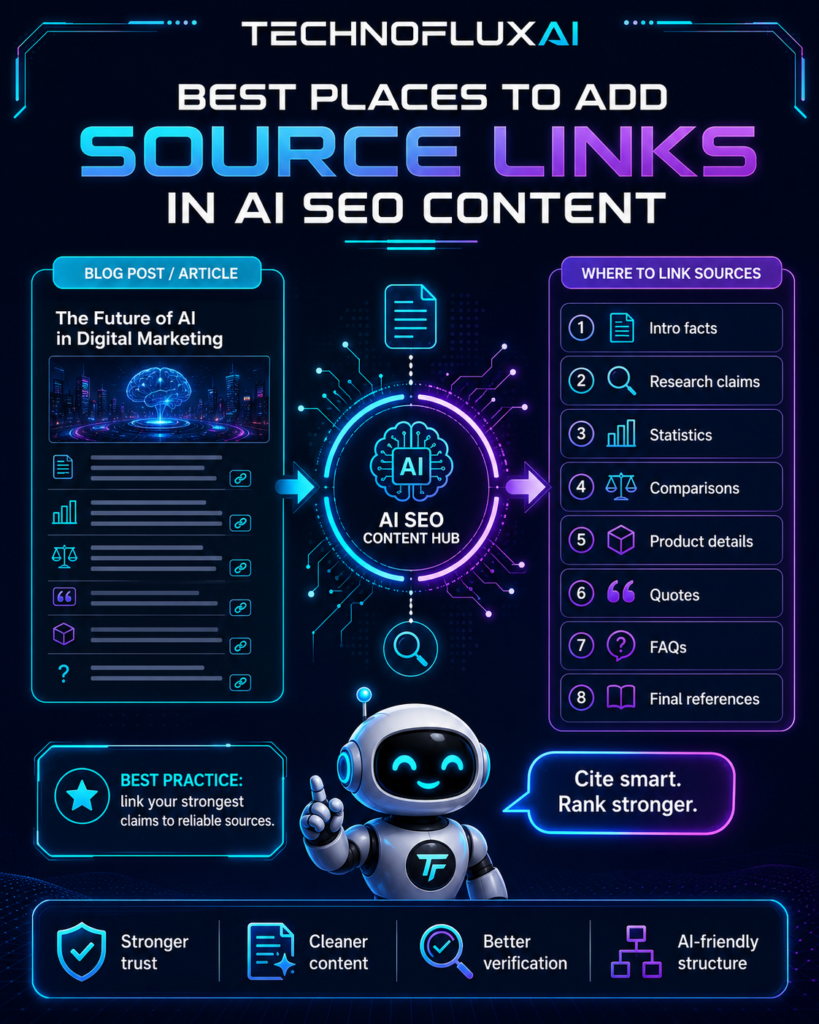
Best Places to Add Source Links in AI SEO Content
AI can help you write faster, but speed alone does not make content trustworthy. Source links show readers where claims come from, support your expertise, and help your article feel more useful.
Quick Answer
The best places to add source links in AI SEO content are statistics, expert claims, definitions, comparisons, legal or medical statements, product details, trend mentions, technical steps, and any statement a reader may want to verify.
Why It Matters
Readers can usually tell when AI content sounds confident but thin. Good source links make your article stronger because they connect your advice to proof, context, and real-world support.
The Main Problem
Many AI-written articles include broad claims without showing where the information came from. That creates weak content, especially when the topic involves facts, tools, rankings, prices, regulations, or current trends.
What This Guide Will Help You Do
This guide shows where source links belong, when they are not needed, and how to add them without making your article look cluttered. You will also learn a simple workflow for reviewing AI SEO drafts before publishing.
Source Link Placement
Add Source Links Where Trust Matters Most
Source links should not be scattered randomly through an article. Place them where they help the reader verify important information, understand context, or make a better decision.
Weak Source Linking
Adding random links at the end of paragraphs without showing what they support.
Better Source Linking
Linking directly after claims, data, comparisons, and definitions that readers may want to check.
Best Source Linking
Using trusted sources naturally while keeping the article readable, helpful, and focused.
1. Add Source Links After Statistics
Statistics need support. If your AI draft includes a number, percentage, survey result, market size, ranking, or growth claim, add a source link next to that statement.
Example:
Weak: “Most customers read reviews before choosing a local business.”
Better: “Many customers check reviews before choosing a local business,” followed by a source link to a credible study, platform report, or consumer behavior survey.
Numbers make content sound specific. Without a source, they can also make the article look careless.
2. Add Source Links After Definitions
Definitions are useful in beginner-friendly content. A source link helps when the term is technical, legal, scientific, financial, or commonly misunderstood.
Good places to cite definitions:
- AI search optimization terms
- Schema markup concepts
- Technical SEO phrases
- Legal or compliance language
- Healthcare or finance terms
3. Add Source Links Near Expert Claims
AI often writes claims that sound expert-level. Before publishing, check whether the claim is common knowledge, your own experience, or something that needs outside support.
Needs a Source
“Search engines prefer content that includes current citations.”
May Not Need One
“Clear examples make SEO content easier to understand.”
When a claim could affect a reader’s strategy, budget, ranking expectations, or compliance decisions, add a source.
4. Add Source Links Inside Comparison Sections
Comparison content needs careful linking. If you compare platforms, tools, methods, prices, rankings, features, or policies, source links help readers confirm the details.
| Comparison Type | Best Source Link Placement | Why It Helps |
|---|---|---|
| Tool features | After the feature claim | Prevents outdated or incorrect details. |
| Pricing | Near the price mention | Allows readers to confirm current costs. |
| Policies | Beside the policy summary | Reduces the risk of unclear advice. |
| Performance claims | After the claim or benchmark | Gives readers proof instead of vague confidence. |
5. Add Source Links Before or After Step-by-Step Advice
Tutorial content often includes steps that depend on a platform, tool, or current process. Add a source when the instructions could change over time.
Examples that should be sourced:
- How to add schema markup
- How to submit a sitemap
- How to use a platform dashboard
- How to follow ad or content policies
- How to configure analytics or tracking
A source link near the step can save readers from following outdated instructions.
6. Add Source Links to Trend and News Mentions
AI SEO content often mentions trends, updates, new tools, algorithm changes, and market shifts. These details age quickly, so they need timely source support.
Warning: Do not let AI invent “recent” trends. Check the date, source, and original context before using the claim.
7. Add Source Links in YMYL Topics
YMYL topics can affect a person’s money, health, safety, legal choices, or major life decisions. These articles need stronger sourcing than casual opinion posts.
Health
Use medical organizations, journals, or official health resources.
Finance
Use official agencies, trusted institutions, or current platform documentation.
Legal
Use statutes, official court resources, government pages, or qualified legal references.
Safety
Use official guidelines, standards, or recognized expert organizations.
Simple Source Link Workflow for AI SEO Content
Use this workflow before publishing an AI-assisted article. It keeps your content cleaner and more trustworthy.
- Highlight factual claims: Mark numbers, definitions, trends, comparisons, and technical instructions.
- Check whether each claim needs proof: Ask whether a reader may want to verify it.
- Find the best source: Use official pages, original studies, documentation, or reputable expert resources.
- Place links close to the claim: Do not bury sources at the bottom of the article.
- Remove weak claims: If you cannot support an important claim, rewrite it or delete it.
- Review link balance: Keep the article helpful without turning every sentence into a hyperlink.
Publishing and Optimization
Source Links Should Support the Reader, Not Distract Them
A good source link strategy is not about adding as many links as possible. It is about placing the right links near the right claims so readers can trust the article.
Use Primary Sources First
Official documentation, original studies, government pages, and direct company resources usually work best.
Avoid Link Stuffing
Too many links can make the page harder to read. Use links where they add real value.
Check Dates
Older sources may still be useful, but current topics need current support.
Best AI Prompt for Adding Source Links
Use this prompt after AI creates a draft. It helps you find weak claims before publishing.
Review this AI SEO article and identify every sentence that needs a source link. Focus on statistics, definitions, expert claims, tool features, pricing, trends, technical steps, YMYL topics, and comparisons. For each item, explain why it needs a source and what type of source would be best.
Common Mistakes to Avoid
Citing Weak Sources
Do not support important claims with random blogs, outdated summaries, or pages that do not show evidence.
Linking Too Far From the Claim
Place the source close to the statement it supports. Readers should not have to guess what the link proves.
Trusting AI Without Checking
AI can sound certain even when the detail is wrong. Verify anything factual before publishing.
Using Sources as Decoration
A source should prove, explain, or support something specific. Decorative links do not help the reader.
FAQ: Source Links in AI SEO Content
Do all AI SEO articles need source links?
Most AI-assisted articles benefit from source links, especially when they include facts, numbers, trends, technical instructions, comparisons, or advice that affects decisions.
How many source links should a blog post have?
There is no perfect number. A short article may need only a few links, while a detailed guide may need more. Add links where they support important claims.
Should source links open in a new tab?
Many publishers choose to open external source links in a new tab so readers can verify information without leaving the article completely.
Can I use internal links as sources?
Internal links are useful for related reading, but they are not always enough to support factual claims. Use external sources when the article needs independent support.
Where should I avoid adding source links?
Avoid linking basic opinions, obvious statements, brand CTAs, repeated claims, or every sentence in a paragraph. Too many links can make content harder to read.
Final Takeaway
The best places to add source links in AI SEO content are the places where trust matters most. Support facts, clarify technical ideas, verify comparisons, and back up claims that readers may use to make decisions.
CTA: Improve Your AI SEO Publishing Process
Before publishing your next AI-assisted article, review every claim that sounds factual, technical, current, or decision-based. Add source links where they help the reader trust and verify the content.
Explore AI SEO GuidesSocial Media Suggestions
YouTube Shorts hook: “AI content can sound confident, but where should you actually add source links?”
TikTok caption: Source links are not decoration. Add them where your AI content needs trust.
LinkedIn post: AI SEO content needs more than clean formatting and keywords. Strong articles also need source links in the right places. Add them near statistics, definitions, expert claims, tool comparisons, trends, technical steps, and YMYL advice. The goal is not to overload the reader. The goal is to make important claims easier to verify.
Facebook post: If you use AI to write blog content, do not skip the source check. The best source links belong next to stats, trends, comparisons, definitions, and claims your readers may want to verify.
Pinterest title: Best Places to Add Source Links in AI SEO Content
Pinterest description: Learn where source links belong in AI SEO articles, including statistics, definitions, expert claims, comparisons, trends, technical steps, and YMYL content.
Hashtags: #AISEO #SEOContent #BloggingTips #ContentMarketing #AIContent #SourceLinks #ContentOptimization #SEOWriting #BlogStrategy #TechnofluxAI
Newsletter teaser: AI content sounds better when important claims are easy to verify. Here is where source links belong before you publish.
TechnofluxAI
Practical AI for creators and website owners
Learn how to use AI, improve AI search visibility, build smarter workflows, and test what actually works.
Explore our other sites
TimewasterAI
— product reviews, buying guides, and useful finds.
Tina Trends
— fashion, beauty, pets, lifestyle, and fun discoveries.
Mistakenly Delicious
— simple recipes and practical cooking ideas.
Want more TechnofluxAI in Google?
Add TechnofluxAI as a Preferred Source to help Google show you more of our AI guides, tests, workflows, and research.