
Estimated reading time: 8 minutes
TechnofluxAI Prompt Workflow
AI Prompt Testing Scorecard: Compare Outputs Without Guessing
Most people test AI prompts by feeling. They run two or three versions, pick the one that sounds best, and move on. That works for quick experiments, but it falls apart when you need repeatable quality. An AI prompt testing scorecard gives you a simple way to compare outputs without guessing.
Quick Answer
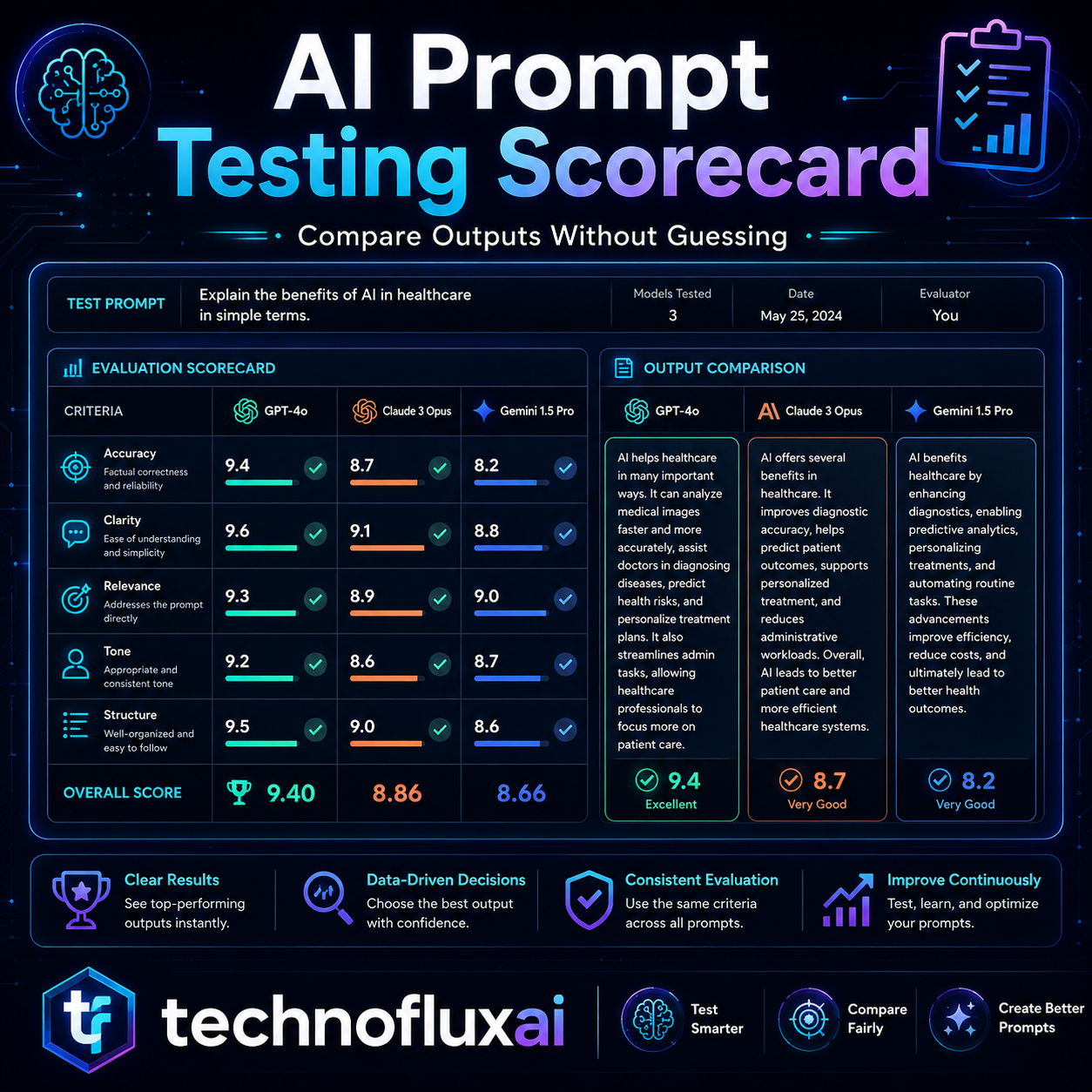
An AI prompt testing scorecard is a simple rating system that helps you compare AI outputs across clear categories like accuracy, usefulness, structure, tone, originality, and actionability. Instead of choosing the output that feels best, you score each result and improve the prompt based on evidence.
Best For
Blog drafts, social posts, SEO outlines, AI images, product descriptions, client reports, email campaigns, YouTube scripts, chatbot responses, and repeatable creator workflows.
The Real Problem
AI tools can produce five answers that all look decent at first glance. The problem is that “decent” is not the same as useful, accurate, brand-ready, or publishable. Without a testing method, you end up choosing based on mood, speed, or whichever output sounds more polished.
What This Guide Will Help You Do
You will learn how to build a simple AI prompt testing scorecard, what categories to measure, how to compare multiple outputs, and how to use the results to improve your prompts over time.
The goal is not to make prompt testing complicated. The goal is to stop guessing and create a repeatable process that makes your AI outputs easier to judge, edit, and trust.
Workflow tip: Use this scorecard before publishing any important AI-assisted content. One extra review round can save hours of fixing weak drafts later.
What Is an AI Prompt Testing Scorecard?
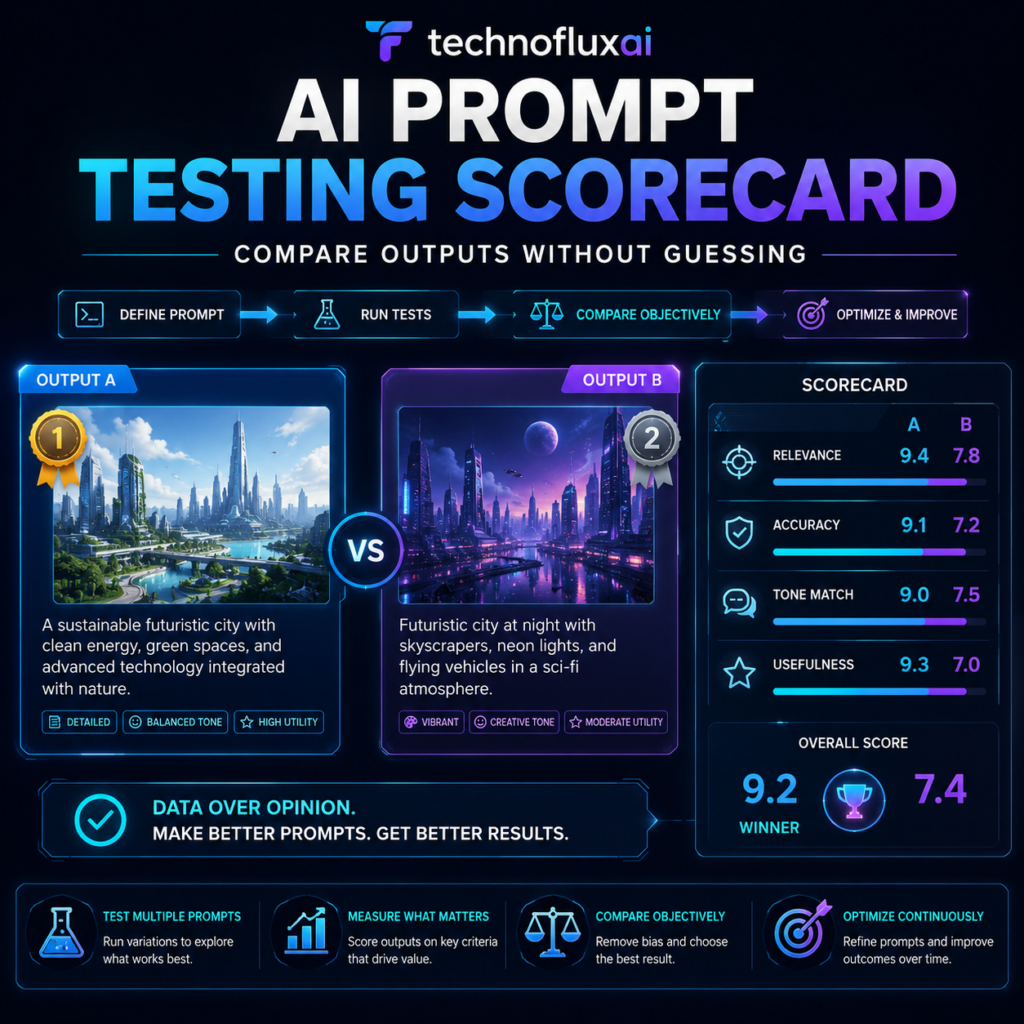
An AI prompt testing scorecard is a structured way to judge AI outputs. You create a list of scoring categories, run the same task through different prompt versions, rate each output, and compare the final scores.
This matters because prompt quality is not always obvious. A response can sound confident but miss the point. Another response can be shorter but more useful. A scorecard helps you separate style from substance.
Without a Scorecard
You compare outputs by instinct, tone, and first impression. This is fast, but inconsistent.
With a Scorecard
You compare outputs by clear standards. This makes your prompt testing easier to repeat and improve.
The 7-Part AI Prompt Testing Scorecard
Use a 1 to 5 score for each category. A score of 1 means the output failed badly. A score of 5 means the output is strong enough to use with light editing.
Scorecard Categories
- Accuracy: Does the output avoid false claims, vague facts, or unsupported statements?
- Relevance: Does it answer the actual prompt instead of drifting into generic advice?
- Usefulness: Can the reader apply the information without needing another explanation?
- Structure: Is the output easy to scan, follow, and edit?
- Tone match: Does it sound right for the audience, platform, and brand?
- Originality: Does it offer specific insight instead of recycled AI filler?
- Actionability: Does it give clear next steps, examples, or decisions?
Simple Scoring System
1 = Poor
Not usable. Needs a major prompt rewrite.
2 = Weak
Some useful parts, but too flawed to trust.
3 = Usable
Good base draft, but needs editing.
4 = Strong
Useful, clear, and close to publishable.
5 = Excellent
High-quality output with only minor edits needed.
How to Compare AI Outputs Without Guessing
A good prompt test compares one variable at a time. If you change the task, audience, format, tone, and model all at once, you will not know what caused the better result.
Prompt Testing Workflow
- Choose one task: Example: write a blog intro, product description, YouTube hook, or email subject line.
- Create 3 prompt versions: Keep the goal the same, but change the instructions.
- Run each prompt separately: Save each output without editing it first.
- Score each output: Rate accuracy, relevance, usefulness, structure, tone, originality, and actionability.
- Compare totals: The highest score is usually your strongest prompt direction.
- Study the weak categories: Improve the prompt where the output scored lowest.
- Retest the winner: Run the improved version again before adding it to your workflow.
Example: Testing Three Blog Intro Prompts
Imagine you want an AI tool to write an intro for a blog post about beginner email marketing. You test three prompt styles.
Prompt A: Basic
“Write an intro for a blog post about email marketing for beginners.”
Prompt B: Audience-Led
“Write a beginner-friendly intro for small business owners who feel overwhelmed by email marketing.”
Prompt C: Outcome-Led
“Write an intro that explains why email marketing feels confusing, gives a quick answer, and promises a simple first workflow.”
What You Might Learn
Prompt A may sound generic. An audience-led version may create better empathy. Prompt C may create a stronger article structure. The scorecard helps you see why one output is better instead of simply saying, “This one feels good.”
AI Prompt Testing Scorecard Template
| Category | Prompt A | Prompt B | Prompt C |
|---|---|---|---|
| Accuracy | 1-5 | 1-5 | 1-5 |
| Relevance | 1-5 | 1-5 | 1-5 |
| Usefulness | 1-5 | 1-5 | 1-5 |
| Structure | 1-5 | 1-5 | 1-5 |
| Tone Match | 1-5 | 1-5 | 1-5 |
| Originality | 1-5 | 1-5 | 1-5 |
| Actionability | 1-5 | 1-5 | 1-5 |
Testing Rule
Do not judge the prompt by the first output alone. Some prompts perform well once and fail later. A strong prompt should produce useful results consistently across multiple runs.
Advanced Prompt Testing Tips
Once you have a basic AI prompt testing scorecard, you can improve it by adding weights, notes, and real publishing outcomes. The best prompt is not always the one with the prettiest first draft. The best prompt is the one that creates the most useful result with the least cleanup.
Weight Important Categories
For SEO content, accuracy and usefulness may matter more than tone. For social content, hook strength and tone may deserve more weight.
Save Winning Prompts
When a prompt scores well, save it as a reusable template. Add notes about where it works best and where it fails.
Track Editing Time
A prompt that scores slightly lower but saves 30 minutes of editing may be better for your real workflow.
Common Mistakes to Avoid
- Testing too many things at once: If every prompt is completely different, you will not know what improved the output.
- Rewarding polish over usefulness: A smooth answer can still be empty, generic, or wrong.
- Ignoring the reader: Prompt testing should measure whether the output helps the target audience, not just whether it sounds impressive.
- Skipping fact checks: A high score does not remove the need to verify claims before publishing.
- Using one score forever: Update your scorecard as your brand, audience, and content goals improve.
FAQ: AI Prompt Testing Scorecard
What is an AI prompt testing scorecard?
It is a simple scoring system used to compare AI outputs across categories like accuracy, relevance, usefulness, structure, tone, originality, and actionability.
Why should I score AI outputs?
Scoring helps you avoid choosing outputs based only on instinct. It gives you a clearer way to identify which prompt creates the strongest result.
How many prompt versions should I test?
Start with three prompt versions. That is enough to compare different approaches without making the process too slow.
What score is good enough to use?
A total score of 28 or higher out of 35 is usually strong enough for a usable draft, but you should still edit and fact-check the final output.
Can this scorecard work for AI images too?
Yes. For images, adjust the categories to measure visual accuracy, brand fit, composition, realism, prompt alignment, and usability.
Final Takeaway
The fastest way to improve your AI results is not to keep asking for “better.” It is to define what better means. An AI prompt testing scorecard gives you a practical way to compare outputs, improve prompts, and build repeatable workflows that save time instead of creating more cleanup.
Creator CTA
Before you publish your next AI-assisted post, test three prompt versions and score the outputs. Save the winner, improve the weak spots, and turn it into a reusable prompt template.
Next step: Build your own AI prompt testing scorecard and use it as part of your content workflow.