

Estimated reading time: 10 minutes
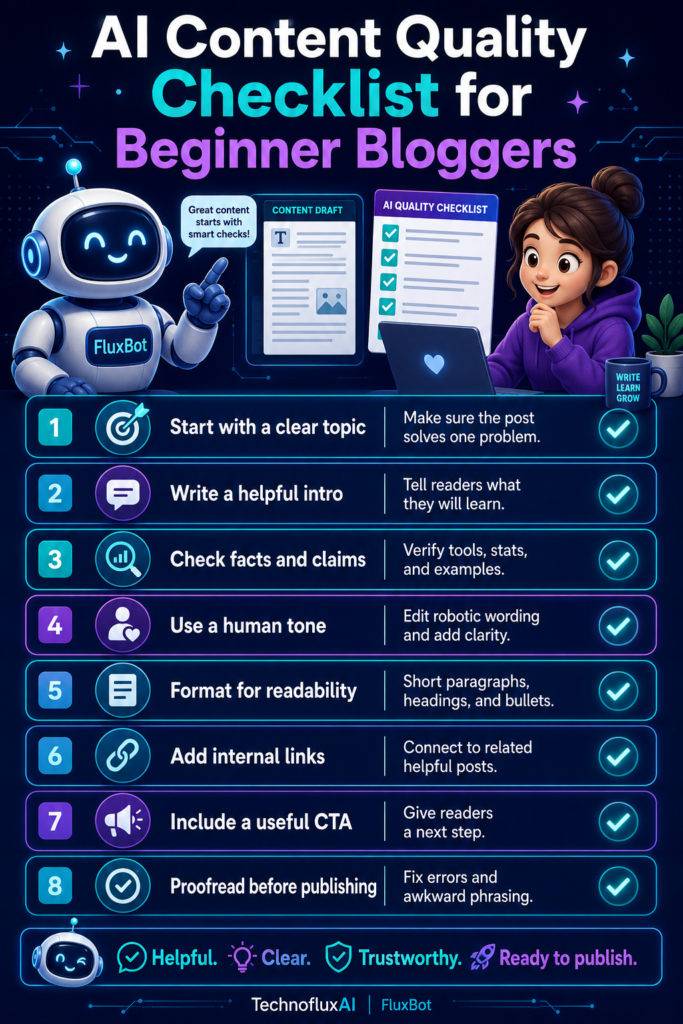
The Beginner Blogger AI Content Quality Checklist
Use this checklist after AI creates the first draft, not before. The first draft is only the starting point. Your job is to shape it into something readers can actually use.
Fast Quality Scan
- Does the article answer the main question clearly?
- Does the intro explain why the topic matters?
- Does each section add something useful?
- Are there practical examples?
- Does the article sound like a real person edited it?
- Are claims, recommendations, and steps accurate?
- Is the post easy to skim on mobile?
1. Check the Search Intent First
Search intent means the reason someone typed the query into Google or another search engine. Before you polish the article, make sure the content matches what the reader actually wants.
Good Match
A reader searches “AI content checklist” and finds a clear checklist they can use before publishing a blog post.
Bad Match
A reader searches for a checklist but gets a long opinion article about why AI is changing blogging.
2. Remove Generic AI Filler
AI drafts often include sentences that sound smooth but do not teach anything. Beginner bloggers should delete or rewrite any line that could appear in almost any article.
Filler Warning Signs
- The sentence sounds important but gives no specific advice.
- The paragraph repeats the heading without expanding on it.
- The same idea appears three different ways.
- The article uses broad phrases instead of examples.
- The content feels like a summary instead of a guide.
3. Add Beginner-Friendly Examples
Examples are one of the fastest ways to make AI content more useful. A beginner reader should not have to guess how your advice applies to their blog.
Example Upgrade
Weak AI sentence: “Make sure your content provides value to the reader.”
Better blogger-friendly version: “If your post is about starting a food blog, include a simple first-week action plan, a list of beginner tools, and one example of a realistic first blog post idea.”
4. Add Your Own Experience or Judgment
AI can help draft, organize, and expand ideas, but your content becomes stronger when you add human judgment. That can be personal experience, a lesson learned, a real opinion, a mistake to avoid, or a decision-making tip.
Human Upgrade
“I would not use AI to publish product reviews without testing the product or clearly explaining where the information came from.”
Why It Works
This gives the reader a real editorial point of view instead of a neutral paragraph that says nothing memorable.
5. Check Accuracy Before Publishing
AI can make confident mistakes. It may invent details, overstate claims, misunderstand tools, or give outdated advice. Beginner bloggers should review anything factual before publishing.
Fact-Check These Before Publishing
- Tool features and pricing
- Legal, financial, health, or technical claims
- Product recommendations
- Statistics or numbers
- Quotes or source references
- Step-by-step instructions
- Plugin, platform, or software settings
6. Improve the Structure for Skimming
Most readers skim before they commit. Your AI-assisted article should be easy to scan, especially on a phone. Strong structure helps readers find the answer faster.
Mobile Readability Checklist
- Use clear H2 headings for each major idea.
- Keep paragraphs short and focused.
- Use bullets for checklists and grouped advice.
- Add examples after abstract tips.
- Break up long sections with cards or callouts.
- Avoid giant walls of text.
7. Make the Article More Helpful Than the AI Draft
A useful AI-assisted article should feel edited, tested, and shaped for a specific reader. Before publishing, ask whether the final post is better than the first draft in a visible way.
Add Specificity
Replace broad advice with examples, steps, product names, use cases, or beginner scenarios.
Add Original Value
Include your opinion, workflow, checklist, template, mistake list, or decision framework.
Add Reader Direction
Make it obvious what the reader should do after finishing each major section.
8. Run the Final Pre-Publish Checklist
Before You Hit Publish
- Read the article out loud and remove robotic sentences.
- Check that the introduction answers the reader’s problem quickly.
- Make sure every H2 section teaches something new.
- Add at least one practical example or mini workflow.
- Verify claims, tools, and any current information.
- Remove repeated phrases and generic transitions.
- Check that the title, slug, and meta description match the topic.
- Preview the post on mobile before publishing.
TechnofluxAI
Practical AI for creators and website owners
Learn how to use AI, improve AI search visibility, build smarter workflows, and test what actually works.
Explore our other sites
TimewasterAI
— product reviews, buying guides, and useful finds.
Tina Trends
— fashion, beauty, pets, lifestyle, and fun discoveries.
Mistakenly Delicious
— simple recipes and practical cooking ideas.
The Beginner Blogger AI Content Quality Checklist
Use this checklist after AI creates the first draft, not before. The first draft is only the starting point. Your job is to shape it into something readers can actually use.
Fast Quality Scan
- Does the article answer the main question clearly?
- Does the intro explain why the topic matters?
- Does each section add something useful?
- Are there practical examples?
- Does the article sound like a real person edited it?
- Are claims, recommendations, and steps accurate?
- Is the post easy to skim on mobile?
1. Check the Search Intent First
Search intent means the reason someone typed the query into Google or another search engine. Before you polish the article, make sure the content matches what the reader actually wants.
Good Match
A reader searches “AI content checklist” and finds a clear checklist they can use before publishing a blog post.
Bad Match
A reader searches for a checklist but gets a long opinion article about why AI is changing blogging.
2. Remove Generic AI Filler
AI drafts often include sentences that sound smooth but do not teach anything. Beginner bloggers should delete or rewrite any line that could appear in almost any article.
Filler Warning Signs
- The sentence sounds important but gives no specific advice.
- The paragraph repeats the heading without expanding on it.
- The same idea appears three different ways.
- The article uses broad phrases instead of examples.
- The content feels like a summary instead of a guide.
3. Add Beginner-Friendly Examples
Examples are one of the fastest ways to make AI content more useful. A beginner reader should not have to guess how your advice applies to their blog.
Example Upgrade
Weak AI sentence: “Make sure your content provides value to the reader.”
Better blogger-friendly version: “If your post is about starting a food blog, include a simple first-week action plan, a list of beginner tools, and one example of a realistic first blog post idea.”
4. Add Your Own Experience or Judgment
AI can help draft, organize, and expand ideas, but your content becomes stronger when you add human judgment. That can be personal experience, a lesson learned, a real opinion, a mistake to avoid, or a decision-making tip.
Human Upgrade
“I would not use AI to publish product reviews without testing the product or clearly explaining where the information came from.”
Why It Works
This gives the reader a real editorial point of view instead of a neutral paragraph that says nothing memorable.
5. Check Accuracy Before Publishing
AI can make confident mistakes. It may invent details, overstate claims, misunderstand tools, or give outdated advice. Beginner bloggers should review anything factual before publishing.
Fact-Check These Before Publishing
- Tool features and pricing
- Legal, financial, health, or technical claims
- Product recommendations
- Statistics or numbers
- Quotes or source references
- Step-by-step instructions
- Plugin, platform, or software settings
6. Improve the Structure for Skimming
Most readers skim before they commit. Your AI-assisted article should be easy to scan, especially on a phone. Strong structure helps readers find the answer faster.
Mobile Readability Checklist
- Use clear H2 headings for each major idea.
- Keep paragraphs short and focused.
- Use bullets for checklists and grouped advice.
- Add examples after abstract tips.
- Break up long sections with cards or callouts.
- Avoid giant walls of text.
7. Make the Article More Helpful Than the AI Draft
A useful AI-assisted article should feel edited, tested, and shaped for a specific reader. Before publishing, ask whether the final post is better than the first draft in a visible way.
Add Specificity
Replace broad advice with examples, steps, product names, use cases, or beginner scenarios.
Add Original Value
Include your opinion, workflow, checklist, template, mistake list, or decision framework.
Add Reader Direction
Make it obvious what the reader should do after finishing each major section.
8. Run the Final Pre-Publish Checklist
Before You Hit Publish
- Read the article out loud and remove robotic sentences.
- Check that the introduction answers the reader’s problem quickly.
- Make sure every H2 section teaches something new.
- Add at least one practical example or mini workflow.
- Verify claims, tools, and any current information.
- Remove repeated phrases and generic transitions.
- Check that the title, slug, and meta description match the topic.
- Preview the post on mobile before publishing.
Advanced AI Content Quality Tips for Beginner Bloggers
Once your article is clear and accurate, the next step is making it feel more valuable than a basic AI answer. This is where many beginner bloggers can stand out quickly.
Add a Mini Framework
Give readers a simple way to make decisions. For example: “Check intent, add examples, verify facts, improve formatting, then publish.”
Add a Before-and-After Edit
Show a weak AI paragraph next to a stronger edited version. This helps beginner bloggers understand what quality improvement actually looks like.
Add a Reader Scenario
Explain how the advice applies to a specific blogger, such as a food blogger, travel blogger, tech blogger, or affiliate blogger.
Common Mistakes Beginner Bloggers Make With AI Content
- Publishing the first draft: AI drafts usually need editing, examples, fact-checking, and structure improvements.
- Using vague prompts: A vague prompt usually creates vague content.
- Ignoring the reader’s skill level: Beginner content should explain terms clearly and avoid assuming too much.
- Overloading the post with keywords: SEO matters, but keyword stuffing makes content feel unnatural.
- Skipping fact-checking: AI can sound confident even when it is wrong.
- Not adding personal judgment: Content feels stronger when a real editor has shaped the advice.
- Writing for word count: A shorter helpful post is better than a long article full of filler.
FAQ: AI Content Quality for Beginner Bloggers
Can beginner bloggers use AI to write blog posts?
Yes. Beginner bloggers can use AI for outlines, drafts, title ideas, summaries, and editing help. The important step is reviewing and improving the content before publishing.
What makes AI content low quality?
Low-quality AI content is usually vague, repetitive, inaccurate, overstuffed with keywords, missing examples, or written without a clear reader problem in mind.
How do I make AI content sound more human?
Add specific examples, remove generic phrases, use natural sentence variety, include your own judgment, and explain ideas the way you would help a real beginner.
Should every AI blog post be fact-checked?
Yes. Any article that includes facts, tools, pricing, steps, recommendations, or claims should be checked before publishing.
Is AI content bad for SEO?
AI-assisted content is not automatically bad for SEO. The risk is publishing content that is thin, unhelpful, inaccurate, or created only to rank instead of helping the reader.
Final Takeaway
AI can help beginner bloggers move faster, but quality still comes from editing. A strong AI-assisted post should answer the search intent, teach clearly, include real examples, avoid filler, and feel shaped by a human who understands the reader.
Reader Next Step
Before publishing your next AI-assisted blog post, run through the checklist section by section. If a paragraph does not help the reader, improve it or remove it. Better editing is what turns AI output into a useful blog article.