

AI Blogging • SEO • Creator Workflows
AI blogging means using artificial intelligence to help with parts of the blogging workflow—not handing your entire website over to an AI and publishing whatever it generates.
AI can help research topics, organize ideas, analyze information, build outlines, improve drafts, create supporting visuals, and speed up repetitive work.
But there’s a big difference between AI-assisted publishing and generating hundreds of generic articles because you can.
AI blogging works best when AI makes your research and production process faster while you remain responsible for the topic, facts, examples, experience, judgment, editing, and final decision to publish.
What Is AI Blogging?
AI blogging is the use of AI tools during one or more stages of creating and maintaining a blog.
That can include:
- Finding questions readers are asking
- Brainstorming article angles
- Organizing research
- Creating outlines
- Drafting sections
- Rewriting awkward passages
- Comparing information
- Summarizing your own notes
- Finding gaps in an existing article
- Creating supporting images or media
- Helping analyze SEO and Search Console data
- Refreshing older content
What AI doesn’t automatically provide is a reason for your article to exist.
If the model simply repeats the same information already available on ten competing pages, publishing faster hasn’t created much value.
AI Blogging Isn’t the Same as Automated Blogging
This distinction matters.
An AI-assisted blogger might use AI to research a topic, organize notes, improve a draft, and identify missing questions—but still personally decide what belongs in the article.
An automated content operation may generate large numbers of pages with little review or original input.
Those aren’t the same strategy.
| AI-Assisted Blogging | Low-Value Automation |
|---|---|
| Starts with a useful reader problem | Starts with how many pages can be generated |
| Uses research and source verification | Relies heavily on generated claims |
| Adds experience, examples, testing, or analysis | Repeats information already available elsewhere |
| Publishes when the article is useful | Publishes because the article was generated |
| AI supports human judgment | Automation replaces most editorial judgment |
Does Google Allow AI-Generated Content?
The important issue isn’t simply whether AI touched the article.
Google’s spam policies describe scaled content abuse as generating many pages primarily to manipulate search rankings rather than help users. Google’s examples specifically include using generative AI to create many pages without adding value for users.
In other words, changing an AI draft manually doesn’t automatically make weak content good, and using AI doesn’t automatically make useful content spam.
The better question is:
What does this page give the reader that they couldn’t get from another generic AI-generated article?
That might be an original test, screenshots, first-hand observations, better instructions, a useful workflow, source verification, a comparison, original data, or a clearer explanation of something confusing.
The TechnofluxAI Approach to AI Blogging
The workflow I use is closer to:
Topic → Existing Content → Research → Gap → Human Input → AI Assistance → Fact Check → Edit → Internal Links → Publish → Measure
The important part is that AI sits inside the workflow. It isn’t the workflow.
One Thing I have Learned while building TechnofluxAi is that Ai tools usually sound easier to use than they are in the real world. I like to try things myself, see where I get stuck, and figure out what actually saves time instead of just repeating promisies.That’s the approach I use throughout this site: keep what works, point out what doesn’t, and explain things in a way that makes sense for someone who is still learning. I started out searching for an image creator. That was my first interaction with Ai. I was frustrated by the vast tool list without any real direction on which tool was best. Then I realized how powerful this tool was .and was going to be in the future. Making mistakes has helped me in the choice of articles I write.
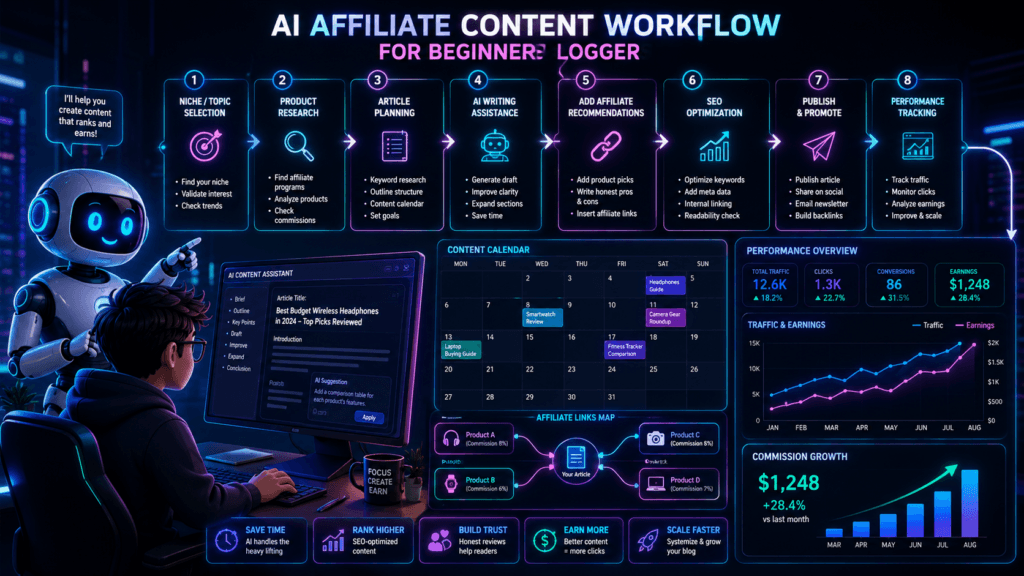
How to Use AI for Blogging Step by Step
A useful AI blogging workflow starts before you ask a chatbot to write anything.
Step 1: Start With a Real Topic
Don’t begin with “give me 100 easy keywords.”
Start with a problem that fits your site and audience.
For TechnofluxAI, that means questions that help creators, solo site owners, and small online businesses use AI more effectively.
Step 2: Check What You Already Published
Before creating another URL, check whether the topic already exists on your site.
Sometimes the better move is to:
- Refresh an old article
- Expand a thin section
- Merge overlapping articles
- Create a supporting article for a genuinely different search intent
AI is useful here because it can help compare drafts, identify overlapping sections, and organize an existing content inventory.
Step 3: Research Before Drafting
Use AI to accelerate research, not replace it.
For factual articles, verify important information against reliable sources—especially:
- Prices
- Product features
- Model names and versions
- Dates
- Policies
- Statistics
- Technical specifications
If a company makes a claim about its own product, the official documentation is usually the first place I want to check.
Step 4: Find the Content Gap
This is where AI blogging gets more interesting.
Ask two questions:
Identify the information that appears repeatedly across existing coverage.
Look for missing examples, testing, screenshots, limitations, decisions, explanations, or workflows.
If you can’t find anything meaningful to add, you may not need another article.
Step 5: Add Human Input Before the Final Draft
This can be something small but useful.
Examples include:
- A screenshot from your own test
- A prompt you actually used
- A result you measured
- A mistake you encountered
- An observation that changed your opinion
- A workflow that solved a real problem
- A limitation that isn’t obvious from the product page
This is much stronger than telling an AI to “make the article sound human.”
Step 6: Use AI to Build the Article
Once the research and original value are clear, AI can help organize the material into a useful draft.
That’s very different from asking:
“Write me a 2,000-word SEO article about the best AI tools. Make it rank #1.”
A better workflow gives the AI your research, verified facts, target reader, article goal, examples, opinions, screenshots, and constraints.
Step 7: Fact-Check the Draft
AI can produce confident mistakes.
Check important factual statements before publishing, particularly anything that could change over time.
Step 8: Edit for the Reader
Human editing isn’t valuable merely because a human touched the text.
The edit should improve something:
- Remove repetition
- Correct errors
- Add missing context
- Cut generic filler
- Clarify confusing explanations
- Preserve your actual opinion
- Add examples where readers need them
Step 9: Handle SEO Without Writing for a Score
Use descriptive titles, useful headings, internal links, clear page structure, and language that matches what the reader is trying to accomplish.
An SEO plugin can flag technical or on-page issues. It can’t decide whether your article deserves to exist.
Step 10: Publish and Measure
Publishing isn’t the end of the workflow.
Use performance data to find pages receiving impressions, queries you didn’t expect, declining articles, and sections that may need improvement.
That gives you something much more useful than an arbitrary publishing quota: evidence about what your audience is actually finding.
You Don’t Need 20 AI Blogging Tools
A complicated stack can become another form of procrastination.
A practical setup usually needs only a few categories:
| Job | Example |
|---|---|
| AI assistant | Research, organization, drafting, analysis, editing |
| Search performance data | Google Search Console |
| WordPress SEO | Rank Math or another established SEO plugin |
| Visual creation | Your preferred image, screenshot, or design workflow |
Add another subscription when it solves a problem you actually have—not because an AI-tools list says you need it.
Can You Make Money With AI Blogging?
Yes, a blog that uses AI in its workflow can make money.
But AI isn’t the business model.
A site still needs useful content, an audience, traffic or distribution, and something that can be monetized.
Common blog monetization models include:
Recommend relevant products or services and earn a commission when qualifying readers purchase through your links.
Monetize eligible traffic through display advertising or other advertising relationships.
Sell useful templates, guides, courses, tools, or other resources built for your audience.
Use useful content to demonstrate expertise and attract relevant consulting, freelance, or service work.
None of those are guaranteed income streams. AI can make parts of content production more efficient, but it doesn’t create demand or trust automatically.
AI Blogging Mistakes I’d Avoid
Publishing the First AI Draft
The first generation is a starting point. Check the facts, remove filler, improve explanations, and add the material only you can contribute.
Publishing More Just Because AI Makes It Possible
Being able to generate 50 articles doesn’t mean your site needs 50 articles.
Publishing fewer pages with stronger original value can make more sense than filling a site with overlapping content.
Creating Several Articles for the Same Intent
“Best AI blogging tools,” “top AI tools for bloggers,” and “best blogging AI software” may not need three separate URLs.
Keyword variations aren’t automatically different topics.
Trusting AI Research Without Checking Sources
An answer can sound convincing and still be wrong, outdated, or unsupported.
For important claims, go back to the original source.
Writing for an SEO Plugin Instead of a Person
A green score isn’t the goal.
SEO tools can help identify issues, but forcing keywords into every heading or stretching an article to hit a word count can make the page worse.
Publishing Generic Affiliate Content
If an affiliate article simply rewrites the manufacturer’s description and adds a purchase button, the reader has little reason to trust or need it.
Add something useful: real testing, screenshots, comparisons, limitations, decision criteria, examples, or an explanation of who should skip the product.
A Better Beginner Plan
If you’re starting an AI-assisted blog, keep the process manageable.
- Choose a focused audience and problem. Know who the site is supposed to help.
- Build a small topic cluster. Start with one important subject and the supporting questions around it.
- Research before generating. Know what already exists and what you can add.
- Create one genuinely useful article. Include examples, testing, screenshots, experience, or analysis where possible.
- Connect related pages. Internal links should help readers move naturally through the subject.
- Measure what happens. Use real performance data to decide what needs updating or expanding.
- Repeat what works. Scale the process only after you’ve learned something from it.
AI Blogging FAQ
What is AI blogging?
AI blogging means using artificial intelligence to assist with tasks such as research, brainstorming, outlining, drafting, editing, analysis, SEO workflows, and content maintenance.
Does Google penalize AI content?
Using AI isn’t automatically a spam violation. Google’s scaled content abuse policy focuses on producing many pages primarily to manipulate search rankings rather than help users, regardless of whether those pages were created by AI, humans, or another method.
Can AI write an entire blog post?
It can generate a complete draft, but that doesn’t mean the draft is accurate, original, useful, or ready to publish. Research, verification, editorial judgment, and original value still matter.
Can you make money with AI blogging?
A blog using AI can be monetized through methods such as affiliate marketing, advertising, products, or services. AI can improve workflow efficiency, but it doesn’t guarantee traffic or income.
How many articles should I publish each week?
There’s no universal number. Publish at a pace that allows you to research, verify, improve, and maintain the content. More pages aren’t automatically better.
Do I need an expensive AI tool stack?
No. Start with the tools needed for your actual workflow and add specialized software when it solves a specific problem.
How long does AI blogging take to work?
There’s no reliable universal timeline for traffic, rankings, or revenue. Results depend on factors such as the topic, competition, site history, content quality, distribution, links, technical health, and whether people actually find the content useful.
Final Thoughts
AI makes blogging faster in some important ways.
It can help you research, organize information, work through drafts, analyze data, update old content, and get past repetitive tasks.
But speed isn’t the strategy.
The real opportunity is using that saved time to do more of what generic AI content usually lacks: testing something, checking the source, adding a screenshot, explaining a confusing detail, sharing a real observation, or answering the question better.
That’s the version of AI blogging I think is worth building around.
Don’t use AI to see how many articles you can publish. Use it to reduce the mechanical work so you have more time for research, testing, judgment, and original value.

About the Author
Jon Hicks
Founder of TechnofluxAI.
I’m the creator behind TechnofluxAI, focused on breaking down powerful AI tools, emerging trends, and practical strategies to help creators and entrepreneurs stay ahead in a rapidly evolving digital world.
Follow TechnofluxAI for the latest AI tools & strategies