
Estimated reading time: 6 minutes
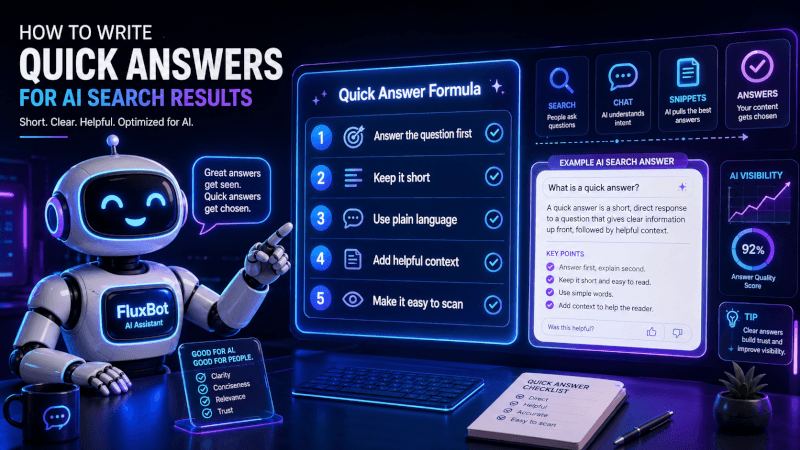
How to Write Quick Answers for AI Search Results
Quick answers for AI search results help your content explain the main point fast, clearly, and in a way that search engines and AI answer systems can understand.
The goal is not to trick AI search. The goal is to make your answer easier to read, easier to quote, and easier to connect with the deeper sections of your article.
Quick Answer
To write a strong quick answer for AI search results, answer the main question in 40 to 70 words, use plain language, include the focus phrase naturally, avoid fluff, and follow the answer with supporting details.
A quick-answer writing guide
This guide shows how to write short answer blocks that help readers, search engines, and AI systems understand your page faster.
Bloggers and site owners
Built for creators, bloggers, small businesses, niche site owners, and beginners learning SEO, GEO, and AI search formatting.
Clarity before tricks
This workflow focuses on direct answers, useful context, clean formatting, and reader-first structure instead of keyword stuffing.
Quick answer writing path
- Step 1: identify the exact question your page answers.
- Step 2: write the answer in one short paragraph.
- Step 3: include the focus phrase naturally.
- Step 4: remove filler, hype, and vague claims.
- Step 5: support the answer with examples below it.
- Step 6: add internal links to the next useful page.

The Quick Answer Formula for AI Search Results
A quick answer should give the reader a useful answer before the article goes deeper.
Think of it as the clean first response your page gives to a direct question. It should not sound like an intro. It should sound like an answer.
Weak quick answer
- Starts with a long backstory
- Uses vague phrases
- Repeats the title without answering
- Hides the main point
- Uses keyword stuffing
Strong quick answer
- Answers the question directly
- Uses plain language
- Includes the focus phrase naturally
- Gives useful context
- Leads into deeper sections
Start With the Exact Question
Before writing, identify the search question. For example, “How do I write quick answers for AI search results?” is clearer than “AI search tips.”
Answer in the First Sentence
Do not warm up with filler. The first sentence should answer the query in plain English.
Keep It Short
Aim for one short paragraph. A useful range is often 40 to 70 words for simple informational questions.
Use the Focus Phrase Naturally
Include the main phrase where it fits, but do not force it. Natural wording is better than repeated exact-match keywords.
Add One Useful Detail
After the direct answer, add one helpful detail that explains why it matters or what the reader should do next.
Support It Below
A quick answer is not the whole article. Follow it with steps, examples, FAQs, comparison points, and internal links.
Quick Answer Examples
The easiest way to learn quick answers is to compare weak versions with stronger versions.
Weak:
In today’s changing search landscape, many creators are wondering about how content should be created for AI-driven platforms.

Better:
Quick answers for AI search results should answer the main question in one short paragraph. Use direct wording, include the focus phrase naturally, and follow the answer with deeper support, examples, and internal links.

Weak:
There are many different ways to write an answer, and it depends on the type of website you have.

Better:
A good quick answer starts with the answer, not the setup. It gives readers the main point first, then uses the rest of the article to explain steps, examples, exceptions, and next actions.
Where to Place Quick Answers
Place the quick answer near the top of the post after a short intro. This helps readers confirm they are on the right page.
After the intro
Use a short intro first, then place a quick answer box before the main body.
Under question headings
For FAQ-style sections, answer the heading question in the first sentence.
Before long lists
Give the short answer before showing a long checklist, table, or comparison.
Inside hub pages
Use mini quick answers on hub cards to explain what each linked guide helps with.
Quick Answer Template for AI Search Results
Use this template when adding quick answers to blog posts, hub pages, comparison guides, and beginner explainers.
# Quick Answer Template

[Main topic] is [simple definition or direct answer].
It helps [audience] do [main benefit] by [method or process].
For best results, [short practical next step].

Example:
Quick answers for AI search results are short answer blocks that explain the main point near the top of a page.
They help readers and AI systems understand the page faster by giving a direct answer before the deeper explanation.
For best results, keep the answer clear, useful, and supported by the rest of the article.
FAQ: Quick Answers for AI Search Results
How long should a quick answer be?
A quick answer should usually be one short paragraph. For many beginner articles, 40 to 70 words is enough.
Should the quick answer include the focus keyphrase?
Yes, include the focus keyphrase when it sounds natural. Do not force it into every sentence.
Where should I place a quick answer?
Place it near the top of the article after a short intro. It should appear before the main explanation.
Can I use quick answers on every post?
You can use them on most informational posts, especially guides, tutorials, comparisons, definitions, and FAQs.
Do quick answers guarantee AI search visibility?
No. Quick answers do not guarantee visibility, but they make your content clearer, more structured, and easier to understand.
Final Takeaway
Quick answers for AI search results work best when they answer first and explain second.
Keep the answer short, useful, and direct. Then support it with steps, examples, FAQs, internal links, and clear next actions.

About the Author
Jon Hicks
Founder of TechnofluxAI.
I’m the creator behind TechnofluxAI, focused on breaking down powerful AI tools, emerging trends, and practical strategies to help creators and entrepreneurs stay ahead in a rapidly evolving digital world.
Follow TechnofluxAI for the latest AI tools & strategies