
Estimated reading time: 15 minutes
Key Takeaways
- AI scheduling tools automate time management and reduce repetitive calendar work.
- Strong AI scheduling options in 2026 include Motion, Reclaim.ai, Sunsama, Akiflow, and Todoist.
- Different tools prioritize different workflows, including automation, focus protection, intentional planning, and lightweight organization.
- AI scheduling apps actively manage time instead of simply storing tasks.
- The best AI scheduling tool depends on how much automation you actually want.
- Clockwise shut down its standalone service on March 27, 2026 after its team announced it was joining Salesforce.
AI scheduling tools are moving productivity software beyond simple task lists. The best ones can actively rearrange calendars, protect focus time, prioritize work, and reduce the amount of manual planning you do every day.

AI scheduling tools are becoming some of the most useful productivity apps available in 2026. Instead of manually organizing meetings, deadlines, time blocks, and daily tasks, modern AI scheduling software can help optimize your calendar, rearrange priorities, reduce conflicts, and improve productivity.
For creators, entrepreneurs, remote workers, agencies, and businesses, these tools can reduce repetitive planning and simplify calendar management.
Some AI scheduling apps focus heavily on calendar automation. Others combine task management, meetings, project planning, and workflow organization into broader productivity systems.
In this guide, we’ll look at the best AI scheduling tools in 2026, what makes each one different, and which platforms fit creators, businesses, teams, and everyday productivity.

What Are AI Scheduling Tools?
AI scheduling tools use artificial intelligence to help organize your time automatically.
Instead of manually deciding:
- when to work
- when to schedule meetings
- when to complete tasks
- how to prioritize projects
…the software helps optimize your schedule dynamically.
- Automatically time block tasks
- Rearrange schedules
- Prioritize deadlines
- Avoid meeting conflicts
- Sync calendars
- Create productivity workflows
- Protect focus time
This category is becoming an important part of modern productivity software.
Best AI Scheduling Tools in 2026
1. Motion — Best Overall AI Scheduling Tool
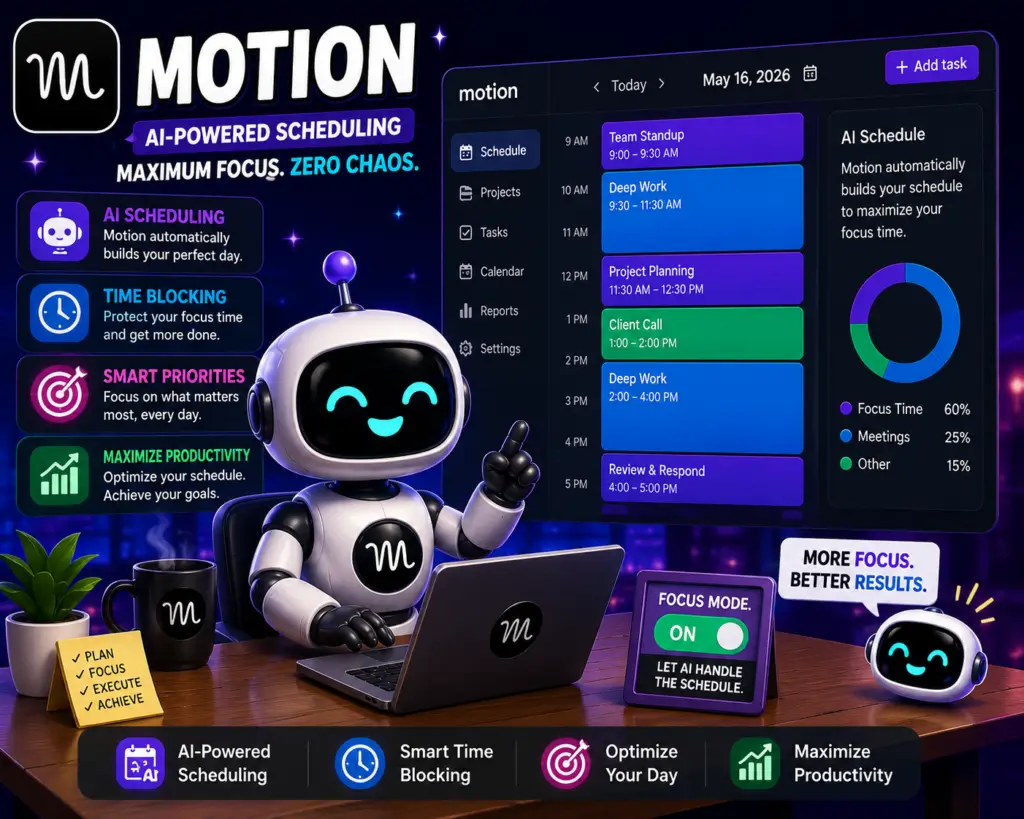
Motion has become one of the most recognizable AI scheduling platforms because it combines scheduling, calendar automation, task management, meeting planning, and workflow organization.
The biggest feature is automatic schedule optimization.
If your meetings move or priorities change, Motion can reorganize your tasks automatically. That can help users avoid constantly rebuilding schedules by hand.
Entrepreneurs, agencies, busy professionals, remote teams, and people managing overloaded calendars.
Pros
- Powerful AI scheduling
- Dynamic task prioritization
- Useful for overloaded calendars
- Strong automation features
Cons
- Higher pricing than basic task apps
- More complex than lightweight productivity tools
2. Reclaim.ai — Best for Calendar Protection

Reclaim.ai focuses heavily on protecting focus time while balancing meetings and work automatically.
One of its biggest strengths is intelligent calendar balancing. The system can help prevent meetings from consuming your entire workday.
- Scheduling habits
- Protecting deep work
- Creating focus blocks
- Adjusting around meetings
- Managing recurring workflows
Best for: knowledge workers, creators, developers, and remote workers who want more control over focus time.
Clockwise — Historical Note: Standalone Service Shut Down
Clockwise was previously one of the better-known AI scheduling tools for teams and collaborative calendar optimization.
Its system focused on reorganizing meetings to create larger blocks of uninterrupted focus time and reduce fragmented schedules.
Its influence is still relevant because many current productivity platforms use similar ideas, including meeting optimization, automated focus time, dynamic scheduling, and calendar balancing.
3. Sunsama — Best for Daily Planning

Sunsama blends task management with intentional daily planning.
Instead of aggressively automating everything, Sunsama encourages users to build realistic schedules manually while still benefiting from smart productivity features.
Sunsama feels more human-centered than many highly automated productivity apps.
4. Akiflow — Best for Fast Workflow Management
Akiflow combines task management, shortcuts, calendar integration, productivity workflows, and centralized planning.
It is designed for speed and can work well for users who want one place to manage tasks coming from several systems.
5. Todoist — Best Lightweight Scheduling Companion
Todoist is not an AI scheduler in the same category as Motion, but many users combine it with calendar systems because of its speed and simplicity.
Todoist works well for recurring tasks, reminders, lightweight project management, and personal organization.
For users who dislike complicated productivity systems, Todoist remains a practical option.

AI Scheduling vs Traditional Productivity Apps
| Traditional Productivity Apps | AI Scheduling Apps |
|---|---|
| Store tasks | Actively place tasks into schedules |
| Require manual prioritization | Can reprioritize dynamically |
| Calendars are adjusted manually | Schedules can adapt automatically |
Traditional productivity apps mainly store work. AI scheduling apps attempt to actively manage when that work gets done.
That is the real shift happening in this category.
Which AI Scheduling Tool Is Best?
- You want maximum automation
- Your calendar constantly changes
- You manage many deadlines
- You want protected focus time
- You need better calendar balance
- You want automation without rebuilding your entire workflow
- You prefer mindful productivity
- You dislike aggressive automation
- You want fast workflow control
- You manage tasks across several apps
- You prefer simplicity
- You mainly need lightweight organization
What About Clockwise?
Clockwise is no longer a current option because its standalone service shut down on March 27, 2026.
Users looking for similar scheduling concepts can compare Motion, Reclaim.ai, Sunsama, and Akiflow instead.
Personal Insight
I think AI scheduling tools are becoming one of the most important categories in software because time management is turning into a real competitive advantage.
The interesting shift is that productivity apps are evolving from passive systems into active assistants. Instead of simply storing tasks, these platforms now attempt to manage your day intelligently.
But there is an important balance.
Too much automation can actually create stress if the software starts to feel like it is controlling your schedule. That is why some people may still prefer lightweight systems like Todoist or calmer planning tools like Sunsama.
My take: The best AI scheduling tool is usually the one that reduces friction without making productivity feel robotic.
FAQs
What is the best AI scheduling tool in 2026?
Motion is a strong option for users who want highly automated calendar planning and task prioritization. The best choice still depends on how much automation you want.
Are AI scheduling apps worth it?
They can be worth it for people who spend significant time manually reorganizing calendars, meetings, deadlines, and daily plans.
Which AI scheduling app is best for teams?
Reclaim.ai is one current option for teams that want automated scheduling, focus-time protection, and calendar coordination. Clockwise should no longer be listed as a current recommendation because the standalone service shut down in March 2026.
Can AI scheduling tools improve productivity?
They can reduce manual scheduling work, protect focus time, and help users adapt plans when priorities change. The actual benefit depends on the workflow and how consistently the tool is used.
Final Thoughts
AI scheduling tools can be genuinely useful for people managing increasingly complicated calendars and workloads.
The biggest change is not simply that these apps use AI. It is that they are starting to move from passive task storage toward active schedule management.
If you want aggressive automation, Motion may fit. If you care about protecting focus time, Reclaim.ai makes more sense. If you prefer deliberate daily planning, Sunsama takes a different approach. Akiflow fits fast workflow management, while Todoist remains useful for people who want simplicity.
The best productivity system is not the one with the most AI. It is the one that removes enough friction that you actually keep using it.