

Estimated reading time: 9 minutes
Featured Quote
“The science of today is the technology of tomorrow.”
AI Tool Privacy Checklist for Beginners
AI tools can save time, speed up content creation, and help small teams work smarter. Privacy problems start when beginners paste sensitive information into a tool without checking what the platform stores, uses, shares, or connects to.
Quick Answer
Before using any AI tool, check its privacy policy, data controls, training settings, file retention rules, app connections, export options, deletion options, and whether you are allowed to upload client, customer, student, health, financial, or business-confidential information.
Beginner Rule
Treat every AI prompt like a message you might need to explain later. When the information would be risky in an email, client chat, public post, or shared document, pause before pasting it into an AI tool.
The Real Privacy Problem
Most beginners worry about AI giving a bad answer. The bigger risk is often giving the AI tool too much information in the first place.
A prompt can contain names, emails, customer details, private strategy, unpublished content, financial numbers, passwords, API keys, medical details, legal documents, or sensitive screenshots. Once that information is uploaded, your control depends on the tool, the settings, the account type, and the company’s privacy practices.
Start with safe habits.
This checklist will help you decide what is safe to upload, what settings to review, which tool promises actually matter, and when you should use a business-grade account instead of a casual free AI app.
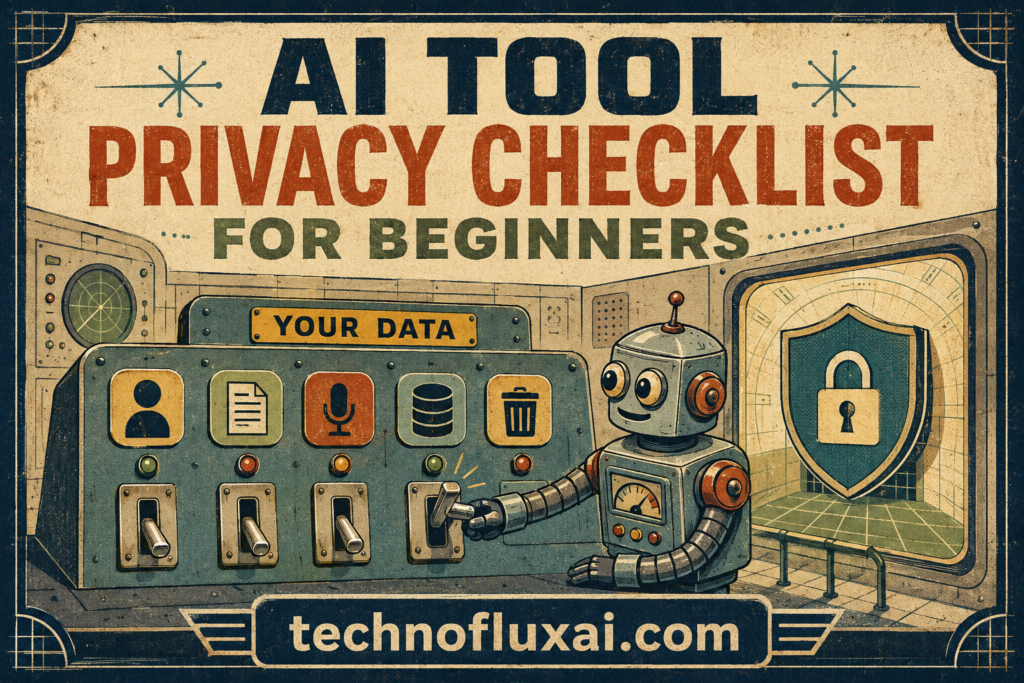
The Beginner AI Tool Privacy Checklist
You do not need to become a privacy lawyer to use AI more safely. A simple checklist can stop the most common mistakes before they happen.
Use these checks before uploading documents, pasting private messages, connecting apps, or asking an AI tool to analyze sensitive business content.
1. Check What You Are About to Upload
- Remove names, emails, phone numbers, addresses, and account numbers when they are not needed.
- Replace real client or customer names with labels like Client A, Customer B, or Project X.
- Delete passwords, API keys, private tokens, and login details before pasting anything.
- Avoid uploading full contracts, tax records, medical documents, or legal files unless your organization has approved the tool.
- Use summaries instead of raw private documents whenever possible.
2. Read the Privacy Policy Like a Beginner
You do not need to understand every legal phrase. Focus on the parts that explain what the AI company collects, how it uses your data, how long it keeps information, and whether data can be shared with third parties.
Look For
- Data collection
- Training usage
- Retention period
- Sharing with partners
- Deletion options
Be Careful When
- The policy is vague
- No deletion process is clear
- Training controls are missing
- Third-party sharing is broad
- Business use is not explained
3. Review Data Controls Before You Start
Many AI tools include privacy or data controls inside account settings. These controls may let you manage chat history, model-improvement settings, connected apps, exports, account deletion, or temporary conversations.
Do this before your first serious project, not after you already uploaded sensitive files. Settings are part of the workflow, not a cleanup step.
Data Control Review
- Open the AI tool’s account settings.
- Find privacy, data, security, or personalization controls.
- Check whether prompts may be used to improve the service.
- Look for temporary chat, history, or memory settings.
- Review connected apps before granting access.
- Confirm whether you can export or delete your data.
4. Separate Low-Risk and High-Risk AI Tasks
Not every AI task carries the same privacy risk. Brainstorming blog titles is very different from uploading a customer list, employee review, legal complaint, or medical record.
| Task Type | Privacy Risk | Safer Beginner Approach |
|---|---|---|
| Blog ideas | Low | Use freely, but avoid unpublished private strategy if it matters. |
| Generic email drafts | Low to Medium | Remove names, email addresses, and private deal details. |
| Client documents | Medium to High | Use approved business tools and anonymize wherever possible. |
| Customer lists | High | Do not upload unless your company has approved the platform and purpose. |
| Passwords or API keys | Critical | Never paste them into a general AI tool. |
5. Check App Connections and Browser Extensions
Some AI tools connect to email, calendars, drives, documents, CRMs, design tools, code repositories, or browser tabs. These connections can be powerful, but they also increase privacy risk.
Before connecting anything, ask what the tool can access, whether it can read files, whether it can write or edit content, and how to revoke permission later.
Warning
Do not connect an AI app to your email, cloud drive, website, payment tool, or customer database just because the setup screen looks simple. Convenience is not the same as safety.
6. Use the Smallest Amount of Data Possible
Good AI prompts do not always need full raw data. Often, the tool only needs a cleaned summary, a sample paragraph, a redacted excerpt, or a fictional version of the real situation.
Instead of This
Uploading a full client proposal with names, pricing, private strategy, notes, and contact details.
Do This
Paste a redacted summary with the goal, audience, offer, tone, and the exact section you need help improving.
Privacy-friendly AI use is mostly about discipline. Give the tool enough context to help, but not more than the task truly requires.
Advanced Privacy Tips for Everyday AI Users
Once the basic checklist becomes a habit, your next step is building a simple privacy workflow. This does not need to be complicated.
The goal is to know which tools are safe for casual brainstorming, which tools are approved for business work, and which information should never be uploaded without permission.
Create a Redaction Habit
Remove personal names, customer details, private numbers, file IDs, addresses, and confidential terms before prompting.
Use Approved Tools
Work projects should use tools your business, school, client, or organization has reviewed and approved.
Audit Connections Monthly
Review connected apps, browser extensions, shared files, and granted permissions on a regular schedule.
A Simple AI Privacy Workflow
Before You Prompt
- Decide whether the task is low-risk, medium-risk, high-risk, or critical.
- Remove unnecessary personal or confidential information.
- Check whether the tool is approved for this type of data.
- Review privacy settings if the project is important.
- Use a redacted summary instead of the full raw file when possible.
- Save the final output somewhere secure if it contains sensitive context.
Common Mistakes to Avoid
Pasting Private Data Too Quickly
Beginners often paste the full situation before thinking about what the tool actually needs. Slow down and remove details first.
Trusting Every AI App
A polished interface does not prove strong privacy practices. Check settings, policies, permissions, and business terms before serious use.
Forgetting Connected Accounts
Connected apps can expose more than a single prompt. Review what each integration can read, edit, or store.
FAQ: AI Tool Privacy for Beginners
Is it safe to paste personal information into an AI tool?
It depends on the tool, account type, settings, privacy policy, and purpose. Beginners should avoid pasting personal information unless it is truly necessary and the platform is approved for that use.
Can AI tools use my prompts for training?
Some AI tools may use user content to improve services, while others offer controls, business plans, or settings that limit this. Check the tool’s current data controls and privacy policy before uploading sensitive content.
What should I never paste into a general AI tool?
Do not paste passwords, API keys, private tokens, full customer databases, payment details, health records, legal secrets, confidential business plans, or anything you are not authorized to share.
Are paid AI tools automatically safer than free AI tools?
Not automatically. Paid plans may offer stronger privacy controls, but you still need to review the policy, settings, retention rules, permissions, and business terms.
What is the safest beginner habit?
Use the least amount of data possible. Redact private details, summarize sensitive documents, and only upload information that the AI tool truly needs to complete the task.
Final Takeaway
AI privacy does not have to be scary, but it does need to be intentional. Beginners should slow down before uploading files, pasting private details, or connecting apps.
The safest habit is simple: check the tool, reduce the data, remove sensitive details, and use approved platforms for important work.
Use AI Without Oversharing
Before your next AI session, remove one piece of unnecessary personal or confidential information from your prompt. That single habit can prevent a lot of privacy mistakes.
Read the Beginner AI Safety Guide
About the Author
Jon Hicks
Founder of TechnofluxAI.
I’m the creator behind TechnofluxAI, focused on breaking down powerful AI tools, emerging trends, and practical strategies to help creators and entrepreneurs stay ahead in a rapidly evolving digital world.
Follow TechnofluxAI for the latest AI tools & strategies