

Estimated reading time: 9 minutes
How to Make Your About Page Better for AI Search
Your About page is no longer just a trust-building page for human visitors. It is also one of the clearest places where AI search systems can understand who you are, what you do, who you help, and why your website should be trusted.
Quick Answer
To make your About page better for AI search, clearly explain your brand, audience, expertise, proof, services, location if relevant, author background, and the specific problems you solve. Then format that information with clear headings, short answer-style sections, schema markup, and internal links.
The Real Problem
Most About pages are vague. They say things like “we are passionate about helping businesses grow” but never explain what the business actually does, who runs it, what makes it credible, or why an AI system should mention it in an answer.
What This Guide Will Help You Do
This guide will help you turn your About page into a stronger AI-search trust asset. You will learn what to add, what to remove, how to structure your page, and how to make your brand easier for Google AI Overviews, ChatGPT-style tools, Perplexity, Bing Copilot, and other answer engines to understand.
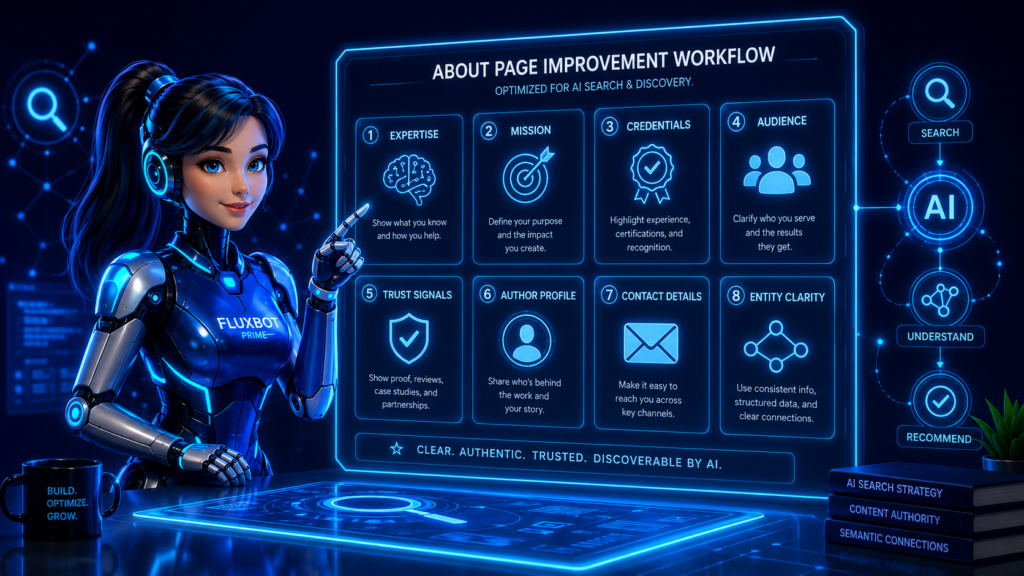
Why Your About Page Matters More in AI Search
AI search systems do not only look for keywords. They try to understand entities, relationships, trust signals, and useful answers. Your About page can help connect those dots. It can explain your brand identity, your expertise, your audience, your services, your location, your founder, and your reason for existing.
Think of your About page as your website’s identity file. When it is clear, specific, and well structured, it gives both people and machines a better reason to trust the rest of your content.
Traditional About Page
Focuses on brand story, mission, and personality. Helpful for visitors, but often too vague for AI systems to confidently understand or cite.
AI-Ready About Page
Combines story with clear facts: who you are, what you do, who you help, what proof you have, where you operate, and what topics you are qualified to discuss.
1. Start With a Clear Brand Definition
The top of your About page should quickly answer the basic identity questions. Do not make visitors scroll through a long founder story before they understand what your website is about.
Use this simple opening formula:
[Brand name] helps [specific audience] achieve [specific outcome] through [service, product, content, or expertise].
Weak Example
“We are passionate about helping businesses grow online with innovative digital solutions.”
Stronger Example
“TechnofluxAI helps bloggers, creators, and small business owners improve website visibility with beginner-friendly AI SEO, content strategy, and automation workflows.”
2. Add Specific Trust Signals
AI search visibility depends heavily on clarity and confidence. Your About page should give search engines and answer engines enough context to understand why your site is credible.
Trust Signals to Include
- Founder or team name
- Relevant experience
- Industry focus
- Real services or products offered
- Years of experience, when true
- Client types or audience served
- Location or service area, when relevant
- Media mentions, case studies, testimonials, or portfolio links
- Clear contact information
- Links to author bios, service pages, and important resources
3. Explain Your Topical Authority
Your About page should not only say what your business does. It should also explain what topics your website covers and why those topics fit your experience.
For a Creator Site
Mention your niche, content categories, audience, and the type of advice you publish regularly.
For a Local Business
Mention your services, city, service area, customer type, and what makes your business different.
For a Consultant
Mention your specialty, methods, client outcomes, professional background, and proof of results.
4. Format the Page for Answers, Not Just Storytelling
A strong About page can still have personality, but it should not be one giant wall of text. AI systems and human readers both benefit from clear sections.
Recommended About Page Structure
- Hero statement: Who you are and who you help.
- Quick summary: A short paragraph that clearly defines your brand.
- What we do: Your services, products, content, or offers.
- Who we help: Your target audience or customer types.
- Why trust us: Experience, proof, process, and credentials.
- Our story: A concise human background section.
- Helpful links: Services, blog categories, contact page, resources, and case studies.
- FAQ: Short answers to common brand, service, and expertise questions.
5. Add an About Page FAQ
FAQ sections are useful because they create clean question-and-answer content. This is especially helpful for AI search, where users often ask conversational questions.
Good FAQ Question
“Who does TechnofluxAI help?”
Good FAQ Answer
“TechnofluxAI helps bloggers, creators, and small business owners use AI tools, SEO workflows, and content systems to improve online visibility.”
6. Use Internal Links Like a Trust Map
Your About page should connect to the most important pages on your site. This helps visitors move deeper into your content and helps search systems understand the relationship between your brand, services, topics, and expertise.
Internal Links to Add
- Your main services page
- Your best beginner guide
- Your strongest case study or portfolio page
- Your contact page
- Your main blog category pages
- Your author bio page, if your site uses separate authors
- Your newsletter or free resource page
7. Add Structured Data When Possible
Structured data does not magically guarantee AI-search visibility, but it can make your website’s identity easier for search engines to understand. For an About page, common schema types may include Organization, LocalBusiness, Person, WebSite, WebPage, and FAQPage when appropriate.
Important Warning
Only use schema that accurately describes the page. Do not mark up fake credentials, fake reviews, fake awards, or services you do not actually offer. AI search rewards clarity. It does not need inflated claims.
Simple About Page Improvement Workflow
Step 1
Rewrite the first paragraph so it clearly explains who you help and what you help them do.
Step 2
Add proof: experience, results, case studies, testimonials, portfolio links, or real examples.
Step 3
Create short H2 sections for services, audience, expertise, story, and contact options.
Step 4
Add internal links and FAQ questions so your page becomes easier to understand and navigate.
Advanced Tips for an AI-Ready About Page
Once your About page is clear and trustworthy, you can make it even stronger by turning it into a brand authority hub. The goal is not to stuff it with keywords. The goal is to remove confusion.
Add Entity Clarity
Use your brand name consistently. Mention your founder, services, niche, location, and core topics in plain language. Do not make AI systems guess what your brand represents.
Create a Proof Layer
Link to proof pages. These can include case studies, testimonials, project examples, press mentions, podcast appearances, YouTube videos, or detailed blog guides.
Use Natural Questions
Add short sections that answer questions like “What does this company do?” “Who is this for?” and “Why should someone trust this advice?”
Common Mistakes to Avoid
- Being too vague: “We help people succeed” does not explain what you do.
- Hiding the real offer: Visitors should not have to guess whether you sell services, products, courses, content, or software.
- Using only brand story: Story matters, but facts create clarity.
- Leaving out the founder or team: People trust people. AI systems also benefit from clear identity signals.
- Forgetting internal links: Your About page should connect to your strongest trust-building pages.
- Overusing AI buzzwords: Say what you actually do. Do not fill the page with empty phrases like “revolutionary innovation.”
- Not updating the page: Refresh your About page when your offers, audience, credentials, or positioning changes.
About Page AI Search Checklist
- The first paragraph clearly says who you are.
- The page explains who you help.
- The page explains what you offer.
- The page includes proof or credibility signals.
- The page links to service, contact, blog, and proof pages.
- The page uses clear H2 and H3 headings.
- The page includes a short FAQ section.
- The page has accurate schema markup where appropriate.
- The page avoids fake claims and vague hype.
- The page is easy to read on mobile.
FAQ: Making Your About Page Better for AI Search
Does an About page really help with AI search?
Yes, it can. A clear About page helps define your brand, expertise, audience, services, and trust signals. That context can support stronger visibility across search and answer-based discovery.
Should I use keywords on my About page?
Yes, but naturally. Use words that describe your niche, services, audience, and location. Do not stuff the page with repeated phrases.
What is the most important section to add?
Add a clear “Who We Help” or “What We Do” section. These sections quickly explain your relevance to both visitors and search systems.
Should I add FAQ schema to my About page?
You can add FAQ schema if the page includes real FAQ content and your markup accurately matches what visitors can see on the page.
How often should I update my About page?
Review it every few months or whenever your services, audience, team, credentials, location, or positioning changes.
Final Takeaway
A better About page is not about sounding bigger than you are. It is about being clearer than your competitors. Tell people and AI systems exactly who you are, what you do, who you help, why you are credible, and where to go next.
CTA
Want to make your website easier for AI search engines to understand? Start with your About page, then review your homepage, service pages, author bios, and blog structure.
Request an AI SEO Website Review
About the Author
Jon Hicks
Founder of TechnofluxAI.
I’m the creator behind TechnofluxAI, focused on breaking down powerful AI tools, emerging trends, and practical strategies to help creators and entrepreneurs stay ahead in a rapidly evolving digital world.
Follow TechnofluxAI for the latest AI tools & strategies
Want more TechnofluxAI in Google?
Add TechnofluxAI as a Preferred Source to help Google show you more of our AI guides, tests, workflows, and research.