Estimated reading time: 6 minutes
Key Takeaways
- MCP, or Model Context Protocol, standardizes connections for AI tools, enabling them to interact with multiple systems seamlessly.
- MCP allows AI agents to perform various tasks such as searching files, accessing APIs, and automating workflows.
- Developers can create one MCP connection for multiple AI models instead of individual integrations, which simplifies AI workflows.
- MCP is essential for moving AI beyond simple conversations to executing comprehensive workflows, making AI more powerful.
- The future of AI will focus on automation and task completion, with MCP forming the foundational structure for these advancements.
What Is MCP? The Beginner Guide to AI Agents, Automation, and Connected Workflows
MCP stands for Model Context Protocol.
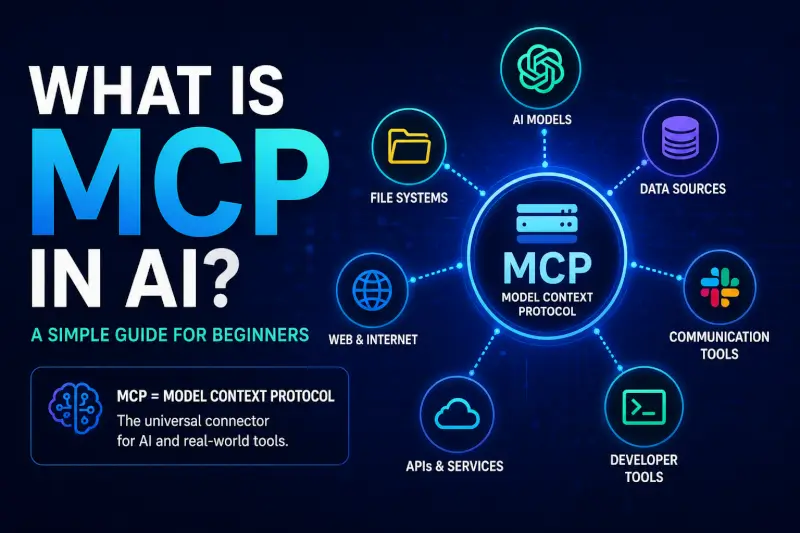
It is a system that helps AI models connect to tools, apps, files, websites, APIs, and workflows using one shared standard.
Think of it like a universal adapter for AI.
Instead of building separate integrations for ChatGPT, Claude, Gemini, and every AI tool individually, developers can build one MCP connection that works across multiple AI systems.
This makes AI agents much more powerful.
Instead of only answering questions, AI can:
- Search files
- Read documents
- Use APIs
- Trigger workflows
- Access business tools
- Automate tasks
- Interact with software systems
MCP is becoming one of the biggest trends in AI automation.
Quick Answer
MCP helps AI models connect to real-world tools and systems.
It allows AI agents to:
- Access apps
- Read files
- Use external tools
- Trigger automations
- Work across workflows
Many developers call MCP:
“The USB-C standard for AI.”
Why MCP Matters
Most AI chatbots are isolated.
They can answer questions, but they cannot actually do much without external connections.
MCP changes that.
Instead of being limited to conversation, AI can become an active assistant that works inside real systems.
Examples include:
- AI reading your Google Drive
- AI checking analytics dashboards
- AI organizing project management tasks
- AI managing automation workflows
- AI connecting to SEO tools
- AI accessing creator systems
This is why AI agents are becoming so important.
The future of AI is not just chat.
The future is AI systems that complete workflows.
How MCP Works
MCP creates a standardized way for AI systems to communicate with tools.
There are usually three parts:
1. The AI Model
This could be:
- ChatGPT
- Claude
- Gemini
- Open-source AI models
The model receives instructions from the user.
2. The MCP Server
The MCP server acts like a bridge.
It tells the AI:
- What tools exist
- What actions are available
- What information can be accessed
This creates structure between AI and external systems.
3. The Connected Tools
These are the actual services being used.
Examples:
- Google Drive
- Slack
- GitHub
- Notion
- SEO tools
- APIs
- Databases
- Workflow systems
The AI can then interact with those tools through MCP.
Real Example of MCP
Imagine you ask an AI assistant:
“Create a blog post, save it to Google Docs, then send the title ideas to Notion.”
Without MCP:
- The AI may only generate text
With MCP:
- The AI can perform the entire workflow
This is why businesses are paying attention to AI agents.
MCP vs APIs
Many beginners confuse MCP with APIs.
They are related, but different.
APIs
APIs are direct connections between software systems.
Developers usually need custom code for every connection.
MCP
MCP creates a shared structure for AI systems to use tools more easily.
Instead of building separate integrations for every AI model, developers can build one MCP-compatible system.
This simplifies AI workflows.
Why AI Creators Should Care About MCP
MCP is not only for developers.
Creators can use MCP systems for:
- Content automation
- AI research workflows
- SEO pipelines
- Video scripting
- AI blogging
- Workflow automation
- AI productivity systems
This fits perfectly with creator-focused AI businesses.
The biggest opportunity is learning how to combine:
- AI tools
- automation
- workflows
- content systems
into repeatable creator engines.
Best Uses for MCP Right Now
AI Content Workflows
AI can:
- Research topics
- Organize outlines
- Save drafts
- Update content systems
SEO Automation
MCP can connect AI with:
- keyword tools
- analytics
- search data
- workflow systems
This creates AI-assisted SEO pipelines.
AI Agents
AI agents are one of the biggest trends in 2026.
Instead of asking one question at a time, agents can:
- complete tasks
- follow instructions
- manage workflows
- interact with tools
MCP helps power those systems.
Productivity Systems
AI assistants can:
- manage schedules
- organize projects
- summarize notes
- update task boards
- automate repetitive work
Common Mistakes Beginners Make
Thinking MCP Is Only for Developers
Many no-code tools are starting to support MCP-style workflows.
This space is becoming more beginner friendly quickly.
Expecting Perfect Automation
AI agents still make mistakes.
Human review is still important.
Especially for:
- publishing
- SEO
- automation
- client work
Connecting Too Many Tools
Beginners often create messy systems.
Start with:
- one workflow
- one automation
- one clear use case
Then expand later.
Personal Insight
MCP reminds me of the early days of WordPress plugins.
At first:
- setup felt confusing
- documentation was messy
- only technical people cared
Then suddenly:
everything exploded.
That is exactly what seems to be happening with AI agents and MCP right now.
Most people still do not understand it.
That creates a huge opportunity for creators and businesses willing to learn early.
The Future of MCP
The biggest shift happening in AI is this:
AI is moving from:
“answering questions”
to:
“performing actions.”
That changes everything.
Future AI systems will likely:
- interact with business tools
- automate workflows
- manage projects
- run creator pipelines
- assist with SEO and GEO
- coordinate software systems
MCP is helping build that foundation.
Final Thoughts
MCP is still early.
But it is becoming one of the most important ideas in AI automation.
If you want to understand:
- AI agents
- automation
- workflow systems
- creator AI
- business AI
then learning MCP now is a smart move.
The people learning this early may have a major advantage over the next few years.
Especially creators building workflow-focused AI brands.
FAQ
What does MCP stand for?
MCP stands for Model Context Protocol.
Is MCP only for developers?
No. Many no-code AI tools are starting to support MCP workflows.
What is MCP used for?
MCP helps AI connect to tools, files, APIs, workflows, and software systems.
Are AI agents the same as MCP?
No. MCP helps power AI agents by giving them access to external tools and systems.
Why is MCP important?
It helps AI move beyond simple chat responses into real automation and workflow execution.