

Estimated reading time: 1 minute
Key Takeaways
- Bug bounty hunting involves understanding how websites work, identifying mistakes, and using organized testing workflows, rather than becoming a ‘movie hacker’.
- Beginners should focus on practical skills like recon, common vulnerabilities, and documentation instead of overwhelming themselves with tools and techniques.
- AI can greatly assist beginner bug bounty hunters by explaining concepts, summarizing information, and organizing notes, making the learning process smoother.
- Real learning happens through understanding vulnerabilities and testing applications, not through chasing quick payouts or emulating hackers.
- Patience, curiosity, organization, and practice are essential traits for success in bug bounty hunting.
- Apple Security Bounty
- Google Vulnerability Reward Program
- Meta Bug Bounty Program
Bug bounty hunting sounds intimidating.
A lot of people imagine movie hackers typing green code into black screens.
How to Become a Bug Bounty Hunter Using AI Workflows
Trying to learn bug bounty hunting can feel overwhelming fast.
One video tells you to learn Python. Another says you need Linux. Then someone on YouTube claims they made $40,000 hacking websites in a weekend.
Most beginners end up confused before they even start.
The truth is simpler.
Bug bounty hunting is mostly about learning how websites work, spotting mistakes, and building repeatable testing workflows.
You do not need to become a movie hacker.
You need:
- patience
- curiosity
- organization
- practice
- ethical testing habits
And honestly, AI tools are making the learning process much easier than it used to be.
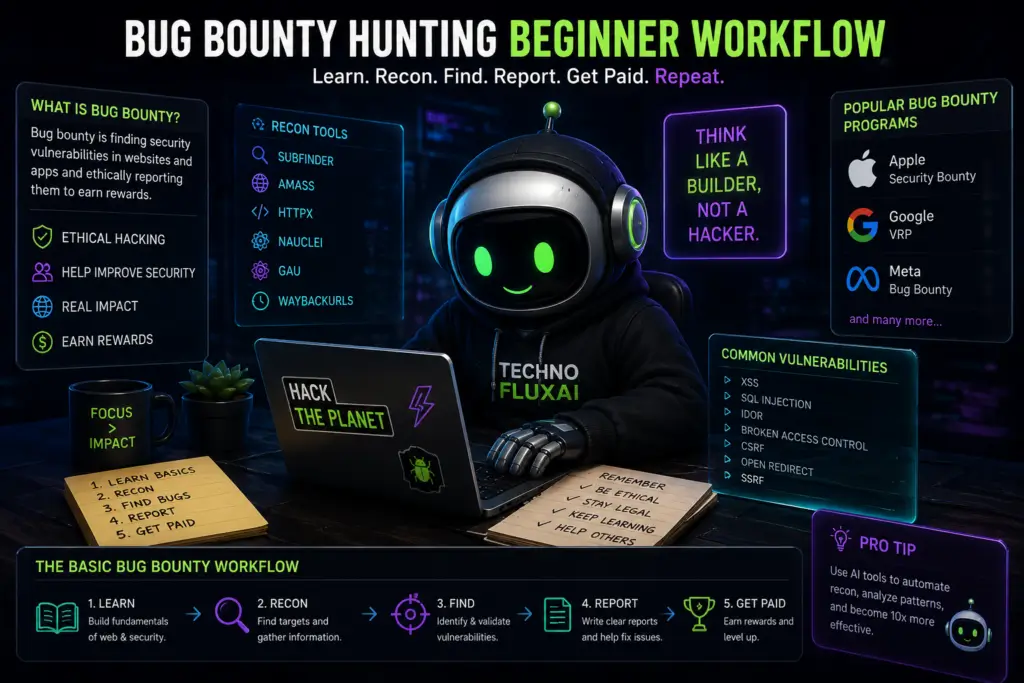
Quick Answer
If you want to become a bug bounty hunter in 2026:
- Learn how websites and APIs work
- Study common vulnerabilities
- Practice in legal training labs
- Use browser developer tools daily
- Learn Burp Suite slowly
- Build recon workflows
- Use AI to help explain technical concepts
- Start with beginner-friendly programs
Do not focus on “elite hacking.”
Focus on learning systems.
The Real Problem With Learning Bug Bounties
Most beginner cybersecurity content is terrible.
It usually falls into two extremes:
- ultra technical explanations
- fake “get rich hacking” content
Neither helps beginners build real workflows.
A lot of new learners bounce between:
- random YouTube videos
- hacking Discords
- giant tool lists
- copy-pasted payloads
…but never understand what they are actually doing.
That creates frustration fast.
The real goal is understanding:
“How does this website actually work?”
Once you understand that, vulnerabilities start making more sense.
How Bug Bounty Workflows Actually Work
Most bug bounty hunters follow the same basic process.
Step 1 — Find a Target
Researchers usually start on platforms like:
- HackerOne
- Bugcrowd
- Intigriti
These companies allow legal security testing on approved systems.
Always read the scope carefully.
Never test random websites.
Step 2 — Recon
Recon means gathering information.
This includes:
- finding subdomains
- discovering APIs
- analyzing JavaScript files
- checking archived URLs
- identifying login systems
- mapping the attack surface
This is where workflows become important.
Most experienced researchers spend huge amounts of time organizing information.
Step 3 — Test for Common Vulnerabilities
Beginners should focus on:
- XSS
- IDOR
- authentication flaws
- exposed admin panels
- API misconfigurations
- information disclosure
You are not trying to “hack everything.”
You are testing how applications behave.
Step 4 — Document Everything
This is where many beginners fail.
Good notes matter.
You need:
- screenshots
- request details
- reproduction steps
- proof of impact
A clean report can matter as much as the vulnerability itself.
How AI Can Help Beginner Bug Bounty Hunters
This is where things get interesting.
AI will not magically find vulnerabilities for you.
But it CAN help explain things faster.
I think this is one of the biggest shifts happening in cybersecurity education right now.
AI tools can help:
- explain HTTP requests
- summarize JavaScript
- break down vulnerabilities
- explain error messages
- organize recon notes
- generate testing ideas
- create workflow checklists
For beginners, this reduces confusion massively.
Instead of getting stuck for hours, you can ask questions in real time while learning.
Beginner Workflow Setup
Here’s a realistic beginner setup.
Browser
Use Chrome or Firefox.
Learn:
- DevTools
- Network tab
- Requests
- Cookies
- Local storage
Burp Suite Community Edition
This is one of the most important beginner tools.
Burp lets you:
- inspect requests
- modify requests
- replay requests
- analyze responses
Do not try to learn every feature immediately.
Focus on understanding traffic first.
Learning Platforms
Best places to practice:
- PortSwigger Web Security Academy
- OWASP Top 10
- HackerOne Hacktivity
These teach real vulnerability patterns legally.
Real Beginner Use Case
Let’s say you are testing a demo web application.
You notice:
- profile URLs contain user IDs
- changing the ID loads another account
That could indicate an IDOR vulnerability.
Now the workflow becomes:
- Inspect request
- Modify parameter
- Observe behavior
- Document result
- Verify authorization issue
- Report clearly
That is how real learning happens.
Not through giant hacker movie moments.
Mistakes Beginners Make
Trying To Learn Everything At Once
Cybersecurity is huge.
Stay focused on web applications first.
Installing Too Many Tools
You do not need 50 recon tools on day one.
Most beginners barely understand browser traffic yet.
Chasing Huge Payouts Immediately
A lot of beginners expect instant money.
Realistically, learning takes time.
Ignoring Documentation
Messy notes destroy progress.
Organization matters more than people think.
My Personal Insight
Honestly, bug bounty hunting reminds me a lot of SEO and AI workflows.
At first everything looks chaotic.
Then patterns start appearing.
The people who succeed long term usually build:
- systems
- organization
- repeatable workflows
- testing habits
- documentation processes
That is why I think AI-assisted workflows will become much bigger in cybersecurity.
Not because AI replaces researchers.
But because AI reduces friction during learning.
And beginners need less friction.
FAQs
Do bug bounty hunters need to know programming?
Some coding helps, but beginners can absolutely start by learning web applications and HTTP fundamentals first.
Can beginners make money from bug bounties?
Yes, but it usually takes time and practice before consistent payouts happen.
Is bug bounty hunting legal?
Only when testing authorized targets that allow security research.
What should beginners learn first?
Start with:
- HTTP
- browser DevTools
- APIs
- authentication
- common web vulnerabilities
Can AI help with bug bounty hunting?
AI can help explain concepts, summarize code, organize notes, and improve learning workflows.
Final Thoughts
Bug bounty hunting is not fast money.
It is a long-term technical skill.
But if you enjoy:
- workflows
- experimentation
- AI tools
- systems
- problem-solving
- learning how technology works
…it can become an incredibly interesting path.
The biggest mistake beginners make is trying to look like hackers instead of learning fundamentals.
Start slower than you think.
Learn how websites work.
Everything builds from there.
Bug Bounty Researchers and Learning Resources
Great for real-world vulnerability reports and beginner research examples.
NahamSec YouTube
One of the most beginner-friendly bug bounty educators.
STÖK YouTube
Excellent recon and workflow-focused cybersecurity creator.
PortSwigger Web Security Academy
Probably the strongest educational authority you can reference.
OWASP Top 10
Essential foundational cybersecurity authority.
Bugcrowd University
Good beginner learning resource.
Intigriti Blog
Modern bug bounty writeups and workflows.
Popular researchers many beginners follow include
NahamSec
Jason Haddix
Frans Rosén
TomNomNom

About the Author
Jon Hicks
Founder of TechnofluxAI.
I’m the creator behind TechnofluxAI, focused on breaking down powerful AI tools, emerging trends, and practical strategies to help creators and entrepreneurs stay ahead in a rapidly evolving digital world.
Follow TechnofluxAI for the latest AI tools & strategies