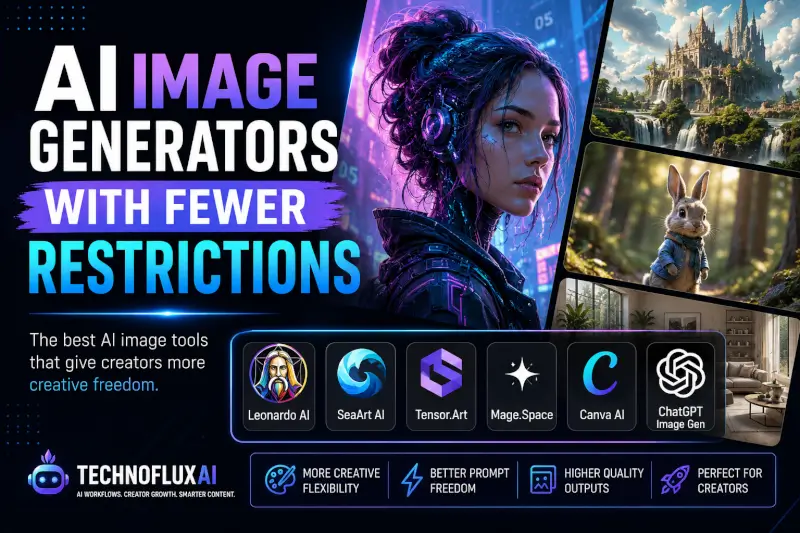
Image Generators With Fewer Restrictions
Leonardo AI
Best for creator visuals, AI characters, thumbnails, realistic images, and social media artwork.
Visit Leonardo AI →SeaArt AI
Best for anime styles, experimental art, AI characters, and flexible creative image generation.
Visit SeaArt AI →Tensor.Art
Best for advanced AI creators who want model control, custom styles, and deeper experimentation.
Visit Tensor.Art →Mage.Space
Best for fast prompt testing, creative experiments, fantasy visuals, and flexible AI image workflows.
Visit Mage.Space →Canva AI
Best for beginners creating TikTok covers, Pinterest pins, YouTube thumbnails, and social graphics.
Visit Canva AI →ChatGPT Image Generation
Best for prompt help, image ideas, visual planning, and beginner-friendly AI image workflows.
Try ChatGPT →AI Image Generators With Fewer Restrictions
AI image generation has exploded over the last few years. Creators are using AI tools for:
- TikTok videos
- YouTube thumbnails
- Pinterest pins
- social media content
- character creation
- marketing graphics
- AI storytelling
The problem is that many AI image generators feel heavily restricted.
Some tools block harmless prompts. Others limit creative styles, artistic experimentation, or realistic image generation. That can become frustrating for creators trying to build unique content workflows.
This guide covers AI image generators that currently offer more creative flexibility compared to many mainstream platforms.
These tools are not “anything goes” platforms. Most still include moderation systems and safety policies. However, they generally provide creators with more freedom for:
- artistic experimentation
- visual storytelling
- custom styles
- creator workflows
- character design
- social media content
I tested these tools as part of broader AI creator workflows involving TikTok content, FluxBot branding systems, AI thumbnails, and creator-focused visual automation.
Some platforms clearly feel more creator-friendly than others.
Quick Answer
The best AI image generators with fewer restrictions right now include:
- Leonardo AI
- SeaArt AI
- Tensor.Art
- Mage.Space
- Canva AI
- ChatGPT Image Generation
The best overall choice for most creators is probably Leonardo AI because it balances:
- flexibility
- image quality
- usability
- creator workflows
- prompt control
For advanced experimentation, Tensor.Art and Mage.Space offer more customization and model flexibility.
For beginners, Canva AI and ChatGPT are easier starting points.
Why Creators Search for “Fewer Restrictions”
Most creators are not searching for unsafe content.
They are usually searching for:
- more artistic control
- fewer blocked prompts
- anime generation
- realistic images
- stylized characters
- creative experimentation
- custom aesthetics
This is especially common among:
- TikTok creators
- YouTube creators
- AI artists
- Pinterest marketers
- thumbnail designers
- meme creators
- storytellers
Many mainstream AI tools prioritize simplicity and safety over flexibility.
That works well for business users, but creators often want more control over:
- prompts
- image styles
- realism
- custom workflows
- artistic direction
That is where some newer AI platforms stand out.
Leonardo AI
Best for:
Creators, realistic images, thumbnails, FluxBot-style visuals, and social media content.
Leonardo AI has become one of the best creator-focused AI image platforms available right now.
The platform feels designed for people actively creating:
- TikToks
- YouTube content
- AI characters
- social graphics
- cinematic images
- stylized artwork
Compared to many beginner AI generators, Leonardo gives users more freedom over:
- prompting
- image style
- model selection
- visual consistency
- realism
- fantasy art
That flexibility matters for creators building recognizable branding systems.
Why Leonardo AI Stands Out
Leonardo balances:
- usability
- image quality
- customization
- workflow speed
better than many competitors.
The interface is also beginner-friendly compared to more advanced AI art platforms.
That makes it easier for creators to quickly generate:
- thumbnails
- social posts
- AI characters
- visual storytelling content
- creator branding assets
Where Leonardo Works Best
Leonardo works especially well for:
- YouTube thumbnails
- TikTok visuals
- AI influencers
- fantasy characters
- creator branding
- FluxBot-style systems
For many creators, it feels like the safest balance between creative flexibility and ease of use.
SeaArt AI
Best for:
Anime styles, stylized artwork, character generation, and visual experimentation.
SeaArt AI has become extremely popular among creators who want more artistic freedom.
The platform supports:
- anime styles
- realistic characters
- fantasy art
- cyberpunk aesthetics
- cinematic visuals
- AI influencers
SeaArt also feels more flexible than many heavily moderated mainstream platforms.
That makes it attractive for creators experimenting with:
- viral visuals
- social media art
- AI storytelling
- fantasy content
Why Creators Like SeaArt
SeaArt gives creators access to:
- multiple image models
- strong anime generation
- customizable styles
- realistic outputs
- faster experimentation
The platform also updates quickly with newer community styles and creator trends.
That is important because AI visual culture changes fast.
Tensor.Art
Best for:
Advanced creators, custom models, and AI experimentation.
Tensor.Art is one of the more advanced platforms on this list.
This tool is less focused on simplicity and more focused on flexibility.
That makes it powerful for creators who want:
- deeper customization
- model experimentation
- custom aesthetics
- advanced prompting
- unique visual identities
Tensor.Art works especially well for creators building recurring AI characters or visual branding systems.
That is one reason it fits well into FluxBot-style workflows.
Why Tensor.Art Feels Different
Most mainstream AI image tools simplify the process heavily.
Tensor.Art gives creators more control over:
- models
- visual outputs
- prompt behavior
- style consistency
That flexibility can create much more unique results.
The downside is that beginners may initially feel overwhelmed.
Still, advanced creators will probably appreciate the extra control.
Mage.Space
Best for:
Prompt experimentation and flexible AI image generation.
Mage.Space is one of the closest things to an “open experimentation” AI image platform.
Compared to many restrictive generators, Mage.Space often feels much more flexible creatively.
That does not mean unlimited freedom. The platform still uses moderation systems.
However, creators usually experience fewer interruptions when experimenting with:
- fantasy prompts
- stylized visuals
- artistic concepts
- cinematic aesthetics
- character designs
Why Mage.Space Is Popular
Many creators like Mage.Space because it feels less restrictive during experimentation.
The platform works well for:
- creators testing ideas quickly
- concept art
- visual storytelling
- AI experiments
- social content generation
For some workflows, speed and flexibility matter more than polished business features.
Mage.Space fits that niche well.
Canva AI
Best for:
Beginners and social media creators.
Canva AI is not the most flexible platform on this list, but it deserves inclusion because it fits real creator workflows extremely well.
Many creators already use Canva for:
- thumbnails
- Pinterest pins
- TikTok covers
- YouTube graphics
- social posts
- marketing assets
Adding AI image generation directly into those workflows makes content production much faster.
Why Canva AI Matters
The biggest advantage is workflow simplicity.
Instead of:
- generating images
- exporting files
- importing into editors
- rebuilding graphics
Canva allows creators to generate and edit visuals in one system.
For beginners, that convenience matters more than advanced customization.
ChatGPT Image Generation
Best for:
Prompt assistance, idea generation, and beginner-friendly image workflows.
ChatGPT image generation has improved rapidly.
One major advantage is how well ChatGPT helps users build prompts naturally.
Beginners often struggle because they do not know how to describe images clearly.
ChatGPT solves that problem surprisingly well.
Where ChatGPT Works Best
ChatGPT works especially well for:
- brainstorming concepts
- refining prompts
- improving image descriptions
- generating creator ideas
- building visual workflows
It is also useful for creators combining:
- text generation
- image concepts
- workflow planning
- AI storytelling
into one system.
Real Creator Workflow Example
Here is a realistic creator workflow using multiple AI image tools together.
Step 1 — Idea Research
Use:
- TikTok trends
- creator search insights
to identify:
- visual trends
- viral aesthetics
- creator styles
Step 2 — Prompt Creation
Use ChatGPT to:
- build prompts
- improve descriptions
- test image concepts
- refine visual direction
Step 3 — Image Generation
Use:
- Leonardo AI
- SeaArt
- Tensor.Art
- Mage.Space
to generate:
- thumbnails
- AI characters
- visual branding
- cinematic scenes
- social media visuals
Step 4 — Content Packaging
Use Canva AI for:
- overlays
- social formatting
- thumbnails
- Pinterest graphics
- creator posts
This workflow is much more effective than relying on a single AI tool.
Mistakes to Avoid
Using Only One AI Platform
Different tools excel at different things.
Creators often get better results by combining platforms together.
Overcomplicating Prompts
Long prompts are not always better.
Simple clear prompts often perform surprisingly well.
Ignoring Branding Consistency
AI visuals become more powerful when creators maintain:
- recognizable styles
- recurring characters
- visual consistency
- branding systems
That is one reason FluxBot-style systems work well.
Chasing Only Viral Trends
Trends help visibility, but long-term creator growth still requires:
- recognizable branding
- workflow consistency
- audience trust
My Experience Using These Tools
One thing became obvious very quickly during testing:
The best AI image workflows are usually not the most “powerful” systems.
They are the systems that reduce friction.
Creators move fast.
Social trends move fast.
TikTok trends move fast.
The easier it becomes to:
- create visuals
- test ideas
- build characters
- generate thumbnails
- experiment quickly
the more valuable the workflow becomes.
That is why creator-friendly tools like Leonardo AI stand out right now.
They reduce friction while still allowing creators enough flexibility to build unique visual systems.
I also think recognizable AI branding systems will become much more important over time.
The internet is already flooded with generic AI images.
Creators who build recurring visual identities, recognizable workflows, and memorable aesthetics will probably stand out much more moving forward.
Frequently Asked Questions
What is the best AI image generator with fewer restrictions?
Leonardo AI is currently one of the best overall options because it balances flexibility, image quality, and creator usability.
Are unrestricted AI image generators safe?
Most platforms still include moderation systems and safety rules. The difference is usually the amount of creative flexibility allowed.
Which AI image generator is best for TikTok creators?
Leonardo AI, SeaArt AI, and Canva AI work especially well for TikTok creator workflows.
Which AI image tool is best for anime styles?
SeaArt AI is one of the strongest options for anime and stylized artwork.
Do creators use multiple AI image tools together?
Yes. Many creators combine:
- ChatGPT
- Leonardo AI
- Canva AI
- Tensor.Art
- image upscalers
- editing tools
into one workflow system.
Final Thoughts
AI image generation is becoming one of the most important creator tools online.
The best platforms are not necessarily the ones with the fewest rules.
They are the platforms that give creators enough flexibility to:
- experiment
- build workflows
- create recognizable visuals
- move quickly
- maintain creative momentum
Right now, Leonardo AI probably offers the best overall balance for most creators.
But advanced users may prefer the customization and experimentation available in Tensor.Art or Mage.Space.
The bigger trend is clear either way.
AI creator workflows are becoming more visual, faster, and much more brand-driven than they were even a year ago.
best-ai-tools-for-content-creators
best-ai-video-generators-for-tiktok
About the Author
Jon Hicks is the founder of TechnofluxAI, where he experiments with AI workflows, creator systems, AI branding, automation, SEO, and GEO-focused content strategies. He regularly tests AI image tools, creator workflows, AI storytelling systems, and social-media-driven AI content experiments.