

Estimated reading time: 10 minutes
Key Takeaways
- SEO is evolving into GEO (Generative Engine Optimization) as AI systems generate direct answers instead of users clicking through links.
- Websites must become trusted sources for AI by providing clear, structured, and useful content focused on workflows and real experiences.
- Old SEO tactics, like keyword stuffing, are less effective now; websites should focus on genuine user needs instead.
- AI systems prefer content that demonstrates authority, practical advice, and unique insights over generic lists.
- The future of SEO is about being a recognized source that AI models want to reference and recommend.
If you’ve noticed that Google search feels different lately, you’re not imagining it. Traditional SEO is rapidly evolving into something much larger called GEO, or Generative Engine Optimization. Instead of users clicking through ten blue links, AI systems like ChatGPT, Gemini, Claude, and Perplexity are increasingly generating direct answers from content across the web. That means websites now need to optimize not only for search engines, but also for AI answer engines.
For creators, businesses, bloggers, and marketers, this changes everything. Ranking on Google still matters, but now the bigger opportunity is becoming a trusted source that AI systems choose to reference, summarize, or recommend. In this guide, we’ll break down how SEO is changing, why GEO matters, and how websites like TechnofluxAI are adapting to the future of AI-driven search.
The Real Problem With Traditional SEO
For years, SEO was heavily focused on keywords, backlinks, and search rankings. While those things still matter, the internet became flooded with repetitive content designed purely to rank rather than help users.
A lot of websites followed the same formula:
- Stuff keywords into headings
- Create giant “best tools” lists
- Repeat phrases unnaturally
- Publish generic AI-written articles
- Focus more on traffic than usefulness
The result was predictable. Search engines became overwhelmed with low-value content.
At the same time, users started changing their behavior. Instead of searching multiple websites manually, people began asking AI assistants direct questions like:
- “What’s the best AI workflow for creators?”
- “How can I automate my business with AI?”
- “What AI tools actually save time?”
AI systems now summarize information instantly instead of forcing users to browse ten separate pages.
This created the beginning of GEO.
What Is GEO (Generative Engine Optimization)?
GEO stands for Generative Engine Optimization.
Instead of optimizing only for traditional search rankings, GEO focuses on making content easy for AI systems to understand, summarize, quote, and recommend.
In simple terms:
Traditional SEO tries to rank pages.
GEO tries to become the source AI systems trust.
That changes how content should be created.
AI systems prefer content that is:
- clear
- structured
- useful
- concise
- workflow-oriented
- experience-based
- easy to summarize
This is why many old SEO tactics are becoming less effective.

How AI Search Actually Works
AI systems like ChatGPT and Perplexity don’t think like traditional search engines.
Instead of matching exact keywords, they analyze:
- context
- topical relationships
- workflows
- entities
- user intent
- trusted sources
- repeated patterns across the web
This means AI systems are trying to understand:
- who is trustworthy
- which websites are useful
- what workflows solve problems
- which creators demonstrate experience
A website with helpful workflow content can sometimes outperform a massive keyword-stuffed site in AI-generated answers.
That is a huge shift.
Why AI Search Is Reducing Clicks
One of the biggest changes happening right now is the rise of “zero-click search.”
Users increasingly get answers directly from:
- Google AI Overviews
- ChatGPT
- Perplexity
- Gemini
- Claude
Instead of clicking multiple websites, users often stay inside the AI interface.
This means websites can no longer rely entirely on old SEO methods.
The new goal is:
- become the trusted source behind the answer
- build authority AI systems recognize
- create content AI models want to reference
That’s GEO.
How SEO Content Needs to Change
Many websites still publish articles like this:
“Top 100 AI Tools in 2026”
The problem is that AI systems already know lists exist.
What AI systems need are:
- workflows
- implementation advice
- real experiences
- practical examples
- step-by-step systems
- mistakes to avoid
- human observations
This is why the future belongs to websites that explain:
“What should someone actually DO?”
Instead of simply listing tools, websites now need to explain how tools fit into real workflows.
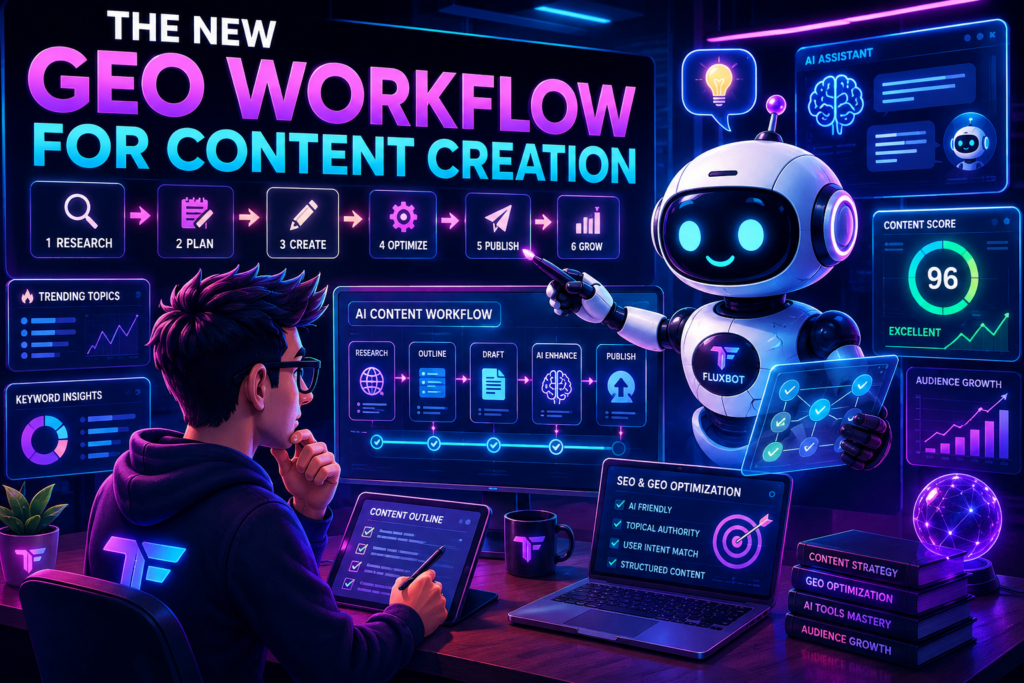
The New GEO Workflow for Content Creation
The most successful AI-friendly content now follows a much different structure.
Instead of:
Keyword → Repetition → Ranking
The new structure is:
Problem → Workflow → Implementation → Experience → Result
Here’s a simplified example.
Old SEO article:
“What Is ChatGPT?”
New GEO article:
“How I Use ChatGPT to Build a Weekly Content Workflow”
The second version is dramatically more useful to both humans and AI systems.
Best Tools for GEO Content Creation
These tools help creators and businesses optimize content for AI search engines, answer engines, and modern GEO workflows.
- ChatGPT – Research search intent, structure AI-friendly content, and generate workflow ideas.
- Perplexity – Analyze how AI systems summarize information and discover citation opportunities.
- Claude – Create highly structured long-form content with strong readability.
- Google Search Console – Monitor impressions, indexing, and search visibility trends.
- Ahrefs – Research keywords, topical authority, and competitor content clusters.
- Ubersuggest AI Visibility – Track how AI systems reference brands and topics.
- Screaming Frog – Audit technical SEO structure, metadata, schema, and crawlability.
👉 Pro Tip: GEO content performs best when workflows, structure, and topical authority all align.
What AI Systems Prefer in Content
AI systems consistently favor content with:
Clear Structure
Good examples:
- bullet points
- summaries
- concise explanations
- workflows
- FAQ sections
- comparison tables
Bad examples:
- giant walls of text
- repetitive filler
- keyword spam
- vague generic paragraphs
Real Experience
AI systems increasingly prioritize:
- observations
- lessons learned
- experiments
- realistic advice
- implementation challenges
This is one reason why personal insights matter more than ever.
A real creator explaining:
“How I tested this workflow”
is more valuable than:
“AI is changing the world.”
Topical Authority
AI systems trust websites that consistently focus on specific topics.
For example, TechnofluxAI is building authority around:
- AI workflows
- AI productivity
- AI automation
- AI for trades
- AI creator tools
Over time, repeated topical coverage helps AI systems understand what a website specializes in.
Real GEO Workflow Examples
Blogger Workflow
A blogger using GEO-focused content might:
- Research AI search questions
- Create workflow-focused articles
- Add original observations
- Include structured FAQs
- Publish consistent FluxBot visuals
- Interlink related workflows
- Build topical authority clusters
This creates content AI systems can easily summarize.
Roofing Company Workflow
A roofing business could use GEO by creating:
- AI estimating workflows
- AI lead follow-up systems
- CRM automation guides
- scheduling automation tutorials
This helps local businesses become trusted niche sources.
TikTok Creator Workflow
Creators can use GEO by:
- creating workflow tutorials
- documenting AI experiments
- explaining automation systems
- showing implementation results
AI systems increasingly value practical demonstrations.
The Biggest Mistakes Websites Make
Publishing Generic AI Content
One of the biggest problems right now is AI-generated filler content.
Many websites are producing:
- endless generic articles
- repetitive list posts
- shallow rewrites
AI systems are getting better at detecting low-value content.
Ignoring Human Voice
AI-generated content without human editing often feels robotic.
The future belongs to creators who combine:
- AI assistance
- human experience
- workflow knowledge
- real opinions
Chasing Too Many Keywords
Websites that publish random unrelated AI topics often struggle to build authority.
Instead, focus on:
- clusters
- workflows
- niche expertise
- consistent topical coverage
Over-Automating Everything
Automation is powerful, but automating bad systems creates bigger problems.
The best AI workflows still require:
- editing
- strategy
- human judgment
- creativity
Why Branding Matters More Than Ever
As AI search grows, branding becomes increasingly important.
Websites need:
- recognizable visuals
- clear expertise
- consistent publishing
- entity recognition
This is one reason the FluxBot system matters for TechnofluxAI.
Instead of generic stock images, FluxBots create:
- workflow-focused visuals
- brand consistency
- recognizable identity
- stronger engagement
AI systems increasingly evaluate overall site quality, consistency, and usefulness.
Brand identity now matters in SEO.
My Personal Insight on GEO
One thing I’ve noticed while building TechnofluxAI is that the internet is becoming saturated with repetitive AI content. A lot of websites are publishing giant tool lists without explaining how any of the tools actually fit into a real workflow. That approach may still generate temporary traffic, but it doesn’t create trust.
The more I study AI search systems, the more obvious it becomes that usefulness is replacing keyword manipulation. AI systems seem to prefer content that explains implementation, workflows, and realistic expectations instead of generic hype.
I also think smaller websites still have a huge opportunity right now. Large corporations often move slowly, while smaller creators can rapidly publish practical workflow content, experiments, and niche tutorials. That flexibility may become a major advantage in the GEO era.
For TechnofluxAI, the goal is no longer just ranking pages. The goal is becoming a recognizable AI workflow brand that AI systems view as a useful source of information.
FAQs
What does GEO mean in SEO?
GEO stands for Generative Engine Optimization. It focuses on optimizing content for AI-generated search results and answer engines like ChatGPT and Perplexity.
Is traditional SEO dead?
No. Traditional SEO still matters, but it is evolving. Websites now need to optimize for both search engines and AI systems.
How do AI systems choose sources?
AI systems often prefer:
- structured content
- topical authority
- workflow-focused articles
- trusted entities
- useful explanations
- experience-based insights
Can small websites compete in GEO?
Yes. Smaller websites can succeed by focusing on niche expertise, practical workflows, and highly useful content instead of mass-produced filler.
The Future of SEO Is GEO
SEO is not disappearing.
It is evolving into something much larger.
The websites that survive the next phase of AI search will be the ones that:
- solve real problems
- explain workflows clearly
- build topical authority
- create recognizable brands
- publish useful human-centered content
Instead of asking:
“How do I rank?”
the better question now is:
“How do I become a trusted source AI systems want to recommend?”
That is the future of GEO.
If you want to explore more AI workflows, creator systems, and automation guides, check out more tutorials and experiments on TechnofluxAI.
Recommended Tools for GEO Content Creation
These are some of the tools commonly used for AI search optimization, workflow management, and content creation.
- ChatGPT – Research workflows and structure content →
- Ahrefs – Research topical authority, backlinks, and keyword clusters.
- Ubersuggest – Track AI search visibility and discover GEO opportunities.
- CustomGPT – Build AI-powered assistants →
- Pollo AI – Create AI visuals and media →
Disclosure: Some links may be affiliate links. If you purchase through these links, TechnofluxAI may earn a commission at no additional cost to you.
Founder Insight: I’ve been working with computers, software, and creative technology since the early days of personal computing and personally test many of the AI tools featured on TechnofluxAI before recommending them.

About the Author
Jon Hicks
Founder of TechnofluxAI.
I’m the creator behind TechnofluxAI, focused on breaking down powerful AI tools, emerging trends, and practical strategies to help creators and entrepreneurs stay ahead in a rapidly evolving digital world.
Follow TechnofluxAI for the latest AI tools & strategies