
Estimated reading time: 9 minutes
AI marketing is moving beyond simple writing tools. The new stack is about visibility, trust, and execution.
Bluefish AI, Bluejay AI, and Gradial AI show how modern marketing teams may track AI search visibility, test AI agents, and automate campaign operations.
Quick Answer
What Is the New AI Marketing Stack?
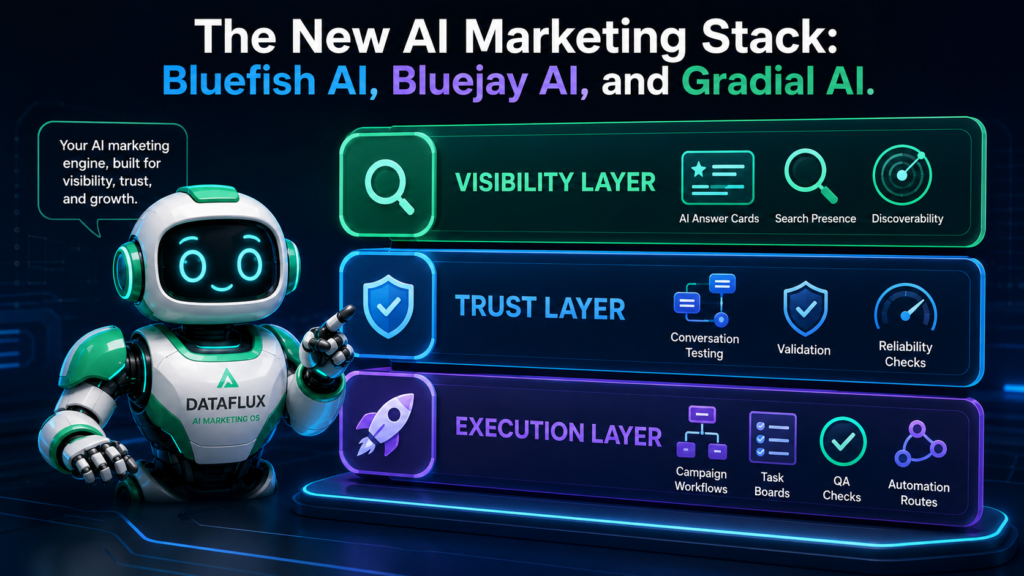
The new AI marketing stack is forming around three major needs: visibility, trust, and execution.
Bluefish AI helps brands understand how they appear across AI-generated search and answer experiences. Bluejay AI helps teams test and monitor AI agents before and after launch. Gradial AI uses AI agents to help marketing teams execute campaigns and content operations faster.
For creators and small businesses, the practical lesson is simple: AI marketing is no longer just “write me a blog post.” The next wave is about how AI systems discover your brand, how AI agents behave, and how marketing work gets done.
AI Marketing Is Moving Beyond Writing Tools
Most AI marketing content still focuses on writing tools.
That matters, but it is no longer the full story.
The next wave of AI marketing is bigger than content generation. Brands now need to understand how they appear inside AI answers, whether their AI agents behave correctly, and how marketing work moves from idea to execution without getting stuck in endless handoffs.
That is where tools like Bluefish AI, Bluejay AI, and Gradial AI become interesting.
These tools are not doing the same job. Instead, they represent three layers of a modern AI marketing stack.
Visibility layer
Trust and testing layer
Execution layer
Core Concept
What Is an AI Marketing Stack?
An AI marketing stack is a group of tools that helps a business use AI for visibility, content, customer interaction, testing, automation, analytics, and campaign execution.
Older marketing stacks were built around websites, email platforms, CRMs, analytics dashboards, SEO tools, and ad platforms. Those still matter. However, AI is adding new problems.
AI Visibility
How does our brand show up in AI answers?
AI Accuracy
Are AI tools describing us correctly?
Agent Trust
Can our chatbot or voice agent handle real customer questions?
Workflow Speed
Can campaigns move faster without breaking quality control?
A modern AI marketing stack needs more than a writing tool. It needs visibility, testing, governance, and execution.
Layer 1: Visibility
Bluefish AI: The Visibility Layer
Bluefish AI is focused on brand visibility and control across AI experiences. It fits into the growing category of GEO, AI search visibility, and AI-native brand monitoring.
This matters because people are no longer only discovering brands through Google search results, social feeds, or ads. Increasingly, they ask AI systems for recommendations, comparisons, summaries, and product guidance.
Why Bluefish AI Matters
Bluefish AI matters because AI search visibility is becoming part of SEO.
It is not enough to rank in traditional search. Brands also need to understand whether AI answer engines can find, summarize, and describe them correctly.
For creators and small businesses, the lesson is simple: your content needs to be clear enough for both humans and AI systems to understand.
Layer 2: Trust
Bluejay AI: The Trust and Testing Layer
Bluejay AI fits the trust and testing layer of the AI marketing stack. It focuses on helping teams test, monitor, and improve AI agents across voice, chat, and text experiences.
This solves a different problem than Bluefish AI.
Bluefish AI is about how AI systems describe your brand. Bluejay AI is about whether your own AI agents behave correctly when people actually use them.
Why Bluejay AI Matters
AI agents are not predictable like traditional software.
A button either works or it does not. An AI agent can fail in softer ways. It may misunderstand a customer, skip a required step, give the wrong answer, or behave differently after a prompt update.
That makes testing important, especially for businesses using AI agents in customer support, sales, onboarding, booking, voice workflows, or service questions.
Layer 3: Execution
Gradial AI: The Execution Layer
Gradial AI fits the execution layer of the AI marketing stack. It focuses on helping marketing teams use AI agents to complete operational work across campaigns, content, QA, asset systems, and marketing workflows.
Many marketing teams do not struggle because they lack ideas. They struggle because campaigns get stuck in the messy middle: briefs, approvals, page updates, asset tagging, QA, CMS changes, and handoffs between tools.
Why Gradial AI Matters
Gradial shows where AI marketing agents are heading.
Instead of only drafting copy, AI agents are starting to handle operational work. That can include updating content, tagging assets, assembling campaigns, checking pages, and moving work across systems.
For smaller teams, the practical takeaway is not to automate everything at once. Start with one repeatable workflow, test it, and keep human review before anything important goes live.
DataFlux Workflow
How to Think About These Tools
You do not need to buy every enterprise AI tool to learn from this shift. The useful part is understanding the order: visibility first, trust second, execution third.
Start With Visibility
Before automating everything, understand how your brand is showing up. Can AI tools explain what you do? Are they citing the right pages? Do they confuse you with competitors?
Add Trust Before Automation
If you use AI agents with customers, test them. Ask vague, confused, angry, and edge-case questions before trusting the agent in a live workflow.
Automate Execution Carefully
Use AI to draft briefs, create checklists, repurpose content, organize campaign assets, and prepare updates. Keep human review before anything important goes live.
What This Means for Creators and Small Businesses
Most creators and small businesses do not need enterprise tools on day one.
However, they should understand the direction.
The future of AI marketing is not just “AI writes content.” It is:
- AI helps people discover your brand.
- AI answers questions about your business.
- AI agents interact with customers.
- AI systems help execute marketing work.
- AI search changes how content gets found.
That means your content needs to be clear, structured, and easy for both humans and AI systems to understand.
For creators, this means building better pillar pages, comparison guides, FAQs, tutorials, and workflow content.
For small businesses, it means making sure your services, offers, pricing pages, support content, and brand positioning are easy to understand and accurate.
Avoid These
Common Mistakes to Avoid
Mistake 1: Thinking AI Marketing Only Means AI Writing
AI writing is only one layer. The bigger opportunity is in visibility, testing, automation, analytics, and campaign execution.
Mistake 2: Ignoring AI Search Visibility
If AI tools summarize your brand incorrectly, your content strategy has a gap. The visibility layer matters because AI answers can influence discovery.
Mistake 3: Launching AI Agents Without Testing
AI agents need real testing because they can fail in unpredictable ways. Businesses need to simulate real conversations and catch issues before customers do.
Mistake 4: Automating Messy Workflows Too Early
Do not automate a broken workflow before you understand it. First map the process, then automate the repeatable parts.
TechnofluxAI Take
AI Marketing Is Becoming a System, Not Just a Writing Shortcut
Bluefish AI, Bluejay AI, and Gradial AI are interesting because they show three different parts of the same shift.
That is the real story.
AI marketing is moving from content creation to systems. The brands that win will not just use AI to write faster. They will use AI to understand visibility, test customer-facing agents, and speed up workflows without losing human judgment.
For creators and small businesses, start with the simple version: make your content easier to understand, test every AI workflow before trusting it, and automate one repeatable task at a time.
FAQ
What is an AI marketing stack?
An AI marketing stack is a group of tools that helps a business use AI for visibility, content, customer interaction, testing, automation, analytics, and campaign execution.
What does Bluefish AI do?
Bluefish AI helps brands understand and manage visibility across AI-generated experiences and AI-native discovery. It fits the visibility layer of the AI marketing stack.
What does Bluejay AI do?
Bluejay AI helps teams test, monitor, and improve voice, chat, and text AI agents. It fits the trust and testing layer of the AI marketing stack.
What does Gradial AI do?
Gradial AI helps marketing teams use AI agents to execute marketing operations, including authoring, QA, tagging, campaign assembly, and work across connected systems.
Should small businesses use these tools?
Some of these tools are aimed more at enterprise teams, but the ideas still matter for small businesses. Start by improving AI search visibility, testing customer-facing AI tools, and automating simple repeatable workflows before investing in a larger AI marketing stack.
About TechnofluxAI
Practical AI Education for Creators and Small Businesses
TechnofluxAI helps creators, bloggers, small businesses, and beginners understand AI tools, AI search visibility, SEO, GEO, automation, productivity workflows, and creator technology without unnecessary jargon.

About the Author
Jon Hicks
Founder of TechnofluxAI.
I’m the creator behind TechnofluxAI, focused on breaking down powerful AI tools, emerging trends, and practical strategies to help creators and entrepreneurs stay ahead in a rapidly evolving digital world.
Follow TechnofluxAI for the latest AI tools & strategies