

Estimated reading time: 25 minutes
GPT-5.6 vs Claude Sonnet 5 for Content Research
GPT-5.6 and Claude Sonnet 5 are both strong choices for content research, but they do not feel the same in a real writing workflow. One may be better for deep structured research, while the other may be better for readable synthesis, planning, and long-form drafting support.
Quick Answer
Use GPT-5.6 when your content research needs deeper analysis, source comparison, technical breakdowns, data-heavy reasoning, or complex SEO strategy. Use Claude Sonnet 5 when you need smooth synthesis, readable briefs, long-context review, editorial judgment, and creator-friendly content planning.
The Real Decision
This is not just a “which model is smarter?” question. For content research, the better question is: which model helps you move from messy information to a trustworthy article plan faster?
Best Workflow
The strongest setup is often not choosing only one. Use GPT-5.6 for research depth and verification planning, then use Claude Sonnet 5 to shape the findings into a clean content brief, outline, and human-readable draft structure.
If your content depends on accuracy, citations, comparisons, and search intent, the model matters. But the workflow matters even more. A strong research prompt, clean source set, and clear editorial goal will outperform a powerful model used casually.
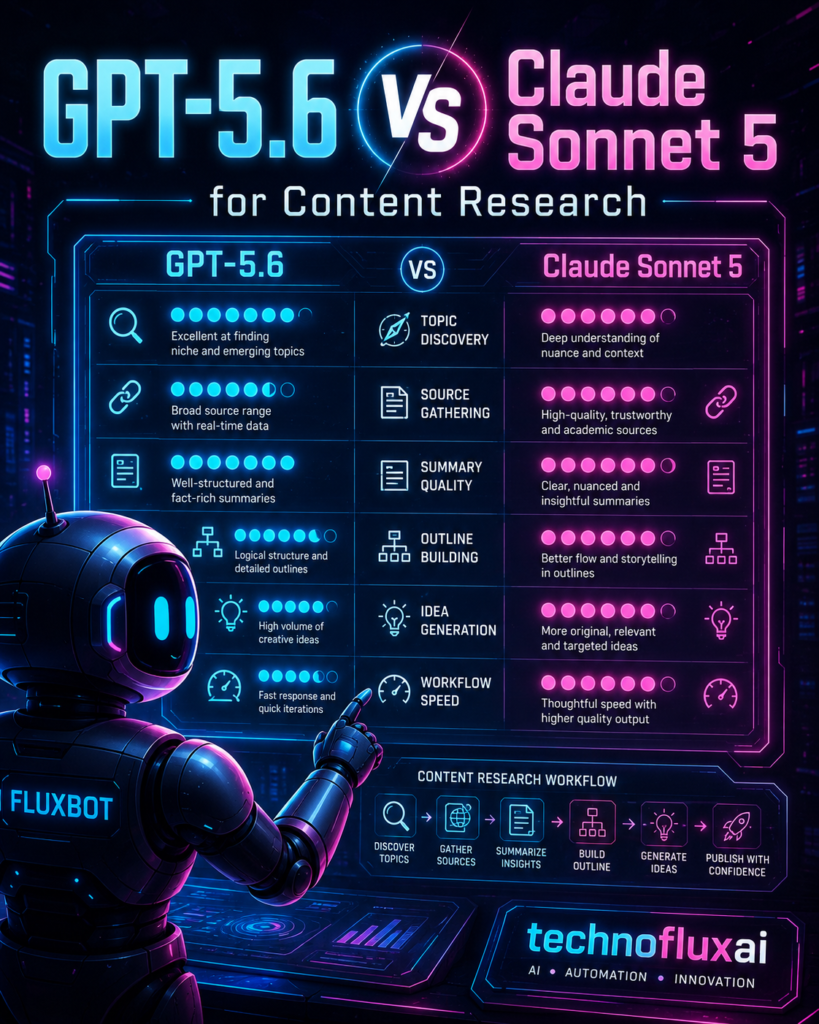
What Content Research Actually Requires
Good content research is not just asking an AI model to “write an article.” Real research involves collecting useful information, separating strong sources from weak sources, understanding the search intent, finding missing angles, organizing claims, and turning everything into a clear editorial plan.
That means the best AI model for content research should help with thinking, not just writing. It should compare ideas, challenge weak assumptions, summarize sources accurately, identify gaps, and help you decide what the reader actually needs.
GPT-5.6 Strength
GPT-5.6 is a strong fit for deep analysis, technical topics, research decomposition, structured comparisons, evidence planning, and complex content strategy decisions.
Claude Sonnet 5 Strength
Claude Sonnet 5 is a strong fit for readable synthesis, long document review, editorial judgment, tone shaping, user-friendly explanations, and turning research into clean content briefs.
Head-to-Head Comparison for Content Research
When to Choose GPT-5.6
Choose GPT-5.6 when the research itself is the hard part. If you need to compare multiple sources, understand technical details, build a complex SEO plan, map entities, or reason through conflicting information, GPT-5.6 is usually the better first stop.
Use GPT-5.6 For:
- Building detailed SEO content briefs.
- Comparing product categories, tools, models, or platforms.
- Finding weak assumptions in an article idea.
- Turning messy notes into a structured research map.
- Analyzing technical, legal, scientific, finance, or software topics.
- Creating a source verification plan before drafting.
When to Choose Claude Sonnet 5
Choose Claude Sonnet 5 when the content needs to feel organized, readable, and editorially clean. It is especially useful when you already have research material and need help turning it into a brief, outline, draft structure, rewrite plan, or audience-friendly explanation.
Use Claude Sonnet 5 For:
- Summarizing long documents into readable takeaways.
- Building smooth article outlines from research notes.
- Improving tone, transitions, and section flow.
- Turning complex research into beginner-friendly explanations.
- Creating editorial briefs for writers or clients.
- Reviewing drafts for clarity, repetition, and reader friction.
Best Workflow: Use Both Models Together
For serious content research, the best workflow is often a two-model system. Let GPT-5.6 stress-test the research and build the information architecture. Then let Claude Sonnet 5 shape that research into a clean content brief or readable draft plan.
1. Research Map
Use GPT-5.6 to break the topic into search intents, subtopics, entities, objections, and missing questions.
2. Source Review
Ask GPT-5.6 to compare sources, flag weak claims, and separate facts from opinions or assumptions.
3. Brief Creation
Use Claude Sonnet 5 to turn the research into a clean outline, angle, reader promise, and section-by-section brief.
4. Editorial Polish
Use Claude Sonnet 5 to check flow, simplify explanations, remove repetition, and improve the reader experience.
Practical Prompt Workflow for Content Researchers
The model you choose matters, but your prompt structure matters just as much. A vague prompt turns even a powerful model into a generic writing machine. A strong prompt turns the model into a research partner.
GPT-5.6 Research Prompt
Analyze this topic for a long-form SEO article: [topic]. Break it into search intent, audience pain points, required subtopics, entities to cover, likely misconceptions, source types needed, comparison angles, and missing questions. Do not draft the article yet. Build a research map first.
Claude Sonnet 5 Brief Prompt
Turn this research map into a clear content brief for a human writer. Include the reader promise, article angle, H2 structure, key points under each section, examples to include, warnings to avoid, FAQ ideas, and a final takeaway. Keep it practical and beginner-friendly.
Common Mistakes to Avoid
Mistake 1: Asking for the Article Too Soon
Research should happen before drafting. Ask for a research map, source plan, and content brief before asking for the finished article.
Mistake 2: Treating AI Output as Verified Research
AI can organize research, but important claims still need source checking, especially for tools, pricing, laws, health, finance, software, and current events.
Mistake 3: Ignoring the Reader
A model can produce impressive research that still fails the reader. Always define who the article is for and what decision it helps them make.
Mistake 4: Using One Model for Every Step
Some models are better for research depth. Others are better for synthesis and polish. Matching the model to the task usually creates better content.
FAQ
Is GPT-5.6 better than Claude Sonnet 5 for content research?
GPT-5.6 is often the stronger choice for deep research planning, technical reasoning, source comparison, and structured SEO strategy. Claude Sonnet 5 is often better when the goal is readable synthesis, editorial flow, and turning research into a clean brief.
Which model is better for SEO content briefs?
GPT-5.6 is stronger for building the strategic research layer of the brief, including search intent, topic clusters, and evidence needs. Claude Sonnet 5 is stronger for turning that strategy into a writer-friendly brief with better flow.
Which model should bloggers use?
Bloggers who need quick, readable outlines may prefer Claude Sonnet 5. Bloggers working on competitive SEO topics, technical comparisons, or affiliate research may get more value from starting with GPT-5.6.
Can I use both GPT-5.6 and Claude Sonnet 5 together?
Yes. A strong workflow is to use GPT-5.6 for research mapping and source analysis, then use Claude Sonnet 5 for brief creation, outline refinement, and editorial polish.
Do these models replace human research?
No. They can speed up research planning, summarization, comparison, and organization, but humans still need to verify important claims, check sources, understand the audience, and make final editorial decisions.
Final Takeaway
GPT-5.6 is the better choice when content research needs deep analysis, structured reasoning, and strategic SEO planning. Claude Sonnet 5 is the better choice when research needs to become a clean, readable, writer-friendly brief. The smartest content workflow uses each model where it is strongest instead of forcing one model to do every job.
Build Better AI Research Workflows
The best AI content does not start with a draft. It starts with better research, better prompts, better structure, and the right model for each step.
Upgrade Your AI Content Workflow
About the Author
Jon Hicks
Founder of TechnofluxAI.
I’m the creator behind TechnofluxAI, focused on breaking down powerful AI tools, emerging trends, and practical strategies to help creators and entrepreneurs stay ahead in a rapidly evolving digital world.
Follow TechnofluxAI for the latest AI tools & strategies
Want more TechnofluxAI in Google?
Add TechnofluxAI as a Preferred Source to help Google show you more of our AI guides, tests, workflows, and research.