

What if your AI assistant could notice that an important email needs attention, prepare information for your next meeting, and keep working on a project after you close your laptop?
That is the idea behind Claude Duet, a proactive AI agent Anthropic introduced on October 21, 2026.
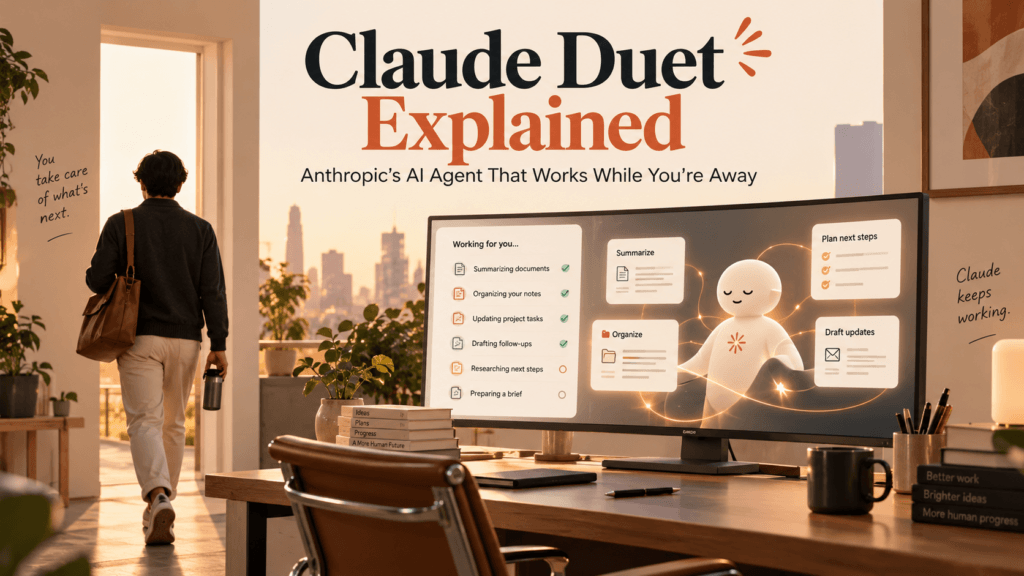
Instead of behaving only like a chatbot that waits for the next prompt, Claude Duet is designed to work across connected apps, surface things that may need your attention, complete assigned work in the background, and ask for approval before taking certain sensitive actions.
Claude Duet is Anthropic’s proactive AI agent for work. It can use connected apps, prepare morning briefings, continue assigned tasks in its own cloud computer, alert you when something needs attention, and pause for approval before actions such as sending a message, making a payment, signing a document, or deleting information.
Anthropic is initially offering Claude Duet as a research preview through a waitlist for eligible Claude Pro and Max subscribers in the United States. It runs on Claude Opus 5.5 and uses the same plan limits as the rest of Claude.
For creators, bloggers, freelancers, and small-business owners, the interesting part is not another AI model benchmark. It is the move from asking AI for help toward handing AI a piece of work and letting it continue without you sitting there.
That sounds useful. It also creates a new set of questions.
What should an AI agent be allowed to see? What should it be allowed to do? How much human review is still necessary? And does an agent actually save time if you still have to check its work?
Those questions matter more than the word “agent.”
What Is Claude Duet?
Claude Duet is a separate Claude experience designed around proactive work rather than a traditional back-and-forth chat.
You can message it with a task much like you would message a colleague. Duet can then use supported apps and connectors, work through steps in the background, and return when the task is finished or when it needs a decision from you.
Its own cloud computer is an important part of that design. Anthropic says Duet has a virtual machine with its own browser, so your personal laptop or phone does not need to remain switched on while an assigned task continues.
Duet can surface information instead of waiting for you to begin every interaction.
Assigned work can continue on Duet’s cloud computer after you step away.
It can work with thousands of supported connectors and plugins.
Important actions are designed to come back to you before Duet completes them.
How Claude Duet Changes the Usual Chatbot Workflow
A normal AI conversation usually begins with you noticing a problem.
You open the chatbot, explain the situation, provide the necessary context, wait for a response, and decide what to do next.
Claude Duet tries to move some of that work earlier in the process.
For example, Anthropic says Duet can prepare a morning brief using information from connected email and calendar accounts. It can also check those accounts periodically and alert you when something appears to need attention.
Importantly, “proactive” does not mean Duet watches every app every second. Anthropic says connected accounts are checked at intervals because constant monitoring would consume plan limits much faster.
That means Duet may be useful for prioritization and routine follow-up, but it should not be treated as a guaranteed real-time alert system for urgent business events.
The interesting part of Claude Duet is not simply that Claude can generate another email or spreadsheet. It is that the agent is being designed to notice work, coordinate across tools, continue tasks without constant supervision, and return to the human when judgment or approval matters.
One Thing I have Learned while building TechnofluxAi is that Ai tools usually sound easier to use than they are in the real world. I like to try things myself, see where I get stuck, and figure out what actually saves time instead of just repeating promisies.That’s the approach I use throughout this site: keep what works, point out what doesn’t, and explain things in a way that makes sense for someone who is still learning. I started out searching for an image creator. That was my first interaction with Ai. I was frustrated by the vast tool list without any real direction on which tool was best. Then I realized how powerful this tool was .and was going to be in the future. Making mistakes has helped me in the choice of articles I write.
What Can Claude Duet Actually Do?
Anthropic describes Duet as capable of handling both small administrative jobs and larger multi-step projects.
Its usefulness will still depend on which services you connect, what permissions are available, how clearly the task is defined, and how reliably the research preview performs in real-world situations.
Review connected information and surface the email, calendar items, and priorities that appear to need your attention.
Continue a job in its cloud environment while you move on to something else.
Work with supported tools for email, invoicing, CRM activity, payroll, ecommerce, design, and other business processes.
Anthropic gives examples such as producing briefs, dashboards, decks, forecasts, and other more involved outputs.
Five Claude Duet Workflows Worth Testing
TechnofluxAI has not independently tested Claude Duet yet, so the examples below are workflow ideas based on Anthropic’s announced capabilities. They are not claims that every workflow will work perfectly in the current research preview.
1. Start the Day With a Creator Priority Brief
Bloggers and solo creators often begin the morning by checking email, opening a calendar, scanning project tools, and trying to remember what was unfinished yesterday.
A practical Duet experiment would be to connect only the tools needed for that planning process and see whether its morning brief can reduce those first 15 or 20 minutes of hunting around.
The useful test is not whether the brief looks impressive. Ask whether it consistently identifies the same priorities you would have chosen yourself.
2. Prepare for Client or Sponsor Meetings
Meeting preparation is a good example of work that is important but repetitive.
If the relevant information lives in connected tools, Duet could potentially collect recent correspondence, upcoming deliverables, unresolved questions, and calendar details into a briefing before a call.
For freelancers and small agencies, that could reduce the time spent manually reconstructing the history of a client relationship.
However, the final briefing still deserves a human check. An AI agent can summarize information while still missing a subtle promise, misunderstanding tone, or assigning the wrong importance to an old message.
3. Find Business Follow-Ups Before They Become Problems
Anthropic specifically describes workflows involving tools such as QuickBooks, Stripe, HubSpot, Gmail, and Slack.
For a small business, one useful test might be asking Duet to identify items such as unpaid invoices or customer follow-ups and then prepare the next action for review.
That is different from giving an agent unrestricted control over financial operations. Anthropic says certain high-impact actions require explicit approval, while some activities such as trading securities or transferring money between accounts remain off-limits.
4. Coordinate a Small Marketing Campaign
Anthropic says Claude Duet can work with thousands of Marketplace connectors and plugins, including services used for communication, ecommerce, design, and customer management.
A creator launching a course, newsletter, digital product, or new service could potentially use Duet to coordinate pieces of the campaign rather than creating everything in one giant prompt.
For example, the agent might gather launch information, prepare drafts, organize tasks, and move between supported tools while returning to the creator before anything consequential is published or sent.
Human review matters here because brand voice, prices, claims, affiliate disclosures, dates, and product details are exactly the kinds of things that should not be blindly automated.
5. Hand Off a Larger Research or Reporting Job
The background-work model becomes more interesting when the job takes longer than a normal chat response.
Anthropic gives examples that include dashboards, financial models, decks, and other substantial work. Instead of watching the AI generate every intermediate step, you could hand off the task and review the finished result later.
This is also where usage limits become important. Bigger jobs require more model turns and background work, and Anthropic says Duet shares the same usage allowance as the rest of your Claude plan.
The best first use for an AI agent probably isn’t “run my business for me.” Start with work that is repetitive, reversible, easy to verify, and annoying enough that saving ten minutes actually matters.
Claude Duet vs. Regular Claude
The distinction should not be exaggerated. Regular Claude already supports sophisticated tools, connectors, and agent-style workflows.
Duet’s main difference is the product experience Anthropic has built around proactivity, background execution, one continuing thread, and the agent reaching back out when something needs your attention.
How Much Does Claude Duet Cost?
During the research preview, Anthropic says Claude Duet is included with eligible Claude Pro and Max plans at no additional Duet charge.
There is an important catch: Duet uses the same plan limits as the rest of Claude.
Background account checks count toward those limits, and larger projects can consume more usage because they require additional model turns and background work.
In other words, the real cost question is not only whether Duet has a separate price. It is also whether the work it completes is valuable enough to justify the Claude usage it consumes.
Who Can Access Claude Duet?
The initial research preview is available through a waitlist for Claude Pro and Max users in the United States.
Anthropic’s current Help Center says Team and Enterprise plans are not included yet, although the company says it plans to bring Duet to those plans later.
Access is being opened in waves, so joining the waitlist does not guarantee immediate access.
Is Claude Duet Safe to Use?
The moment an AI agent can work across email, calendars, documents, business software, or payment tools, security stops being an abstract AI discussion.
The agent is interacting with information and systems that may actually matter to your business.
Anthropic says Claude Duet uses multiple layers of protection, including approval controls, credential isolation, defenses against prompt injection, classifiers for sensitive information, adversarial testing, penetration testing, and its existing model safeguards.
Anthropic also says Duet does not directly see your passwords or sign-in tokens under its credential-handling design.
For highly sensitive information, the company says a dedicated classifier is designed to reject requests involving its strictest information tier, such as credit card numbers and government identification. Other sensitive categories may require explicit instructions before Duet sends them.
Those protections are meaningful, but they are not the same thing as a guarantee that an AI agent cannot make a mistake.
Give an AI agent the minimum access needed for the workflow you are testing. Expand permissions only after you understand what it does well, what it gets wrong, and how easy it is to catch a mistake.
Practical Claude Duet Safety Checklist
- Connect only the apps needed for the workflow you are testing.
- Review permissions instead of approving every integration automatically.
- Begin with low-risk, reversible tasks.
- Read outgoing customer, client, sponsor, and employee messages before approval.
- Verify financial figures, forecasts, invoices, and calculations.
- Do not confuse a polished AI summary with verified source data.
- Disconnect apps you no longer need.
Claude Duet Limitations You Should Know
Claude Duet is a research preview, and Anthropic is unusually direct about several things that are not finished yet.
Anthropic says Duet may misread a thread or misjudge what is urgent.
Something urgent can arrive between scheduled account checks.
The research preview does not currently let you watch or take over Duet’s browser.
Some connectors have limitations, and Microsoft 365 is not currently available according to Anthropic’s Help Center.
Anthropic says Duet is currently more focused on professional work than tasks such as personal ticket booking.
Background checks and larger jobs consume the same Claude plan limits you use elsewhere.
Should Creators and Small Businesses Try Claude Duet?
Claude Duet is worth watching if your workday involves repeatedly jumping between inboxes, calendars, customer systems, documents, project tools, and other business apps.
Its most interesting promise is not that AI can write faster.
We already have plenty of tools that can generate text.
The bigger idea is reducing the amount of mental work required to notice what needs doing, collect the necessary context, move between applications, and keep routine projects progressing.
Whether Claude Duet delivers that consistently is still an open question.
Reliability matters. So do connector quality, approval friction, plan limits, security, and how often you need to correct the agent.
If you get access to Claude Duet, don’t begin by connecting your entire digital life.
- Choose one repetitive workflow you already understand well.
- Connect only the apps necessary for that workflow.
- Run the same type of task several times.
- Track how often you need to correct or rescue the result.
- Compare the time saved with the time spent reviewing the agent.
That gives you something more useful than a first impression: evidence about whether proactive AI actually improves your workflow.
Frequently Asked Questions About Claude Duet
Is Claude Duet a new AI model?
No. Claude Duet is a proactive agent experience powered by Claude Opus 5.5. The product experience, not a separate “Duet model,” is the main distinction.
Can Claude Duet work while my computer is off?
Yes. Anthropic says Duet works on its own computer in the cloud, so assigned work can continue after you close the app or step away from your device.
Is Claude Duet free?
It is not a standalone free product. During the research preview, Anthropic says Duet is included with eligible Claude Pro and Max plans at no additional Duet charge and shares those plans’ usage limits.
Can Claude Duet send emails?
Duet can work with connected email accounts, but Anthropic says it is designed to ask for your approval before sending a message.
Does Claude Duet support Gmail?
Yes. Anthropic specifically lists Gmail among the services Duet can work with through supported integrations.
Can Claude Duet make purchases?
Anthropic says Duet can support purchases using services including Stripe’s Link and Shopify’s Shop Pay. Purchasing involves approval steps and remains subject to supported workflows and account availability.
Is Claude Duet available outside the United States?
Not in the initial research preview. Anthropic currently lists access for eligible Pro and Max users in the United States through a waitlist.
Is Claude Duet available on Team or Enterprise plans?
Not yet. Anthropic’s current Help Center says Team and Enterprise plans are not included in the research preview, although the company plans to support them later.
What’s the difference between Claude Duet and a normal chatbot?
A conventional chatbot generally waits for you to initiate the conversation. Claude Duet is designed to perform background work, check connected information periodically, surface priorities, and contact you when work is finished or a decision is needed.
Claude Duet Is Really a Test of Delegation
Claude Duet represents another step away from AI that simply answers questions and toward AI that can be given responsibility for part of a workflow.
For creators and small-business owners, that could eventually matter more than another jump in chatbot intelligence.
Email triage, meeting preparation, routine follow-ups, campaign coordination, reporting, and administrative work consume hours without necessarily creating much new value.
If an AI agent can reliably remove some of that work while keeping important decisions with the human, the time savings could be significant.
The word reliably is doing a lot of work there.
Claude Duet is still a research preview. Anthropic itself acknowledges mistakes and unfinished capabilities, so this is not the point to hand an AI agent unrestricted control over important business systems.
It is the point to start testing a bigger question:
What work can you safely delegate to AI without creating more work checking the AI?
That is the experiment worth watching.
This article is based on Anthropic’s published Claude Duet product information and independent reporting available as of October 24, 2026. TechnofluxAI has not independently tested Claude Duet. Features, eligibility, limits, integrations, and pricing may change during the research preview.
The background agent concept is interesting – the handoff point between autonomous work and human checkpoints is where most agent products stumble. Curious how it handles long-running tasks with external dependencies. Good technical depth here. Testing AI tools all day, I clear my head with Traffic Road.