

Estimated reading time: 15 minutes
If ChatGPT can answer your entire article without visiting your website, you may be writing the wrong article.
That doesn’t mean blogging is dead. It means the easiest kind of blogging to reproduce has a much stronger competitor.
AI is very good at summarizing information that already exists. Ask it how to grow tomatoes, write a meta description, clean an oven, choose a WordPress theme, or organize a closet and it can assemble a reasonable answer from common knowledge.
So why spend your time publishing another version of information AI already knows?
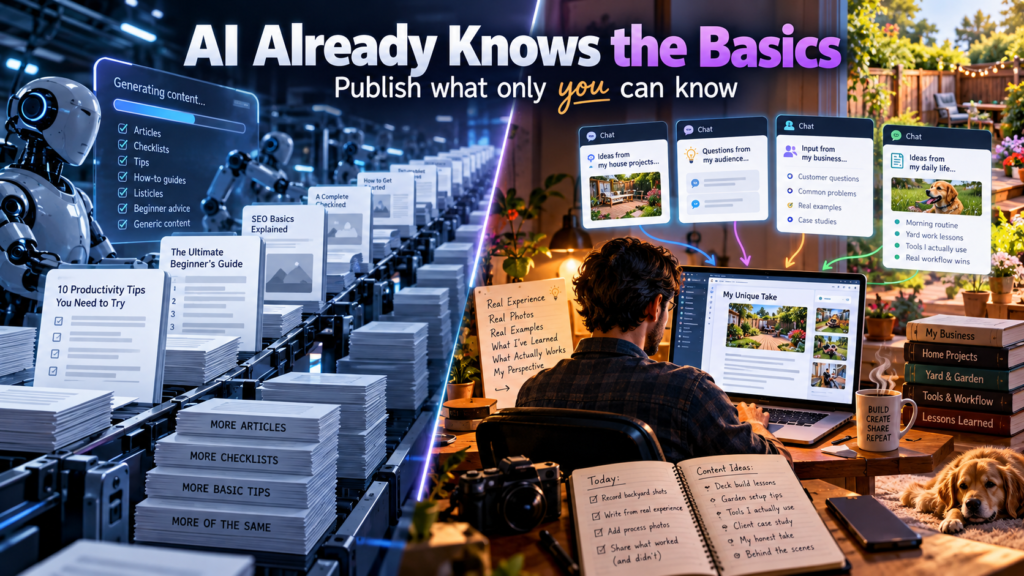
Your advantage is everything it doesn’t know.
ChatGPT doesn’t know what happened in your house yesterday. It doesn’t know what grows in your yard, what broke on your website, what your customers asked this week, which experiment failed, what your analytics show, what a product felt like after you actually used it, or why you rejected three seemingly good ideas before choosing the fourth.
That’s where I think creators should spend more of their energy.
ChatGPT cannot fully replace content based on information it does not possess, including firsthand experience, original experiments, private business data, local observations, real product use, failures, screenshots, personal workflows, human judgment, and original research.
Don’t Compete With AI at Summarizing Common Knowledge
There’s nothing wrong with informational content. People still need explanations, tutorials, definitions, comparisons, and answers.
The problem starts when your entire contribution is rearranging information that was already available somewhere else.
AI makes that kind of content much easier to create, but it also makes it less distinctive.
This matters beyond ChatGPT. Google encourages creators to produce people-first content with original information, research, analysis, and evidence of firsthand expertise. Its spam policies also distinguish useful AI-assisted work from scaled production of unoriginal pages created mainly to manipulate search visibility.
So I don’t think the useful question is, “Should I use AI to write?”
A better question is:
You can still use AI to research, organize, challenge, edit, format, and clarify the work.
But give it something real to work with.
10 Types of Content ChatGPT Cannot Easily Replace
None of these categories is magically AI-proof. Once you publish information publicly, AI systems may eventually be able to understand or summarize it.
That’s not the point.
The advantage is that you were the source of the new information.
1. First-Hand Experiments
Don’t just explain what is supposed to happen. Test it.
Run the same prompt through five AI tools. Change one element of a landing page. Try three image generators on the same difficult prompt. Remove a WordPress plugin and measure what happens to load time.
Then publish the method, result, surprises, failures, and limitations.
Before you ran the experiment, the result didn’t exist.
2. Things You Know Because of Where You Live
Your physical environment is a source of original information.
What survives in your yard? Which plants collapse in your summer heat? Which pests appear every spring? Which local store consistently has something in stock? How does your weather change the way you maintain your house, garden, car, solar equipment, or pool?
A generic answer about growing tomatoes isn’t the same as documenting what happened when you tried to grow them through 115-degree Arizona heat.
3. Things Inside Your House
Your house is full of potential information that isn’t sitting in an AI training manual.
Maybe an appliance keeps failing in the same strange way. Maybe you found a better way to organize a cramped pantry. Maybe a smart-home device loses its connection every three days. Maybe a repair that sounded easy online turned into a four-hour mess.
Take pictures. Record what happened. Explain what worked and what didn’t.
4. Things Happening Inside Your Business
Your private business data may be far more interesting than another generic article about “growing a business.”
What happened to affiliate clicks after changing a button? Which traffic source unexpectedly converted? Which ad failed? What questions keep arriving from customers? Which page gets traffic but makes almost no money?
You don’t have to publish sensitive financial information. Percentages, ranges, anonymized examples, or controlled experiments can still reveal something useful.
5. Failure Reports
Success stories are nice. Failure reports can be more useful.
Tell readers what you tried, why you thought it would work, what actually happened, and what you would change next time.
A failed AI workflow, useless plugin, bad content experiment, broken automation, or poor conversion test can save another creator hours.
AI can tell somebody what should work. You can document what happened when it didn’t.
One Thing I have Learned while building TechnofluxAi is that Ai tools usually sound easier to use than they are in the real world. I like to try things myself, see where I get stuck, and figure out what actually saves time instead of just repeating promisies.That’s the approach I use throughout this site: keep what works, point out what doesn’t, and explain things in a way that makes sense for someone who is still learning. I started out searching for an image creator. That was my first interaction with Ai. I was frustrated by the vast tool list without any real direction on which tool was best. Then I realized how powerful this tool was .and was going to be in the future. Making mistakes has helped me in the choice of articles I write.
6. Before-and-After Results
Show the starting point and the result.
Maybe you rewrote an article, changed a prompt, compressed images, altered a checkout page, reorganized an AI workflow, or removed five WordPress plugins.
Capture the before state. Make the change. Capture the after state.
Include enough context that readers understand what changed without pretending one experiment proves a universal rule.
7. Original Screenshots
Screenshots can do more than make an article prettier.
They can show analytics, settings, dashboards, workflows, tool interfaces, error messages, test outputs, Search Console data, or an unexpected result.
They also provide evidence that you were actually there using the thing you’re discussing.
A screenshot should support the article rather than exist as decoration. Blur private information and anything you shouldn’t publish.
8. Personal Workflows
A workflow becomes valuable when it comes from doing the work repeatedly and figuring out where different tools actually fit.
I often have three AI conversations open at the same time.
One is for inspiration and brainstorming. Another helps challenge or refine the idea. Once the idea is strong enough, I move the structured version into a specialized GPT for execution.
I don’t think that automatically makes three AI conversations better than one. It’s simply a method that fits the way I work.
Each conversation has a job.
More importantly, I’m directing the movement between them. One AI response isn’t automatically becoming the finished article. Ideas get questioned, moved, rejected, refined, and eventually executed.
That’s a human-directed multi-AI workflow rather than a single prompt pretending to be an entire publishing process.
9. Human Judgment
AI can produce options incredibly quickly.
Some are good. Some sound fake. Some technically answer the question while completely missing the point.
Some should be deleted.
Human judgment decides what sounds wrong, what doesn’t fit the audience, what needs checking, what deserves another test, and whether the idea should be published at all.
Creating more possibilities makes judgment more important, not less.
10. Original Data
If you run a website or online business, you’re probably generating original data already.
Search Console impressions. GA4 behavior. Affiliate clicks. CTR. Revenue. Rankings. Conversion rates. Time spent completing a workflow. AI credits consumed. Test results.
You don’t need a giant research department.
A carefully documented small experiment can be useful when you explain exactly what you measured and avoid claiming the result applies to everybody.
What Custom GPTs Being Retired Teaches Us About AI Workflows
There’s another reason I’ve been thinking about owning the information and systems behind your work.
OpenAI has announced plans to retire custom GPTs and move creators toward plugins.
As of September 29, 2026, OpenAI says custom GPTs are scheduled to retire on December 11, 2026. OpenAI also lists October 26, 2026 as the planned date when creation of new custom GPTs ends for affected Enterprise workspaces. Some qualifying Enterprise workspaces with an approved deferral have a later retirement date.
OpenAI recommends identifying the GPTs you depend on and reviewing their instructions, reference files, connected apps, and familiar prompts before migration. It also recommends testing migrated replacements rather than assuming they will behave exactly like the original GPT.
That’s especially important if your GPT uses custom actions.
OpenAI says custom actions do not transfer through the migration workflow. Depending on the integration, recreating that functionality may require another available app or additional technical work.
This isn’t a reason to panic.
It’s a useful reminder about what you actually own.
Your GPT Is Not the Asset — Your System Is
If you’ve spent months refining a custom GPT, it can start to feel like the GPT itself is the system.
It isn’t.
The valuable pieces are the instructions you wrote, prompts you refined, templates you developed, reference files you collected, examples you selected, decision rules you added, tools you connected, and tests you use to decide whether the output is good enough.
That’s the intellectual structure behind the GPT.
Platforms change. Models change. Interfaces change. Features disappear. Pricing changes. GPTs can become plugins.
A documented system can be rebuilt.
Your prompts, instructions, workflow logic, examples, reference material, decision rules, and testing process are the portable business asset.
How to Prepare Before Custom GPTs Go Away
Don’t wait until the GPT you use every week becomes urgent to replace. Document the system while you can still compare the old and new versions.
- Copy and save your core GPT instructions. Keep a readable master copy outside the GPT itself.
- Save important prompts. Especially save prompts you use repeatedly or that reliably expose weaknesses.
- Save reference files locally. Don’t make one AI interface the only place important source material exists.
- Document connected tools. Record what connects to the workflow and why it is there.
- Document custom actions. These deserve special attention because OpenAI says custom actions do not transfer through its migration workflow.
- Save 5–10 test prompts. Use normal tasks plus at least one difficult case.
- Save examples of ideal outputs. They give you something concrete to compare after migration.
- Write down the workflow outside ChatGPT. Explain what goes in, what happens next, what gets checked, and what counts as finished.
- Test the migration to plugins. Check instructions, reference material, formatting, tools, integrations, and difficult edge cases before depending on the replacement.
- Keep a backup copy of the system. Treat the workflow like a business asset rather than a disposable chat configuration.
My Three-AI Workflow Is a Good Example
I often have three AI conversations open at once. One is for inspiration. Another helps challenge or refine the idea. Then the structured idea moves into a specialized GPT for execution.
The specialized GPT is useful, but the GPT interface isn’t the most important part.
The workflow is.
I know why each conversation exists. I know what information gets passed from one stage to another. I know where I need to make a decision instead of accepting an AI answer.
If that GPT disappears, I shouldn’t have to reinvent the entire thought process.
If I’ve documented it properly, I can rebuild the execution stage inside a plugin or another AI environment.
That’s a much safer way to think about AI tools: use the platform, but own the process.
What Should Bloggers Publish Now?
You don’t have to abandon informational content. Make it harder to replace by adding something only you can supply.
| Generic idea | Stronger original angle |
|---|---|
| How to Grow Tomatoes | What I Learned Growing Tomatoes in 115-Degree Arizona Heat |
| Best AI Writing Tools | I Used 5 AI Writing Tools on the Same Article — Here’s What Broke |
| How to Use ChatGPT | My 3-AI Workflow for Researching and Publishing an Article |
| Best WordPress Plugins | The 7 Plugins I Removed After They Slowed Down My Site |
| How to Make Soup Thicker | I Tested 5 Ways to Thicken Potato Soup — Here’s Which Worked Best |
The difference isn’t that the second headlines are longer or more dramatic.
Someone had to do something before those articles could exist.
Someone had to grow the tomatoes, test the tools, use the workflow, remove the plugins, or thicken the soup five different ways.
AI can help organize those results afterward. It couldn’t know the outcome before somebody performed the experiment.
Original Information Also Matters for AI Search
There’s a GEO reason to think this way too.
AI search systems need sources.
If every page on a topic repeats the same facts, you’re adding another copy of information that is already abundant. Original experiments, firsthand observations, clearly labeled data, useful tables, screenshots, and specific results add something different to the information ecosystem.
That does not guarantee an AI citation. It does not guarantee Google rankings either.
But it gives search and AI systems something genuinely new to understand rather than another rewritten version of what dozens of pages already say.
Google’s guidance for its AI search experiences makes a similar point: creators should focus on unique, valuable, non-commodity content that satisfies visitors instead of manufacturing pages for every possible query variation.
Should Bloggers Still Write Informational Articles?
Yes. Informational content isn’t obsolete.
Sometimes a reader needs a clear explanation more than an experiment. Your job may be to explain a complicated subject better than the available sources do.
But I would be increasingly uncomfortable building an entire website around articles whose only purpose is summarizing easily available facts.
Add experience when you have it. Add an experiment when it would answer an unresolved question. Add screenshots when they prove something. Add data when it clarifies a result. Add judgment when readers need help making sense of the options.
And if you have nothing useful to add yet, sometimes the right decision is to wait until you do.
Frequently Asked Questions
What content can AI not replace?
AI cannot fully replace information it does not independently possess. That includes firsthand experiences, original experiments, private business data, local observations, product use, failures, screenshots, personal workflows, original research, and the creator’s own judgment.
Should bloggers still write informational articles?
Yes. Informational articles can still be valuable when they answer a reader’s question clearly and accurately. The opportunity is to go beyond generic summaries by adding original examples, firsthand knowledge, better explanations, testing, data, or analysis where appropriate.
Does Google penalize AI content?
Google does not prohibit content simply because AI helped create it. Its guidance focuses on usefulness, originality, quality, and purpose. Using generative AI or other methods to create large amounts of unoriginal content primarily to manipulate rankings can violate Google’s scaled content abuse policy.
What are custom GPTs being replaced with?
OpenAI has announced plans to retire custom GPTs and help creators migrate their workflows toward plugins. Plugins can combine reusable instructions, reference material, and connected apps.
When are custom GPTs being retired?
OpenAI currently schedules the standard retirement of custom GPTs for December 11, 2026. Qualifying Enterprise workspaces with an approved deferral may have a February 11, 2027 retirement date. Users should follow the notice for their own account or workspace because availability and migration timing can vary.
How do I save my custom GPT workflow?
Save the instructions, important prompts, reference files, connected-tool information, custom-action details, test prompts, examples of ideal outputs, and a written description of the complete workflow outside the GPT. Then test the replacement against those saved examples.
Will my GPT automatically become a plugin?
Don’t assume it will. OpenAI describes a migration workflow that eligible creators can use when migration is available. The replacement should still be reviewed and tested. Custom actions do not transfer through the migration workflow, and existing GPT conversations do not migrate.
Is original data better for AI search visibility?
Original data can make a page more distinctive and useful as a source because it contributes information rather than simply repeating existing material. That does not guarantee rankings, inclusion in an AI answer, or citations. The data still needs to be accurate, understandable, relevant, and presented with enough context to be useful.
The Question I’d Ask Before Publishing
AI has made it incredibly cheap to produce another article.
That doesn’t mean another article deserves to exist.
Before publishing your next one, ask:
If the answer is “nothing,” don’t automatically delete the draft.
Make it better.
Run an experiment. Take a screenshot. Open Search Console. Test the product. Record what failed. Document the workflow. Measure a result. Add an observation. Explain the decision you made and why.
Give AI something it didn’t already have.
And while you’re doing that, document the AI systems behind your own work too.
Your favorite tool may change. Your custom GPT may become a plugin. The interface you use next year may look nothing like the one you’re using now.
Your experience, data, processes, experiments, and judgment are much harder to replace.
That’s the part worth publishing — and the part worth preserving.

About the Author
Jon Hicks
Founder of TechnofluxAI.
I’m the creator behind TechnofluxAI, focused on breaking down powerful AI tools, emerging trends, and practical strategies to help creators and entrepreneurs stay ahead in a rapidly evolving digital world.
Follow TechnofluxAI for the latest AI tools & strategies